Mara Vale
A choreographer turned festival director who can see the labour hidden inside every apparent solo. Her greatest challenge is learning that leadership does not mean becoming indispensable.
 LAMBO-MUSICARTIST · AUTHOR · LICENSING
LAMBO PUBLISHING · MUSIC-DRIVEN ENSEMBLE DRAMA · LORII MYERS
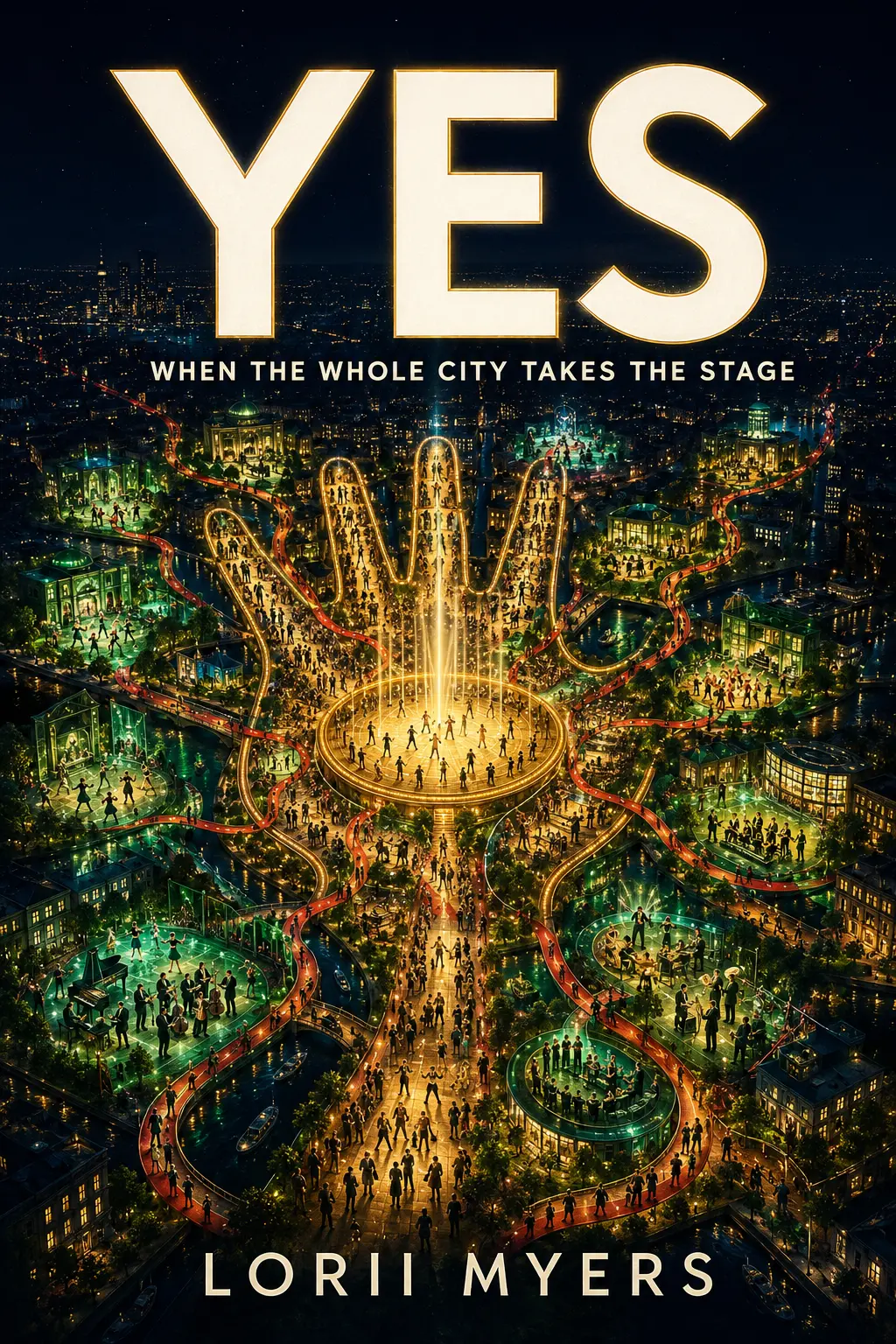
When the Whole City Takes the Stage
One city. 413 accepted submissions. Sixteen zones. Seven days. One impossible yes.
STORY + ORIGINAL MUSIC
“All Of Me Said Yes” carries the project's full-hearted central promise as a complete authorized song.
THE STORY
The algorithm delivers an efficient answer: reduce 413 submissions to twenty-seven. Mara Vale sees what the numbers erase. Instead of shrinking the city's talent to fit the stage, she commits to rebuilding the production so every submission has a place.
That decision turns inclusion from an inspiring idea into an enormous practical test: 2,416 participants, sixteen creative zones and seven days to prove they can become one coherent show. It also opens a $480,000 funding gap—and a dangerous alternative. If Mara cannot close it without surrendering the work, an existing agreement could give Victor Slate control for ten years.
A choreographer turned festival director who can see the labour hidden inside every apparent solo. Her greatest challenge is learning that leadership does not mean becoming indispensable.
A magnetic former performer whose argument is dangerous because he can make concentration look magnificent. He does not lack artistry. He mistakes visibility for value.
THE EXPERIENCE
The music is not decoration. Every original song changes a decision, deepens a character or moves the production forward—while being designed to stand on its own.
The choreography moves from breathtaking spectacle to learnable dances, audience participation and choruses made to live beyond the story.
Conceived for the page, stage and screen, YES is an uplifting ensemble story about what becomes possible when someone stops asking who deserves the stage—and changes the stage itself.
THE FIRST AHA
A spectacular solo depends on twenty-four people the official cameras never show. From the audience's angle, one person appears to rise. From Mara's angle, an entire human structure is carrying him.
That discovery becomes the story's larger challenge: not simply to admit more people, but to redesign the conditions that decide whose contribution counts.
APPROVED BOOK DESCRIPTION
An algorithm chooses twenty-seven acts. Mara Vale says yes to all 413.
Now she has seven days to turn 2,416 people across sixteen city zones into one unforgettable production—while proving the city's beloved arts festival deserves to remain public.
Victor Slate offers the easier future: one star, one centre, one flawless spectacle. Mara's answer is riskier. Make room for every act. Build a stage that can survive a no. Let people join, watch, hold back or leave without turning their choice into proof for somebody else.
But opening the doors is only the beginning. As the city starts to move together, every success creates a more dangerous question: who owns the moment once the world wants it?
YES is an exhilarating ensemble novel about music, power, permission and the courage to create a centre that can move.
The whole city is ready to take the stage. The final answer still belongs to them.
SYNOPSIS
An algorithm selects twenty-seven acts. Mara Vale commits to making room for all 413 submissions. Now she has seven days to prove that 2,416 participants across sixteen zones can become one production—and close a $480,000 funding gap before an existing agreement could give Victor Slate control for ten years.
READ CHAPTER ONE
Presented from an author-approved author-review edition.
Green Light
At six o’clock on Monday morning, Port Aurora gave itself permission to make noise.
The first sound came from the harbour: one clean blast from the commuter ferry, answered by a tugboat that had no official reason to answer. A delivery cyclist rang a silver bell along Mariner Street. Two kitchen workers carrying bread through an alley struck the bottoms of their trays with open palms. Above them, apartment windows lifted one after another, releasing radios, scales, warm-up chords and the bright argument of a trumpet player who had begun before the rest of the building agreed to be awake.
From the sixth floor of the Civic Arts Office, Mara Vale watched the city find the beat.
She stood at the south window with one hand around a coffee she had forgotten to drink. Below her, the intersection at Calder and Ninth remained empty for three more seconds. Then every pedestrian signal flashed white at once.
Across Port Aurora, public screens changed from municipal blue to a field of electric green.
OPEN CITY SUBMISSIONS ARE NOW LIVE.
The campaign track struck its first pulse through speakers in plazas, stations, recreation centres and storefronts. It did not ask the morning to wake politely. It arrived as if the city had been waiting all night behind a curtain.
Mara’s fingers moved against the cup.
Five, six, seven, eight.
She stopped them.
“Twelve unauthorized drummers in Meridian Square,” Priya Shah announced from the operations table. “They’ve applied for a permit while actively violating the permit requirement. I respect the efficiency.”
“Are they blocking the tram?”
“Not yet.”
“Then they’re twelve early applicants.”
Priya looked over the top of her glasses. “You’ve been festival director for eleven minutes and already sound dangerously festive.”
“I started at five forty-nine. I’ve been festival director for twenty-two minutes.”
“Then the decline is worse than I thought.”
Around them, the office came alive. The submissions wall filled with names, thumbnails and coloured location markers. Staff moved between consoles carrying cables, revised schedules and the special panic of people who had spent nine months preparing for a day that had finally become real.
Open City had started thirty-seven years earlier with a borrowed stage, six extension cords and a municipal memo objecting to all seven. It now occupied twelve downtown blocks, three parks, the waterfront and every spare minute in the Civic Arts Office. For one night each year, Port Aurora turned its streets over to performers who had spent the rest of the year fitting their work into bedrooms, basements, back rooms and the hours left after paid employment.
This year, the festival also carried an unadvertised assignment: prove it deserved to remain public.
Mara looked toward the far end of the room, where a second display remained dark. Its polished black frame bore one discreet silver word.
SLATE.
Priya followed her gaze. “It hasn’t exploded.”
“A low standard for civic technology.”
“It hasn’t rejected anyone either.”
“It’s not authorized to reject anyone.”
“I know. I wrote that sentence into the operating agreement eight times.”
After three years of declining sponsorship and rising security costs, the city had approved Slate Live as a trial partner. Applause would analyze applications, predict audience interest and recommend a balanced festival program. Recommend had survived four council meetings, two procurement reviews and one dinner at which Victor Slate smiled across a table and accused Mara of nostalgia for human error.
Error had never charmed her. She had built her career keeping it from becoming consequence.
“First hundred,” called a coordinator.
Applause broke out across the room. Mara turned from the black screen.
One hundred applications in four minutes was not a record, but it was close. The submissions wall had become a living mosaic: a seniors’ tap company in yellow raincoats; a twelve-voice choir filming in a tire shop; three percussionists surrounded by overturned recycling bins; a string quartet on roller skates; a woman manipulating thirty feet of red fabric from the roof of a parking garage; a man who described his act only as “operatic weather.”
Mara opened that application.
Priya leaned beside her. “Professional interest?”
“Public-safety concern.”
The video began with a baritone in a silver coat singing toward a handmade cloud suspended above a child’s paddling pool. On the final note, the cloud released a precise square of rain over his head.
Priya considered it. “Strong finish.”
“Unprotected power cable.”
“And there she is.”
Mara flagged the application for technical review, not rejection.
She moved to the next.
At Calder and Ninth, the intersection that had been empty was now occupied by sixteen bicycle couriers. They waited in four clean rows, one foot on the pavement and one on a pedal, their jackets catching the green light from the public screen above them.
At the front stood Jax Moreno.
Mara knew his name before his application card appeared. Most of the city did. Jax could turn thirty seconds of movement into ten million views and ten million views into an argument about whether what he did counted as dance. He had built a following from loading docks, basketball courts and places where security usually arrived before applause.
In the live street feed, he lifted two fingers.
The couriers answered by clicking their brake levers in rhythm.
The traffic light turned red. Their bodies dropped over the handlebars. Wheels spun backward. Reflective strips flashed in disciplined fragments. When the light changed, the formation released through the intersection without breaking its geometry. One rider vaulted from the seat, another folded beneath a turning frame, and Jax passed through the centre as if sixteen bicycles had become parts of one enormous moving instrument.
“No closure permit,” Priya said.
“They cleared the intersection in forty-one seconds.”
“The application says thirty-eight.”
“He added the bow.”
On-screen, Jax looked directly into the traffic camera and bowed.
Mara felt a smile arrive and removed it before Priya could document the event.
“Send him the route limitations,” she said.
“Not a rejection?”
“A limitation.”
“I’ll alert the historians.”
Two districts north, Gloria and Benny Cruz were having a disagreement in perfect time.
Their submission began in the glass atrium of Union Station. Gloria wore a cobalt suit with trousers wide enough to turn every pivot into weather. Benny wore black and the expression of a man who had been informed of a plan after it became irreversible.
“You’re ahead,” Gloria said.
“You’re late.”
“I’m making an entrance.”
“You’ve been making it since 1979.”
Then the music reached them.
The argument did not end. It became choreography.
Gloria advanced on a sharp diagonal; Benny escaped through a turn. She pursued. He countered. Their hands met, separated and met again, each contact carrying the precision of forty-seven years spent learning exactly how much pressure the other person would return. Commuters slowed around them. A child abandoned a rolling suitcase to imitate Gloria’s shoulders. Benny caught the suitcase before it struck a column and incorporated the rescue into a sweeping turn.
The child applauded. Gloria finished facing the camera.
“That,” she said, breathing hard, “was the correct tempo.”
“That,” Benny replied, “was my tempo.”
They were still disputing ownership when the video ended.
Mara replayed the final eight counts.
“You know them,” Priya said.
“Everyone knows Gloria and Benny.”
“You replayed Benny’s left hand.”
Mara had. For less than a second, as Gloria turned away, Benny’s hand had remained open in the space where hers had been. The audience would see comedy. A choreographer saw the fraction of delayed release that made the comedy matter.
“They’ll need a larger floor,” Mara said.
She moved on.
By six twenty, applications had arrived from every district. The map glowed with so many green points that the shoreline disappeared beneath them.
At a laundromat on Brant Street, Nia Bell sat beneath a public speaker while someone else’s voice sang a melody she had written.
She had heard it in pharmacies, elevators and the background of videos whose creators never knew where the hook came from. The singer had altered two notes. The producer had doubled the rhythm. The advertising agency had added a slogan. Still, the melody belonged to Nia in the private, undeniable way a scar belonged to the body beneath a sleeve.
On the folding table in front of her, a phone displayed the Open City application page.
NAME OF ACT.
She typed NIA BELL, erased it and typed BELL SOUND.
NUMBER OF PERFORMERS.
She entered one, stared at the word, then changed it to eight.
The dryers turned behind her with a soft recurring thump. A machine at the end of the row gave a high metallic chirp each time the drum completed a rotation. Nia listened until both sounds found the same measure.
She raised the phone and began to sing—not the melody coming from the public speaker, but a new line that moved between the dryers, gathering their rhythm without surrendering to it. Her voice was warm at the centre and startling at its edges. A woman folding towels stopped with both hands inside a sheet. Two university students lowered their conversation. The attendant leaned out from behind a rack of wire hangers.
Nia reached the place where the voice wanted to open.
She stopped recording.
The laundromat resumed around her.
She watched the unfinished video once. Her thumb hovered over DELETE, moved to RETAKE, then landed on SUBMIT.
The screen turned green.
APPLICATION 241 RECEIVED.
Nia set the phone facedown as if it had done something reckless without her.
In the Civic Arts Office, Mara opened application 241 thirty seconds later.
The fluorescent light flattened the laundromat; a dryer door opened behind Nia and stayed there like a silver mouth. Then Nia sang, and Mara’s hand tightened on the edge of the console.
The recording ended where her body had already leaned toward the next note.
“Why eight performers?” Mara asked.
Priya checked the form. “No names supplied.”
“Put it in clarification.”
“Technical?”
“Artistic.”
Priya’s hands paused above the keyboard. “We don’t have an artistic-clarification queue.”
“We do now.”
Priya created one.
Mara replayed the application. Not the entire thing. Only the last four seconds, where Nia’s voice reached the edge of something and retreated.
On the street below, Green Light entered its final refrain. People who had learned the campaign dance from thirty-second clips began performing it at crosswalks. The movement was simple enough to imitate: a held beat, a turn of the shoulders, two steps that seemed to gather momentum, then a release forward when the signal changed. Children exaggerated it. Office workers attempted it without putting down their coffee. An elderly man performed only the shoulders and looked pleased with his edit.
The city was not dancing together. Not exactly.
It was answering itself.
Mara saw the exchange from the window: one corner initiating, another answering half a block away, a third changing the timing to accommodate a stroller, a delivery cart, a body that moved differently. The sequence improved each time someone misunderstood it.
Her mind began arranging the street before she gave it permission.
Couriers entered from Calder. Gloria crossed against them on the held beat. The laundromat rhythm travelled through the percussion line. Above it, Nia’s unfinished note began to open.
Mara stepped away from the glass.
She had not been hired to choreograph the city. She had been hired to deliver a festival on time, within budget, without giving Council a reason to privatize it.
“Three hundred,” someone called.
The office cheered again.
At six thirty-four, the dark Slate display awakened.
No one touched it.
Silver light moved around its frame. The Slate Live mark appeared, followed by the word APPLAUSE in calm white letters.
Priya crossed the room before the loading circle completed.
“It’s twenty-six minutes early.”
“Disconnect it,” Mara said.
“It’s on the city environment. I can close our interface, not its process.”
The display divided into columns.
APPLICATION. AUDIENCE PROBABILITY. COMMERCIAL RETENTION. PROGRAM FIT.
At the bottom of the screen, a status message appeared.
PRE-SCREENING ACTIVE.
“It is authorized to analyze,” Priya said. “It is not authorized to decide.”
Mara placed her coffee on the nearest desk.
“Call Victor.”
The first application entered the system.
JAX MORENO / CALDER COURIER COLLECTIVE.
The submission video played at accelerated speed. Applause sampled the first formation, the traffic-camera bow and two seconds of the central sequence.
Eight seconds after the application entered, the card turned red.
NOT RECOMMENDED.
Reason codes populated beneath it.
HIGH VARIANCE. LOW FORMAT PREDICTABILITY. LIMITED SPONSOR ALIGNMENT.
The next application entered.
Six seconds.
Red.
The next.
Seven seconds.
Red.
Across the submissions wall, green points continued appearing faster than the staff could count them. Across the Slate display, those same points turned red almost as quickly as they arrived.
Outside, the city danced beneath a hundred green screens.
Inside, a machine that had never stood in any of its streets began deciding which parts of Port Aurora deserved to be seen.
PUBLISHING · STAGE · SCREEN · MUSIC
YES is an original Lorii Myers source novel, conceived from the beginning as the foundation for a future stage musical and potential film adaptation. The novel and any future stage work will remain distinct creative properties.
The twenty-eight-chapter Authoritative Master V05 remains private and under the rights holder's control. Its structural, pacing, continuity and production-integrity audit is complete; independent human editing, music and stage development, rights review and adaptation production work remain. Qualified agents, editors, publishers, producers, composers, choreographers and adaptation partners may request a professional conversation directly with the rights holder.