A deadline inside the mystery
Ashgrove will be cleared in days. One recording may still be hidden inside, another is missing and the public record claims the producer's mother chose a permanent silence the surviving evidence cannot explain.
 LAMBO-MUSICARTIST · AUTHOR · LICENSING
LAMBO PUBLISHING · UPMARKET PSYCHOLOGICAL SUSPENSE · LORII MYERS
The past was altered by a human hand.
What led her back may not have been.
An investigative audio producer follows a stranger's recordings to the Halifax house where she spent a childhood she cannot remember—and into a history someone deliberately rewrote.
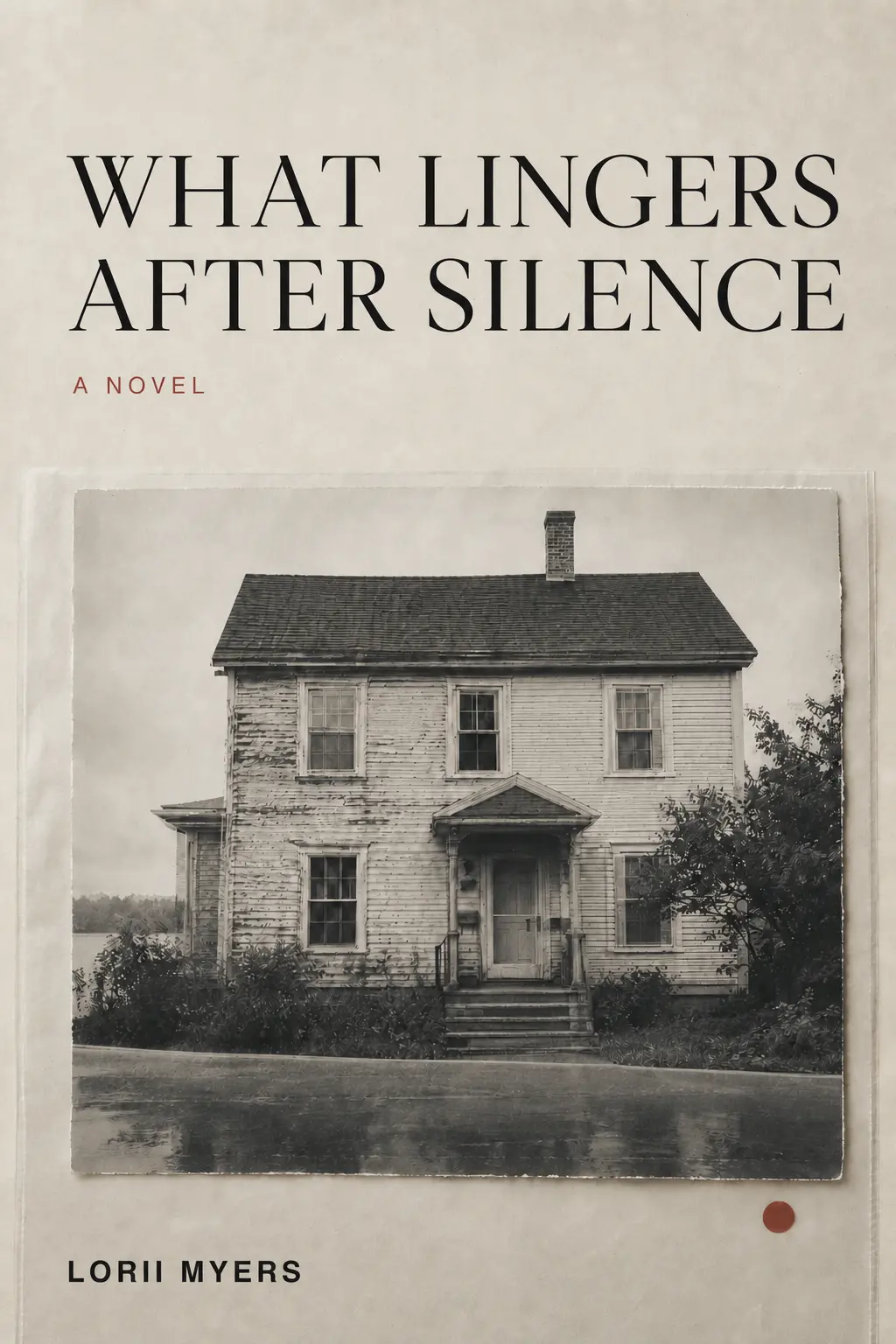
THE STORY
The producer has spent her career separating evidence from feeling. Then a sealed archive index bears her late mother's name, and a recording points to 14 Ashgrove Lane—the house where she lived as a child and remembers almost nothing.
Ashgrove will be cleared in days. One recording may still be hidden inside, another is missing and the public record claims the producer's mother chose a permanent silence the surviving evidence cannot explain.
Every witness has a different right to speak. The investigation can correct what was altered only if the producer learns that finding the truth does not give her the right to control every voice that carries it.
WHAT SETS IT APART
Recordings, ledgers, consent conditions and disputed archive forms create a precise investigative engine without losing the emotional force of a daughter approaching her mother's hidden history.
The central question is not only what happened, but who has the authority to reveal it. Privacy, evidence and ownership remain in tension through the final decision.
The Quiet One never supplies a fact. It may be trauma, conscience, inherited vigilance, pattern recognition or something less explainable—leaving the human solution intact and the atmosphere unresolved.
OFFICIAL BLURB
An investigative audio producer has built her career on one rule: follow the evidence, never the feeling.
Then Cheryl Bell brings her a fractured family history and recordings made by her daughter, Marie. For years, Marie traced the pressure that gathered whenever anyone neared a buried truth. She called it The Quiet One.
Two clues make the investigation personal: a sealed archive index bearing the producer's late mother's name, and a recording pointing to 14 Ashgrove Lane—the Halifax house where she spent a childhood she cannot remember.
The property will be cleared in days. One recording may still be inside. Another is missing. And the public record claims her mother chose a permanent silence no surviving voice can explain.
To discover who rewrote her mother's wishes, the producer must enter the house—and the story—she trained herself to keep at a distance.
Every clue has a human source. Every witness has a different right to speak. But the route home feels familiar before the house does.
The past was altered by a human hand.
What led her back may not have been.
COMPLETE SYNOPSIS
The synopsis below contains major spoilers and is provided for agents, editors, publishers and adaptation partners.
An investigative audio producer has built her career—and Open Book, her documentary project—on one rule: follow the evidence, never the feeling.
Then Cheryl Bell brings her recordings made by her adult daughter, Marie. For years, Marie has tracked a strange pressure that gathers whenever someone approaches a concealed truth. She calls it The Quiet One. The producer dismisses the name but cannot dismiss Marie's evidence: a sealed archive index linking Nora Bell to the producer's late mother, Evelyn Grace Hart, and to 14 Ashgrove Lane in Halifax.
The producer lived at Ashgrove as a child. She remembers almost nothing about it.
The house will be cleared within days, and Marie's research suggests a recording remains hidden inside. Another is already missing. Protected records also reveal that Evelyn left a private route through which her adult daughter could one day access part of the archive. Whether it was an invitation or a warning is unclear.
The Bell family is divided. Cheryl wants its history recovered. Her sister Elise fears another outsider will turn private pain into a public story. Their brother David distrusts the investigation, while Marie insists that sharing her research does not mean surrendering control of it. The producer establishes item-by-item consent, allowing each person to decide what may be examined, retained or disclosed.
Documentary evidence—not The Quiet One—leads to an authorized search of Ashgrove. In the music room, a sealed reel is recovered from an upright piano bench. A permitted Bell family recording and a separately controlled archive cassette connect Evelyn and Nora to the same institutional record. But the chain is incomplete, one recording remains missing, and private voices cannot establish public fact on their own.
At the centre of the mystery is Report 6-B. The official record claims Evelyn permanently withdrew her protected testimony, closing access to it and shaping every later account. Yet the dates do not align: the permanent-withdrawal form appears to have been created after Evelyn supposedly signed it.
As the investigation becomes personal, the producer discovers that Evelyn deliberately protected her daughter's identity. She also begins to recognize her own central flaw. She has treated control as care, believing that protecting people means deciding what they should reveal. Marie and the Bells force her to confront how closely that resembles the institution she is investigating. Evelyn's daughter may have a right to seek the truth, but she does not automatically own her mother's private testimony.
At the first evidentiary hearing, the court finds the proof insufficient. The withdrawal remains valid, access is revoked and Report 6-B stays unchanged. With protection of the house about to expire, the investigation appears finished.
Then a document examiner discovers that Evelyn's withdrawal is a composite. Her genuine signature panel was transferred onto a later form declaring her withdrawal permanent. The instruction Evelyn actually signed provided temporary privacy until her daughter reached adulthood. The permanent form did not exist at the time.
The new, testable evidence allows the record to reopen. An interviewer's retained paperwork confirms Evelyn's original instruction. Archive records show that a professional refused to certify the later withdrawal. A former clerk's ledger documents its rejected routing. The trail leads to Adrian Shaw, who denies constructing the composite but admits knowingly processing it as permanent without authorization because he believed stricter secrecy would protect the institution.
The court voids the permanent withdrawal and restores Evelyn's temporary condition. Report 6-B is corrected through public administrative evidence without releasing Evelyn's testimony. The truth enters the public record, but the private recordings remain sealed.
The producer's final decision is not about evidence but power. Realizing that Open Book has placed too much authority in her hands, she relinquishes unilateral archive access and final editorial control. Independent custody and item-level consent become permanent safeguards. No one person can claim ownership of another's story—or another's silence.
Ashgrove and its surviving records pass into protected stewardship. The missing recording is never recovered. The nature of The Quiet One remains unresolved: trauma, conscience, inherited vigilance, pattern recognition or something less explainable. It has never supplied a fact. It has only drawn attention toward places where facts were concealed.
Months later, the corrected Report 6-B remains linked to the public record. The producer leaves her impressions notebook sealed. When Elise invites her to lunch, she accepts without turning the meeting into another investigation.
From somewhere nearby comes the sound of a piano chord being tested.
The window is open.
READ THE OPENING SAMPLE
Presented from an author-approved author-review edition.
CHAPTER ONE
At four seventeen on a November afternoon, Cheryl asked whether I planned to turn her daughter into a diagnosis or a ghost story.
The recorder between us was still dark. Cheryl had aligned the bottom of the consent form with the edge of the table, then aligned it again.
“Neither,” I said. “I’m here to hear what happened.”
“That isn’t the same as believing me.”
“No.”
Beyond the studio window, a delivery truck reversed through the alley, its warning signal repeating at patient intervals. The room was deliberately plain: two chairs, one table, a shaded lamp, enough acoustic treatment to keep a difficult sentence from sounding theatrical.
I pointed to the unchecked boxes on the form. Recording preserved her account. Investigation tested it. Publication would be another decision.
“And my family?” she asked.
“You can speak for yourself. No one else.”
She signed permission for private recording and left public release blank.
I started the recorder.
Cheryl began with the house. Not its location or age, but the details that proved it had once been ordinary: red tulips beside a cracked walkway, a porch swing David installed after Elise was born, children’s drawings held to the refrigerator by fruit-shaped magnets. She remembered neighbours at summer barbecues and a laundry basket that was never empty.
“David worked hard,” she said. “The girls had friends. We were not a family people worried about.”
“Were you worried?”
“Not then.”
She had prepared the story carefully. I could hear the joins: sentences polished through repetition, dates reduced to seasons, the parts that began with we whenever a singular responsibility approached.
“Marie was always sensitive. Rooms affected her. People affected her. Teachers called her intense.”
“What did you call her?”
Cheryl’s thumb pressed into the paper cup. “My daughter.”
It was her first unrehearsed answer.
Marie noticed the instant a visitor wanted to leave, the argument her parents had postponed until the girls slept, the way Elise could be laughing and lonely at once. At dinner, one raised eyebrow from Marie could make her sister collapse into giggles. She corrected adults when they used a word they did not mean.
“She was not frightening,” Cheryl said.
“But something frightened you.”
The truck stopped beeping. In the sudden quiet, Cheryl looked towards the recorder as if the question had come from there.
“Things became difficult around Marie.”
“That isn’t what I asked.”
Precision removed the answer she had prepared.
“When did you become afraid?”
Cheryl released the cup. A shallow crease remained under her thumb.
“I wasn’t afraid of her. Not exactly.”
She began again without chronology. Marie would stop midway down a hall and listen. She would ask why everyone kept pretending nothing had been said when, according to Cheryl, nothing had.
“We spoke to teachers. We looked for explanations. Everyone had one.”
“What did Marie say before the adults explained her?”
Cheryl’s face tightened. “This is the part people use against her.”
“Then I need her words, not their conclusion.”
For several seconds, only the red timecode moved.
“She said someone was listening.”
“Someone in the house?”
“Someone near us. She wasn’t consistent about where.”
“Did Marie see this person?”
“She said she did. None of us did.”
The correction mattered: she said, not she saw. Cheryl was protecting the distance between experience and proof even while asking me to cross it.
“Did she give the person a name?”
“The Quiet One.”
I wrote it once.
“Did she use that name only as a child?”
“That’s what we decided. Years later, she used it again in a recording. There are no questions audible. Only Marie.”
“Who holds the original?”
“It isn’t mine alone.”
“Then why come now?”
Cheryl looked at the dark public-release box.
“Marie contacted me on Friday. We hadn’t spoken properly in months. I’d sent her a family summary of what happened. She returned it with every we circled and said that if I was ever going to tell what happened, I should tell it to someone who would stop me when I began speaking for her.”
“Did she ask you to contact me?”
“No. She gave me a standard.” Cheryl swallowed. “I spent the weekend deciding whether meeting it would make me a better mother or only a better source.”
“And?”
“I don’t get to decide that before Marie does.”
The answer was not polished enough to be borrowed. Cheryl had earned it during the silence between Friday and Monday.
Friday had been 31 October. Cheryl did not claim the message authorized this interview, only that it had ended her delay.
“And you chose me?”
“I listened to an Open Book episode. You stopped a woman halfway through the sentence everyone else would have used in the trailer.”
The compliment landed as an obligation. My hand tightened around the pen.
The episode she meant had cost us a trailer and three weeks of negotiation. Until that moment, I considered the lost attention evidence of judgment. Hearing Cheryl name it as the reason she trusted me turned an old restraint into present debt.
“Marie’s message is her reason for contacting you,” I said. “It is not permission to bring her recording.”
“I know.” Cheryl’s voice roughened. “That’s why I came alone.”
I stopped the recorder.
She looked startled.
“You asked whether I would protect Marie from a story imposed on her,” I said. “I can’t answer by asking you to surrender material you don’t control.”
She studied me differently—not with trust, but with the possibility of it.
“If I’m authorized to bring a copy, it stays private.”
“Until we establish what it is, when it was made and who can decide its use.”
Cheryl gathered the form but left the crushed cup. At the door, she turned.
“There’s one more thing. A street name appears on the recording.”
I started a new file with her permission.
“Have you ever heard of Ashgrove Lane?”
The name narrowed the room. Somewhere beyond the treated walls, a single warning tone sounded and stopped.
I knew only that I had heard the street before.
I did not answer.
CHAPTER TWO
At eight thirty-two, Cheryl called from the kitchen she had described to me as proof.
The fruit-shaped magnets were visible behind her, holding up a calendar and a takeout menu. David sat at the table with a printed copy of her consent form. A second window opened on my screen, and Elise appeared against an unidentifiable pale wall.
“This stays off the record,” David said.
“Yes.”
“No transcript?”
“No recording. I’ll document only the permissions we agree to. Anything else remains an unverified lead unless its speaker separately authorizes a written note.”
He looked at Cheryl. “That is not what I asked you.”
“It’s what I should have asked,” she said.
The studio was nearly dark around my laptop. I had left the lamp above the interview table on, though Cheryl’s chair was empty. On the screen, her family occupied separate rectangles even when two of them were sitting inches apart.
David lifted the consent form. “What do you have?”
“Two audio files Cheryl authorized for private review. The interview and a short follow-up identifying Ashgrove Lane as an unverified lead.”
“And what do you intend to do with them?”
“Nothing further until I know what each of you permits.”
Elise leaned towards her camera. “I permitted Mom to say a recording existed. I did not permit her to make us part of an investigation.”
“I understand.”
“Do you?” David asked. “Because privacy was the one promise we managed to keep.”
Elise gave a small, incredulous laugh. “We kept a lot of things private. That doesn’t mean we kept Marie safe.”
Cheryl closed her eyes for a moment. “This is why I wanted all of us here.”
“No,” Elise said. “You wanted a decision. Those are different.”
David folded the consent form along its existing crease. “Tell us exactly what you told her.”
Cheryl began with the permissions, then the house, then Marie. She moved through the interview more quickly than she had with me. When she reached The Quiet One, David stopped folding the paper.
“You used that name?”
“Marie used it.”
“With us.”
“With me,” Elise said. “You corrected her every time.”
“I asked what she meant.”
“You asked until she gave you an answer you could repair.”
David placed the form flat on the table. “And you preferred the answer that frightened everyone.”
“I preferred that someone remembered what she actually said.”
The argument had been waiting longer than the call. Cheryl watched it pass between them as though she had spent years trying to stand in its path.
“What changed?” I asked.
All three looked towards their cameras.
“Marie changed,” Cheryl said. “She stopped asking us to believe her.”
Elise shook her head. “She stopped asking you. She started keeping dates.”
“Dates of what?” I asked.
“Things she noticed. What had been said. Who denied saying it. When the name appeared.”
“Not only those things,” Cheryl said. “Appointments. School events. David’s cancelled train. Ordinary days.”
Elise nodded. “That was the point. She put the strange entries beside things we could verify.”
“She was building a case,” David said.
“She was stopping us from moving the facts.”
Cheryl looked towards him. “We did move them.”
David’s hand tightened on the folded form.
“There was an argument about the order,” Cheryl continued. “David remembered Marie using the name after material arrived from Halifax. Elise remembered hearing it before.”
“Memory is not a date,” David said.
“Which is why Marie kept them,” Elise replied.
Elise looked at me. “That’s the problem. Mom tells the version where Marie was sensitive and needed protection. Dad tells the version where she found ordinary things and misunderstood them. Both versions end with Marie being corrected.”
Cheryl’s voice lowered. “And yours?”
“Mine ends with none of us checking the order.”
For the first time that evening, David had no immediate question.
I said, “What needs to be put in order?”
Cheryl’s hand moved towards the edge of the laptop and stopped. “The recording. Marie’s notes. The Halifax material.”
“You told me the street name appeared on the recording.”
“It does.”
“What didn’t you tell me?”
David turned to her. Elise went very still.
Cheryl answered me without looking at either of them. “Ashgrove appears somewhere else.”
“Where?”
“On an index Marie made. Beside it, she wrote two words.”
“Which words?”
“Open Book.”
The words explained why Cheryl had chosen me. They did not prove Marie had.
“That may not refer to my project,” I said.
“I know.”
“Do you know when she wrote it?”
“No.”
“Do you have the original?”
“No.”
“Then for now I have your account of the index, not the index itself.”
“Correct.”
David pushed his chair back. “This is exactly what I meant. Two common words, and now they become an instruction.”
“I treated them as a lead,” Cheryl said.
“You treated them as permission.”
Elise spoke before Cheryl could answer. “And you treat every missing date as proof that nothing happened.”
“I treat missing dates as missing dates.”
“Good,” I said. “Then that’s where we begin.”
David looked at the screen.
“Not with what Marie saw,” I continued. “With what existed, who held it and when she could have encountered it. We begin with a dated inventory, a named custodian and no assumptions about what Marie knew. The recording stays private. No original changes hands. No one’s account becomes public. Elise speaks only for herself. Cheryl does the same.”
“And me?” David asked.
“You decide whether to participate. You do not decide for the others.”
His jaw shifted, but he nodded once.
Elise agreed to a private follow-up. Cheryl agreed to send nothing until I issued written terms. David would describe only the Halifax items he had personally handled and verify only the accuracy of his own account.
It was not consent to investigate. It was consent to establish what consent would require.
Cheryl looked from David to Elise. “Then tell her the rest.”
“The Halifax material never belonged to Marie,” David said.
“It came into this house in a sealed box from Cheryl’s mother.”
CHAPTER THREE
By nine the next morning, Lena had written HOLD across Thursday’s studio booking in red pencil.
“I can keep the room until noon,” she said. “After that, it goes to someone who knows what they’re making.”
The production office was too narrow for both of us, the wall calendar and the equipment shelves. I set my childhood notebook face down on the only clear corner of her desk.
“Release it.”
Lena looked at the notebook, then at me. “You said the family might proceed.”
“They may allow an inquiry. They have not agreed to become a program.”
“We could use the slot for private development.”
“A production room creates momentum. Momentum starts making decisions for people.”
She took the red pencil from behind her ear. “That sounds like experience.”
It was. I had once watched an unconfirmed sentence acquire music, a provisional title and a delivery date before the source understood that everyone else had begun calling it a story. We had corrected it before release. I still remembered how pleased the room had been with itself.
“Release the slot,” I said.
“The room deposit is gone.”
“I know.”
“The distributor will ask what replaced it.”
“Nothing replaced it.”
Lena studied me. “That answer costs more than the deposit.”
Empty space looked like failure to people who measured production by movement. I signed the cancellation anyway.
Lena crossed Thursday from the calendar. My chest tightened at the clean white space it left. The distributor would fill it within the hour; weeks of production planning had just become somebody else’s opportunity.
“Now tell me why you brought that,” she said.
I opened the school notebook.
Ashgrove Lane had sent me searching through a box of childhood papers before sunrise. Inside the back cover, my mother had written MITTENS in blue ink and then, below it, PLEASE. I remembered her exasperation clearly; the house around it remained blank. The notebook had remained in my possession for years: narrow-ruled pages, blunt pencil, my name printed inside in a hand attributed to my younger self. It could not prove where I had been or what I had known.
It did establish a sequence.
My mother had kept the notebook with school records in a box that reached me after her death. I had never documented who packed it or whether pages disappeared before it entered my custody. The cheap staples were rusted, and the centre fold opened more easily than the rest. None of that proved tampering. It was history we would have to account for if the gap ever mattered.
Entries appeared almost every school day until the week Cheryl had named. Then they stopped. They resumed the following Monday with no explanation.
Lena did not reach for the book. “Does her date come from a document?”
“Memory. Her inventory labels it that way.”
“So the date may move.”
“Yes.”
“And the gap may mean nothing.”
“Yes.”
She waited.
“It doesn’t feel like nothing,” I said.
The admission seemed to take up more room than the desk allowed.
Lena pulled the second chair towards her. “Then we need rules before you touch the next fact.”
We did not write a manifesto. We wrote one page.
Each person could authorize only an account or object they controlled. Originals stayed with their custodians. An impression could be recorded as an experience, never promoted to a fact. My connection to Ashgrove would be declared to every independent reviewer before I coordinated another evidentiary step.
Lena added one line of her own: investigation and production would remain separate until the relevant people made distinct release decisions.
“What happens if one family member agrees and the others do not?” she asked.
“We investigate only what that person can give. We don’t turn the others into characters by omission.”
“And if your name appears?”
“Someone independent tests the work.”
“Not me.”
“Not you.”
She drew a box around that answer. Lena was operations, not absolution.
At ten fourteen, I sent the page separately to Cheryl, David and Elise.
Elise replied first: private conversation, no recording, every later decision reserved.
David’s answer followed: he would identify only objects he had handled and authorize no transfer or public use.
Cheryl called instead.
“If this ever becomes public, I don’t want our surname used.”
“We’ll record that preference. It won’t make the rest of your family anonymous, and it won’t decide release.”
“You won’t build a public story while we decide?”
I looked at the erased booking.
“There’s no room booked,” I said.
The silence on the line changed texture.
Cheryl had made the inventory I requested: one page, her own recollections only, dates marked as remembered, no recordings or images. The sealed Halifax carton came first. Marie’s recording appeared near the bottom with its content field blank. Cheryl had followed the boundary before knowing whether I would.
Then I saw the date.
I placed her page beside my notebook. The overlap was not corroboration. It was one reported date falling inside one unexplained interruption. Yet the air in the office seemed to draw close around the two sheets.
My first instinct was to hide the notebook until I knew more. The instinct frightened me more than the match.
I opened the conflict register.
Under Potential related witness, I entered my own name. Under Permitted next step, I wrote independent review before further evidence work.
Lena watched without speaking.
“I may be inside this,” I said.
“Do you want to be?”
“No.”
It was not entirely true. A small, disloyal part of me wanted Ashgrove to explain why I had never been able to place the name. I entered that too—not in the evidence log, but in the private conflict note the reviewer would see.
Lena turned the red pencil in her fingers.
“The room is gone,” she said. “The case can wait.”
“The family shouldn’t have to wait for me to feel neutral. I won’t.”
She wrote HOLD beside my name, then closed the calendar.
The red word was no longer protecting a studio slot.
SCREEN ADAPTATION · S-02-PILOT
An investigative audio producer follows a family recording toward a disputed archive, a Halifax house and the childhood she cannot remember—while refusing to turn either memory or possible supernatural experience into evidence it has not earned.
Current authority v1.3 · 27 August 2026. One-hour drama · 55 screenplay pages.
Scripted teaser + five acts. One-hour pilot + supporting package v1.0; continuing series engine established.
Available for television story editing and development conversations. The screenplay remains private.
Public teaser summary: Cheryl Bell authorizes a private interview—but not public release—about the daughter her family once explained away. Her account names the Quiet One and Ashgrove Lane; the street name strikes the Producer with a recognition she cannot yet treat as evidence.
PUBLISHING & SCREEN CONVERSATIONS
The Halifax house, archival recordings, compressed property deadline and restrained uncertainty surrounding The Quiet One create a visually distinctive story world while the investigation remains grounded in human evidence and moral consequence.
The 76,726-word Authoritative Master v9.1 is available for qualified professional review. Title clearance and independent human editing remain before publication, and the full manuscript remains private.
SELECTED WORDS FROM THE MANUSCRIPT
Approved quotations by Lorii Myers, selected to accompany this manuscript’s public blurb and synopsis.
““I want the chance to identify my own mistake, not the power to erase it.””