The Record
Separate memory, promise and interpretation from the recurring conditions of the relationship as it exists now.
 LAMBO-MUSICARTIST · AUTHOR · LICENSING
LAMBO PUBLISHING · RELATIONSHIP NONFICTION · LORII MYERS
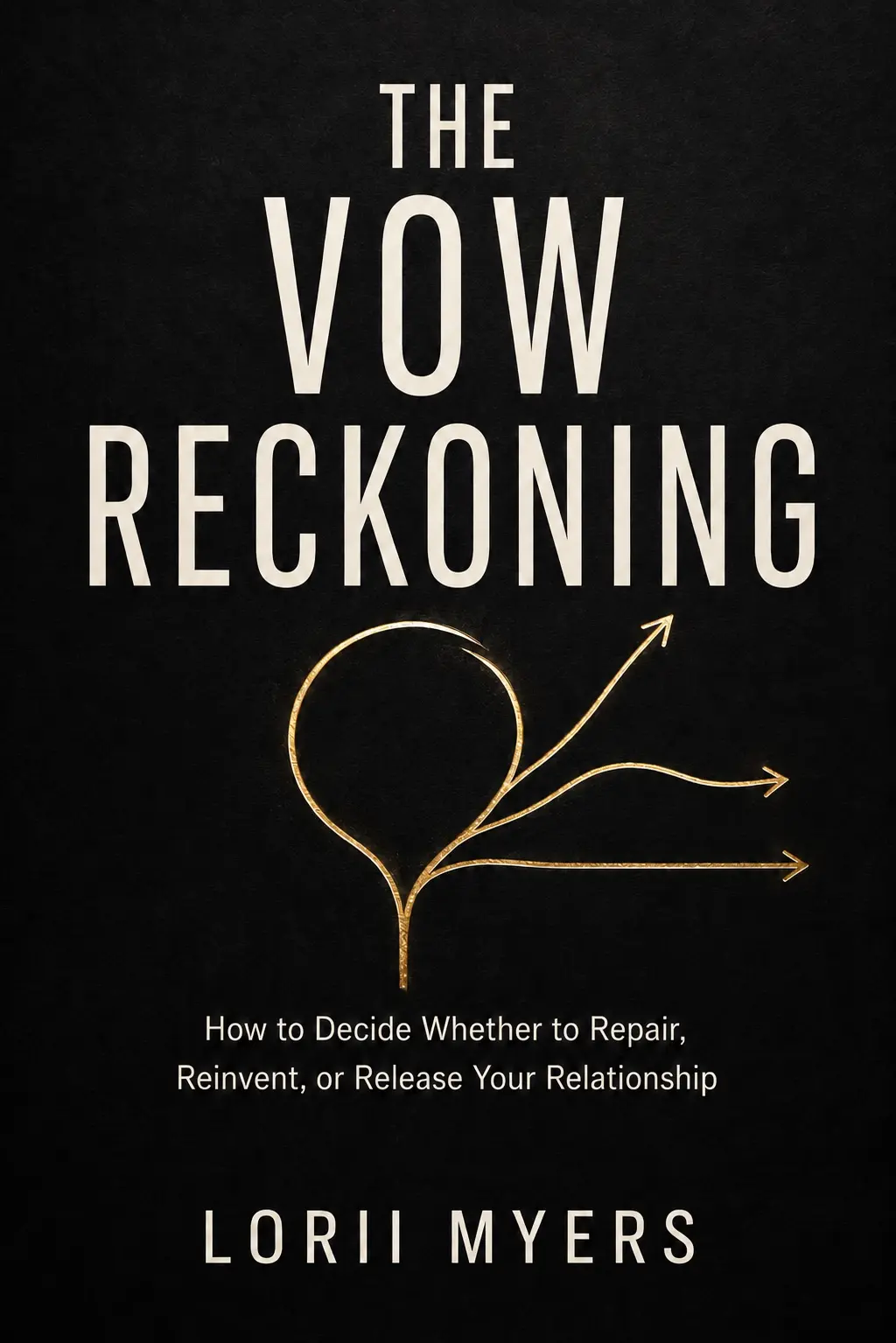
How to Decide Whether to Repair, Reinvent, or Release Your Relationship
Are we still choosing this vow, or merely continuing it?
THE CENTRAL PROPOSITION
Love, history, hope, fear and recent improvement can all be real without settling what a relationship can sustain. The Vow Reckoning brings commitment back into contact with the life being lived now.
Separate memory, promise and interpretation from the recurring conditions of the relationship as it exists now.
Test whether remorse and intention become sustained conduct that survives ordinary pressure.
Decide whether the evidence supports repair, a genuinely redesigned vow, or an honest release.
THE ETHICAL BOUNDARY
A difficult relationship is not the same as an unsafe one. Where coercion, intimidation or violence remove free consent, protection and individual support take priority over joint exercises, shared disclosure or relationship repair.
THE READING EXPERIENCE
What is true now: patterns, absences, repairs, costs and the facts love cannot erase.
What change can demonstrate when promises are tested by time, pressure and ordinary life.
Repair, reinvention or release—three serious outcomes, each requiring evidence and agency.
OFFICIAL BLURB
Most relationships at a crossroads are not empty of love. They are crowded with history, hope, fear—and one question neither time nor feeling can answer:
Are we still choosing this vow, or merely continuing it?
The Vow Reckoning offers a clear framework for finding the answer. Build the Record of what is true now. Test whether promises become sustained conduct. Then face the Choice: repair the relationship, reinvent its terms, or release it honestly.
This is neither an argument for staying nor permission to leave at the first difficulty. It is a refusal to let duration, guilt, improvement, or love alone decide a future that still requires two free yeses.
A vow is not honoured simply because it survives.
It is honoured when truth is allowed to answer it.
SYNOPSIS
The Vow Reckoning begins where relationship advice often becomes partisan: at the point when love, history, remorse, improvement, hope and fear all argue at once. Each may contain truth. None can decide the future alone.
Lorii Myers introduces a three-stage framework for separating emotional weight from decision evidence. The Record examines what is repeatedly lived now. The Proof tests whether intention becomes conduct that survives ordinary pressure. The Choice gives repair, reinvention and release equal moral seriousness.
Across eighteen chapters, six practical decision tools help readers examine patterns without reducing a relationship to a score. A dedicated Second-Vow Design asks what reinvention would require in daily life—not as renewed sentiment, but as a new agreement with observable terms.
The framework does not treat safety as a shared communication problem. Where coercion, intimidation or violence compromise free consent, protection and individual support come before mutual disclosure or repair.
Neither pro-staying nor pro-leaving, The Vow Reckoning refuses to let duration, guilt, temporary improvement or love alone make a decision that still requires two free yeses. A vow is honoured when truth is finally allowed to answer it.
FROM THE OPENING
From the Prologue, “The Question at the Table.” Opening review material is available through a qualified publishing conversation.
READ CHAPTER ONE
Presented from an author-approved author-review edition.
The cups from the night before were still on the table.
One had left a faint ring on the wood. The other sat exactly where it had been placed during the conversation that neither person had finished. Morning had arrived with its usual evidence—light under the blinds, a delivery truck reversing somewhere on the street, a kettle beginning to complain—but the house no longer felt usual. A question had been spoken in it, and the question had changed the scale of everything around it.
They had gone to bed in different ways. One had stayed awake, reconstructing the conversation until every sentence acquired five possible meanings. The other had slept for several hours, then surfaced before dawn with the conviction that something irreversible had happened, though no decision had been made.
At the table, they did what long-practised couples often do when the largest truth in the room is too large to lift at once. They discussed the day.
There was a repair appointment to confirm. Someone in the family needed a call. A form had to be signed. One of them moved the cups to the sink, and the other wiped the ring from the table. Their competence with ordinary life was almost beautiful. It was also part of the problem. They knew how to keep a household moving while the relationship inside it stood still.
Near the doorway, one of them paused.
“What happens now?”
The other looked at the clean place where the cup had been.
“I think we have to stop talking about what we used to be.”
Neither said what came next: Then what are we?
Every established relationship has at least two biographies.
The first is the biography people can tell. It has a beginning, recognisable turning points, private jokes that became family folklore, difficulties survived, addresses shared, photographs dated, and a list of things built together. It explains why the couple belongs in the same sentence. At anniversaries and gatherings, this is the relationship that can be narrated. It has sequence and meaning. Even its difficult chapters may acquire the polished shape of hardship overcome.
The second biography is harder to tell because it is still being written. It consists of how the two people speak when no one is listening, what they no longer mention, who initiates repair, where tenderness has been replaced by caution, which truths are edited before they are spoken, and whether either person still expects the other to be curious about an inner life. It lives in tone, repetition, avoidance, and consequence. It may look nothing like the first biography.
Truth often reaches two people at different speeds. The person naming it may have assembled it gradually through edited sentences, repeated disappointments, postponed requests, and private recognition. The person hearing it may receive the whole conclusion in one conversation. To one, the truth is accumulated; to the other, it is sudden.
The listener’s shock remains valid. It does not prove the truth was invented that day. The speaker’s longer private knowledge also creates a duty: when disclosure can be made safely, the other person cannot be left indefinitely inside a version of the relationship that is no longer shared.
Both are real. The mistake is allowing the remembered relationship to testify in place of the lived one.
A vow records what two people intended once. A marriage reveals what they are creating now.
This is not an argument against vows. It is an argument for taking them seriously enough to ask whether they remain active. A promise cannot survive as language alone. It requires present-tense conduct. If the words say partnership while the pattern says unilateral power, the pattern is governing. If the words say loyalty while the inner life has been abandoned, the pattern is governing. If the words say love while every difficult truth is punished, postponed, or made unspeakable, the pattern is governing.
Promises describe intention. Patterns reveal governing reality.
That distinction can feel severe because memory is not a deception. The earlier love may have been generous and entirely true. The people at the beginning may have meant everything they said. They may have carried each other through losses, illness, uncertainty, parenthood, financial strain, or years when the world outside the relationship felt unreliable. None of that becomes false because the present has changed.
But the past cannot perform the work of the present.
A durable relationship exists in more than one tense. It carries what two people once promised, what they are doing now, and what their conduct makes possible. Trouble begins when one tense governs all the others. Nostalgia can turn an earlier partnership into a standard the present is forbidden to contradict. Immediate distress can commit the opposite error, treating the latest season as though it has always been the whole story.
The reasonable objection to present-focused reckoning is that people under strain are unreliable historians. Exhaustion narrows attention. Resentment selects supporting details. A frightening conversation can make years of generosity briefly inaccessible. This objection deserves respect. The past can correct exaggeration by showing capacities the couple has genuinely possessed. Yet a capacity once demonstrated is not automatically still available. History tells us what occurred. Only current behaviour shows what remains usable.
The reverse also matters. Another couple may describe a bleak year in which conversation became practical and affection scarce. Look more closely, and each still protects time for the other’s concerns, revises plans when new needs appear, and returns to unfinished disagreements. Their present feeling is thin, but their mutual responsiveness has not vanished. A difficult chapter should not be promoted into a complete biography merely because it is the chapter being read now.
A useful reflection is to write three brief accounts: what the relationship has proven before, what it repeatedly does today, and what today’s pattern is likely to produce if it continues. Give each account its own page. Do not ask one page to cancel another. Then notice which page you instinctively defend and which you rush to discredit. That reaction may reveal whether memory is serving understanding or protecting you from information.
A shared past deserves a witness, not a veto.
Almost every relationship enters periods in which its lived biography looks depleted. Grief can narrow two people’s attention. Illness can turn companionship into logistics. Work can consume the imagination. Caregiving can leave very little energy for anything beyond the next necessary task. A new child, an empty house, retirement, a move, a financial shock, or a family crisis can temporarily rearrange the entire emotional economy of a home.
It would be reckless to treat every such period as evidence that the relationship is finished. Long love includes weather.
The harder question is whether the difficulty is weather passing through the structure or whether the difficulty has become the structure.
A hard season has a context. Even when the couple is exhausted, there is usually some shared recognition of what has happened to them. They can name the pressure without making each other its enemy. They may fail each other under strain, but there remains some expectation of return: a sense that when capacity reappears, they will use it to find one another again. The relationship is burdened, not disowned.
A finished structure can look calmer. Bills are paid. Events are attended. Necessary information is exchanged. There may be no single catastrophe to point to. Yet the accommodations built for a temporary difficulty have become permanent architecture. One person no longer asks because the answer has been disappointing too often. The other no longer notices the absence of the question. Silence stops being recovery and becomes policy. Parallel lives are not a response to pressure; they are how the relationship now avoids exposing itself.
The distinction is not whether the couple is happy every day. No serious relationship could survive that standard. It is whether difficulty is being carried by the relationship or whether the relationship itself has become the difficulty no one is permitted to name.
This is why a snapshot cannot decide the matter. One terrible month may be a season. Five peaceful years may still conceal a finished structure. The record must be long enough to reveal the governing pattern and honest enough to include exceptions. It must make room for the afternoon when ease unexpectedly returned, the conversation that did go differently, the apology that was offered without prompting. Evidence is weakened not only by denial but also by a determination to prove a conclusion already preferred.
The record therefore needs both condition and trajectory.
Condition describes where the relationship is now: guarded, warm, hostile, companionable, unequal, uncertain, or emotionally thin. Trajectory asks what happens when the condition is named. Does truth produce curiosity or punishment? Does a difficult conversation create new information, or merely repeat the familiar distribution of blame? When one partner changes an important behaviour, does the relationship make room for that change, or pull both people back towards the roles they know?
Two relationships can look equally unhappy and be moving in opposite directions. In one, the distress is the pain of a structure finally telling the truth; the disruption may be evidence of life. In the other, calm has returned because one person has stopped asking for anything; the absence of conflict may be evidence of surrender.
This is why peace cannot be read without context. Some peace is safety. Some peace is exhaustion after hope has withdrawn.
The present-tense marriage is not a mood averaged across a month. It is the pattern by which the relationship responds when reality enters it. A living structure may bend, protest, and require time, but it remains capable of taking in truth. A finished structure can sometimes tolerate almost anything except an honest description of itself.
The couple at the table had been seen, only the evening before, by people who regarded them as proof that commitment could last. They had arrived together, remembered names, carried food, told a familiar story, and left at the appropriate time. Nothing about the evening was fraudulent. They had developed real social grace and a real history of being dependable together.
But public competence can obscure private absence.
This is particularly true in long relationships because the partnership becomes an institution in other people’s lives. Family members expect the pair to appear together. Friends organise invitations around them. Children, including adult children, may experience the parents’ relationship as part of the landscape of home. Businesses, caregiving arrangements, property, and community roles may all depend on the couple functioning as a unit. The relationship is not merely an emotion between two people. It has infrastructure.
Infrastructure matters. It cannot be dismissed with a slogan about authenticity. Yet the more useful a relationship is to everyone around it, the harder it can become for the two people inside it to admit that usefulness and intimacy are no longer the same thing.
The public marriage asks, Can they continue to function?
The lived marriage asks, What does functioning now require them to conceal?
Those are different questions.
There is also a private public marriage: the version each partner displays to the other. One may continue performing optimism to avoid frightening the family or provoking conflict. The other may perform normality because naming the distance would create obligations they do not want. Both may participate in a careful fiction without consciously agreeing to it. They are not necessarily lying. They may be protecting what they still value while postponing what they do not know how to face.
Protection, however, can become preservation of the problem.
Bringing a relationship into the present is often mistaken for assembling a prosecution. One person begins naming what is wrong; the other hears a list of charges. The conversation becomes a contest between examples. Every hurt must be balanced by a good deed. Every complaint receives a counter-complaint. Soon the couple is no longer asking what is true. They are trying to determine who is entitled to be dissatisfied.
The Record has a different purpose.
It does not ask whether one person is good and the other bad. It asks what the relationship has become through both action and inaction. It includes asymmetry where asymmetry exists; neutrality must not be confused with false equivalence. One person may have caused more damage, exercised more control, or refused more attempts at repair. A humane account does not blur responsibility to make the story tidier.
At the same time, the record is larger than fault. Two decent people can create a structure in which neither can live fully. One may need forms of closeness the other cannot sustain. Their visions of the future may have separated. A division of roles that once felt generous may now diminish them both. The relationship may be damaged by conduct, outdated by growth, exhausted by repetition, or some combination of all three.
The first task is not to decide. It is to stop using the opening chapters of the relationship as proof of its current condition.
That requires each person to tolerate an account that does not preserve a preferred identity. The reliable partner may also be emotionally absent. The dissatisfied partner may also have stopped making honest bids for change. The person who caused a major injury may still have contributed years of care. The record becomes useful when neither person has to be reduced to one role for the governing pattern to be named.
A record can become unjust while remaining factually accurate. Events may be arranged to prove a character judgment decided in advance: selfish, impossible, cold, controlling, unstable. Each new moment is then recruited as confirmation. The other person is no longer encountered as someone capable of choice but as the predictable expression of a fixed nature. Reckoning becomes a trial with no genuine possibility of revision.
The ethical unit of description is not motive but observable sequence. What was requested? What response followed? What happened after the response was challenged? Motives matter, but they are partly hidden. A partner may withdraw because of shame, fatigue, anger, avoidance, or a belief that speaking will make matters worse. The effect can be named without pretending to know its single cause. Precision leaves room for explanation without erasing consequence.
Cool description has its own danger. A person can hide behind neutral language to avoid naming humiliation, loneliness, fear, or anger. Accuracy is not emotional anaesthesia. The aim is to distinguish feeling from verdict: I feel dismissed is information about experience; you’re incapable of respect is a sentence imposed on identity. The first claim can be explored alongside behaviour. The second tends to close the inquiry before either person learns anything new.
For one disputed pattern, write three lines: what a camera or calendar could establish, what meaning you assigned to it, and what effect it had on your participation. Mark the line about which you’re least certain. Then add one exception that genuinely complicates your account. An exception need not disprove a pattern; it tests whether the description is spacious enough to remain true when reality refuses to be tidy.
Honest description stays open to correction without surrendering consequence.
When Leah and Martin made their first Record, neither began with the problem that governed them.
They wrote what was easiest to defend. They had built a stable home. They still preferred each other’s company to most other people’s. They wanted the same broad future: the same city, the same circle of family, the same ordinary expectation that they would be beside each other when life became difficult. There was no concealed alternative life waiting behind the inquiry.
They were not divided about where they wanted to go.
They were divided about what happened whenever the journey became uncomfortable.
Martin used humour to lower the temperature. A question about money became a joke about Leah running an audit. A request concerning his family became a story about how no one survived family gatherings anyway. When Leah said she felt alone in a decision, Martin answered with enough warmth to make anger look disproportionate.
Leah usually laughed. Then she kept the part that had not been answered.
By the time she raised it again, the single incident had acquired an archive. She brought three earlier examples, two contradictions, and the exact sentence Martin had used six months before. She did not believe one example would be taken seriously. Martin heard the accumulated case as proof that no present response could matter.
He joked because every difficult subject felt like a hearing.
She built a hearing because every difficult subject became a joke.
Neither intended the system they had created. Each could explain why their conduct was reasonable. The explanation did not make the pattern less governing.
Their first useful sentence was not about character.
When discomfort enters, Martin makes it smaller until Leah makes it larger.
The sentence gave each person somewhere to stand without assigning either a permanent role. Martin was not incapable of seriousness. Leah was not naturally prosecutorial. They had built two protections that repeatedly summoned each other.
The fuller Record also included what complicated the problem. Martin could remain present through illness, practical emergency, and grief. Leah could release small disappointments without keeping score. Their difficulty appeared most reliably when a request might expose disagreement between them. The danger was not conflict itself. It was the speed with which both people prevented conflict from remaining its actual size.
Leah added one line beneath the Record:
I wait until the truth has witnesses.
Martin added another:
I make the truth entertaining so it won’t require an answer.
They read both without debate.
The relationship did not lack love or shared direction. It lacked a way for discomfort to remain in the room without being disguised or enlarged.
That distinction mattered. Their Record was not pointing towards a different agreement. It was identifying conduct that made an agreement they both still wanted increasingly difficult to inhabit.
Repair had acquired a precise subject.
Use this privately or with a willing partner only where reflection and disclosure are safe. Write five present-tense sentences about the relationship as it ordinarily operates—not its best day, worst day, origin story, or hoped-for future.
Name its usual emotional climate, what happens when pressure arrives, what each person edits or avoids, what the relationship does well, and one fact you most resist admitting. Describe conduct before explaining motive.
What are today’s repeated patterns building?
Do not force a verdict. The purpose is to give the present relationship a biography of its own.
At the table, the couple began with two sheets of paper. They did not write grievances. They wrote descriptions.
We are efficient.
We are careful.
We rarely surprise each other.
We know how to prevent a bad evening.
We don’t know how to create an honest one.
One of them added, after a long silence:
We still protect the relationship from outsiders. We no longer know whether we protect it from the truth.
They read the sentences without debate. The account was incomplete, but something had shifted. For the first time, the present relationship had been allowed to exist on the page without being corrected by its history.
The question was no longer whether they had once built something worthy.
They had.
The question was what their refusal to decide was building now.
THE FINAL THESIS
Authoritative Master v3.7 has passed portfolio audit and production verification. Independent human editing, source and rights review, copyediting and proof remain before publication. Qualified editors, agents and publishers may request current review materials directly from Lambo Entertainment.
SELECTED WORDS FROM THE MANUSCRIPT
Approved quotations by Lorii Myers, selected to accompany this manuscript’s public blurb and synopsis.
“An ending without a villain is not an agreement to distribute responsibility evenly.”
““Tell me everything you feel” is not necessarily intimacy; it can be compulsion.”