The story arrives
Inherited associations can supply character, danger, value or belonging before individual evidence has entered the room.
 LAMBO-MUSICARTIST · AUTHOR · LICENSING
LAMBO PUBLISHING · CANADIAN SOCIAL CRITICISM · LORII MYERS
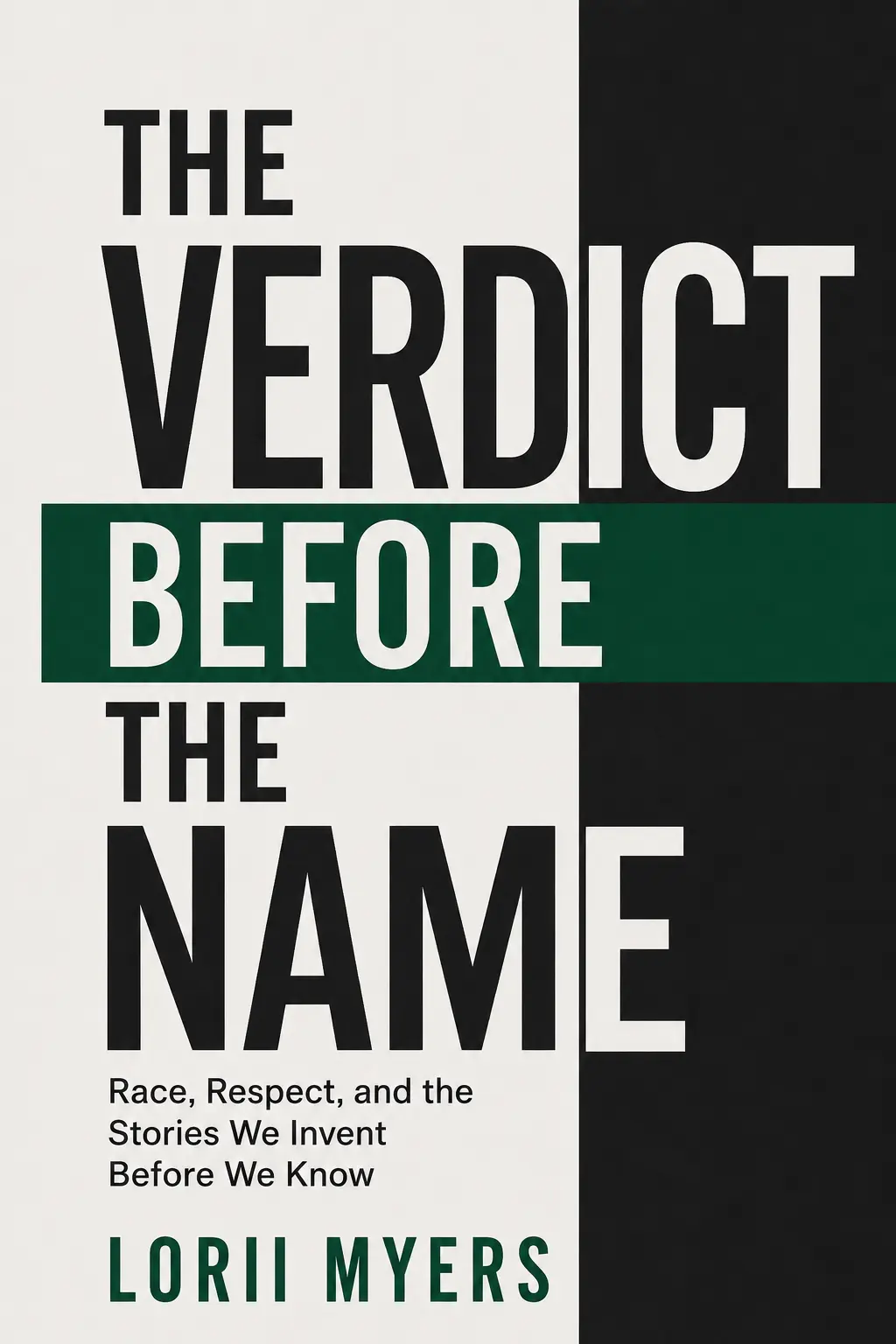
Race, Respect, and the Stories We Invent Before We Know
Before a person is known, race can supply a story.
THE CENTRAL PROPOSITION
Racism reverses the proper order of encounter. A story arrives before the person, becomes a verdict and begins shaping what others permit themselves to notice, doubt, protect, punish or ignore.
Inherited associations can supply character, danger, value or belonging before individual evidence has entered the room.
A private assumption becomes consequential when it authorizes different scrutiny, patience, protection, access or consequence.
Repeated decisions shape environments whose outcomes can later be mistaken for proof that the original story was true.
THE ARGUMENT’S SPINE
The sequence is a way to investigate movement, not a shortcut around evidence. Each transition must be established rather than assumed.
THE READING EXPERIENCE
Racial cue, inherited association and the private verdict that begins organizing perception.
Grace, inhibition, conviction and the social rooms that teach unequal permission.
Material consequence across institutions, measurement, representation and usable authority.
Evidence, revision, repair, automated systems and the return of the person before the category.
OFFICIAL BLURB
Before a person is known, race can supply a story.
The story becomes a verdict. The verdict becomes permission—to doubt, exclude, watch, punish or ignore.
Those decisions repeat. Patterns harden into conditions. The conditions return looking like proof.
In The Verdict Before the Name, Lorii Myers traces this machinery from private assumption to public consequence—through families, schools, workplaces, healthcare, law and automated systems.
Grounded in Canadian history, law and research, the book rejects both colour-blindness and easy explanation. It asks what evidence can establish, what it cannot—and who pays when a category is allowed to impersonate truth.
Racism reverses the proper order of encounter.
The verdict arrives first.
The name is forced to answer.
SYNOPSIS
The Verdict Before the Name begins with a reversal: before a person can be encountered as an individual, race can supply a ready-made story. That story becomes consequential when it starts organizing credibility, danger, belonging, patience, protection and consequence.
Lorii Myers traces the movement from private assumption to public condition. A story becomes a verdict. The verdict creates permission. Permission shapes decisions. Repeated decisions become patterns. Patterns harden into conditions, and those conditions can return looking like proof of the account that helped produce them.
Across four parts, the book moves through families, schools, workplaces, healthcare, law, institutions and automated systems. It distinguishes prejudice from discrimination, intent from effect, association from causation, representation from usable authority and visible compliance from private conviction.
The manuscript refuses two easy exits. Colour-blindness cannot repair a pattern it declines to examine, while disparity alone cannot establish every cause attributed to it. The work asks what evidence can support, where inference begins and whose life carries the cost when certainty outruns proof.
The final movement turns toward repair: mechanisms must be named, reasons made answerable, measurements kept within their limits and systems left open to revision. The aim is neither denial nor permanent accusation. It is a more truthful order of encounter.
The category may be relevant. It cannot be allowed to become the whole person. The name must arrive before the verdict.
READ CHAPTER ONE
Presented from an author-approved author-review edition.
Before a person gives you a name, a story about the category may already have arrived.
It arrives through the eye, but it does not begin there. The eye notices complexion, hair, features, dress, perhaps accent. History supplies the interpretation. Institutions reinforce it. Culture gives it a vocabulary. Before the person has said what they believe, where they were born, whom they love, what they fear, what they have endured, or what they are capable of doing, the category begins making suggestions.
Belonging.
Foreignness.
Trust.
Threat.
Intelligence.
Poverty.
Privilege.
The observer may believe they are simply seeing what is there. But physical variation and racial meaning are not the same thing. Skin tone may be visible. Race is the interpretation attached to it.
Human variation is real. Ancestry is real. Populations have histories, migrations, adaptations, and patterns of genetic inheritance. But the familiar racial divisions through which modern societies sort human beings do not form nature’s fixed filing system. Genetic variation does not divide humanity cleanly into the conventional racial boxes used by governments, employers, schools, courts, hospitals, or census forms. Genetic ancestry can reveal population histories and statistical patterns; those patterns do not map neatly onto changing social labels.1, 2
To describe race as a fiction, then, is not to call it imaginary.
It is to call it fashioned.
A legal border is fashioned. A currency is fashioned. A corporation is fashioned. None is unreal to the person whose movement, survival, employment, or property depends upon it. Human beings possess an extraordinary ability to create systems and then live inside them as though the systems had always existed.
Race is such a creation, but one of unusual intimacy. Its rules were written onto bodies and then presented as though the bodies had written the rules.
A fiction can become an institution. An institution can become an inheritance. An inheritance can become a neighbourhood, a presumption, an exposure, or a door that opens more readily for one person than another.
The invention is social. The consequences are not.
Human beings divided, conquered, enslaved, excluded, and despised one another long before modern racial categories. Lineage, religion, citizenship, language, geography, caste, conquest, and kinship all organized belonging and rank. Those histories could be brutal without being identical to the racial system that later emerged.
Historians disagree about the precise origins of modern race and about the relative weight of commerce, empire, slavery, settlement, theology, law, administration, and science. What can be said more carefully is that Western racial classification consolidated over centuries as perceived ancestry and visible traits were used to sort internally diverse populations into supposedly natural types and rank them by capacity, morality, civilization, and fitness to rule.1, 3
No single event, institution, or motive completed that construction. Its durability came from interaction: unequal arrangements produced visible conditions, and racial ideology recast those conditions as evidence that the hierarchy was natural.
This circularity is one of racism’s most durable habits: first, constrain the person; then, interpret the constraint as character.
Racial categories did not become consequential merely because people believed in them. They became consequential because institutions learned to act upon them.
Law was among the most powerful manufacturers.
Canada’s own records reveal how flexible official racial language has been. Census tables once treated English, Irish, Scottish, French, German, Scandinavian, and other European origins as distinct “races.” Modern Canadian data systems use different population-group categories, developed for particular statutory and statistical purposes. Nature did not reorganize itself between the forms. The state changed what it needed the categories to do.4, 5
Those classifications were not merely descriptive.
Federal law imposed a head tax on Chinese immigrants beginning in 1885, and Parliament later increased it. The Chinese Immigration Act, 1923 almost entirely barred Chinese immigration until its repeal in 1947. The operation of the law is sufficient to establish the point: a state category became tax, restriction, family separation, and exclusion.6
Earlier versions of the Indian Act and related federal law imposed statutory rules for who would be recognized as an ‘Indian,’ including sex-based rules that removed status from some First Nations women who married non-status men and affected descendants. The centralized Indian Register was created in 1951; current sections 5 and 6 continue the federal system of registration and entitlement. Later amendments addressed many sex-based inequities, though the statutory category and its consequences remain.7
The distinction is essential: First Nations, Inuit, and Métis are distinct peoples with their own histories, political identities, communities, rights, and relationships to land and Crown. Registration under the Indian Act is not the same as Indigenous identity, citizenship, or belonging. The example concerns the reach of federal classification and its legal effects; it must not reduce Indigenous nationhood to race.
A bureaucracy can appear bloodless. It uses boxes, clauses, registries, certificates, and numbered sections. Yet a box on a form can be the final administrative expression of generations of force.
The form does not shout.
It does not need to.
Once a category determines who may enter, which family may reunite, whose identity the state will recognize, or what rights become available, the category has acquired jurisdiction over human possibility.
Canada has often narrated itself through contrast with the United States, especially as a destination on the Underground Railroad. That history matters. It is not the whole history. Parks Canada’s national historic designation records that more than four thousand people of African descent were enslaved in colonies that became part of Canada between the seventeenth century and abolition in 1834.8 A country can participate in refuge and injustice. National innocence is another verdict delivered before the evidence.
The United States developed a different legal architecture, but its record makes the construction of racial boundaries unusually visible.
In 1662, Virginia enacted a rule providing that a child’s free or enslaved status would follow the condition of the mother. The rule departed from English common-law approaches that generally linked a child’s status to the father; in colonial Virginia, it made enslavement inheritable through women held in bondage.9
The statute attached a child’s legal future to birth before any act by that child. It did not complete the construction of race by itself, but it helped harden ancestry into an enforceable and inheritable condition.
In 1790, the first federal naturalization law limited eligibility to a “free white person.” Whiteness became a qualification for citizenship even though no stable biological definition established who counted as white.10 The United States census changed its racial categories repeatedly across later decades, adding, removing, dividing, and renaming classifications as political and social understandings changed.11
Nature did not revise itself between censuses. The state revised its question.
In Ozawa v. United States (1922), the Supreme Court held that Takao Ozawa could not qualify as a ‘white person’ for naturalization because the statutory term was treated as limited to those classified as Caucasian. In United States v. Bhagat Singh Thind (1923), the Court acknowledged an anthropological argument that could place Thind within the Caucasian category but held that ‘white person’ referred instead to the term’s common understanding.12, 13
The two opinions did not apply one stable scientific test. Their stated reasoning changed while the naturalization boundary remained exclusionary. The cases therefore reveal a legal category whose content depended on institutional judgment rather than a biological line waiting to be discovered.
The question was not simply, What is this person?
The deeper question was, Will this person be admitted?
That is the difference between classification and description. Description attempts to identify what exists. Classification determines how what exists will be treated.
A bone does not carry a census category. A gene does not apply for citizenship. Human bodies contain ancestry; institutions assign the permissions.
Law gave racial categories force. Science gave them, for a time, the appearance of inevitability.
European naturalists and later racial theorists attempted to classify humanity into distinct types. During the eighteenth, nineteenth, and early twentieth centuries, various fields used skull measurements, visible features, intelligence claims, evolutionary language, and eugenic theories to rank populations. Their methods often reflected biased assumptions, inadequate data, circular reasoning, and the political hierarchies of the societies in which they worked.3
The authority of science made racial ideology more difficult to challenge. A prejudice presented as preference can be disputed. A prejudice presented as measurement claims the prestige of fact.
Numbers can be made to kneel before power while still appearing objective.
This is not an indictment of science. It is an argument for scientific discipline. Science contains methods for correcting error, challenging assumptions, revising categories, and rejecting claims that evidence cannot sustain. Modern genetics and biological anthropology reject the idea that humanity consists of a small number of discrete, biologically uniform races corresponding to familiar social categories. Human genetic variation is overlapping, complex, and shaped by migration and interconnection.1, 2
This does not mean ancestry is meaningless or every population is genetically identical. It means ancestry cannot carry the philosophical or political weight racial hierarchy placed upon it.
Biology can help trace lineage.
It cannot issue civic worth.
The distinction is especially important because “race is not biological” is sometimes heard as “bodies do not differ.” Bodies plainly differ. Some inherited traits and health conditions vary in frequency among populations with different ancestral histories. But socially assigned race is often an imprecise proxy for ancestry, environment, exposure, income, stress, geography, and access to care. Treating race itself as the biological cause can hide the variables that actually require attention.2
The responsible claim is neither that biology explains racial inequality nor that biology contains no human variation. It is that biological evidence does not justify converting ancestry into a hierarchy of personhood.
The fiction was never the existence of difference.
The fiction was that difference came with a rank.
The phrase social construct can sound deceptively gentle. It may suggest something optional, like a custom that can be discarded once enough people cease believing in it.
But construction does not imply weakness.
A prison is constructed.
A market is constructed.
A school boundary is constructed.
The fact that human beings made something tells us it can be changed. It does not tell us the thing lacks power.
Race became material through accumulated decisions about land, housing, education, labour, citizenship, transportation, policing, voting, lending, health care, and public investment. The mechanisms differ by country, people, place, and period. Accuracy requires particularity.
Canada’s residential-school system separated Indigenous children from families and communities as part of a state-supported effort to disrupt cultures, languages, and social continuity. The Truth and Reconciliation Commission documented the system and its continuing legacies in its final report.14 This was not simply interpersonal prejudice. It was policy, institution, funding, authority, and enforcement acting together.
Other populations encountered different mechanisms. Chinese exclusion operated through immigration law and taxation. Anti-Black racism developed through enslavement, segregation, restricted opportunity, and discrimination that changed across region and time. None should be blended into a universal injury. Similar habits of rank do not create identical histories or remedies.
Yet the histories share one feature: classification became action.
Over time, action became pattern.
The fiction travelled through institutions until it appeared as a statistic.
This does not mean every unequal outcome can be attributed entirely to racism. Social outcomes usually have multiple causes. Income, geography, education, health, public policy, discrimination, migration history, family conditions, and personal decisions can interact in ways that resist a single explanation. A disparity is evidence that requires investigation, not a verdict that eliminates investigation.
But the opposite error is equally serious. The absence of openly racist intent does not prove the absence of a racialized mechanism. A rule may appear neutral in isolation while operating within conditions shaped by an older exclusion. Evidence must trace the chain rather than merely announce the conclusion.
What policy created the exposure?
What practice shaped access?
What comparison is appropriate?
What changed when the rule changed?
Who exercises discretion?
What alternative explanation fits the evidence?
These questions are not designed to make racism impossible to establish. They are designed to make the argument strong enough to survive scrutiny.
Moral urgency does not excuse causal carelessness. If an explanation is wrong, its remedy may fail the people it was intended to serve.
Race is not only something institutions have done to people. It has also become something people use to understand history, build solidarity, protect cultural memory, organize politically, and name shared experience.
There is no contradiction in this.
A category can begin as an instrument of domination and later become a language of resistance. People may take an imposed label and make community within it. They may reject it, revise it, combine it with other identities, or claim it on terms the original classifiers never intended.
This is why moving beyond racism cannot mean ordering racialized people to abandon race while racial hierarchy remains active.
Nor can it mean confusing race with culture. Cultures have practices, languages, histories, institutions, arts, relationships, and memories. Race may overlap with some of those experiences, but it does not contain them. No racial label can explain the internal diversity of the people placed inside it.
There is no single Black experience, white experience, Indigenous experience, Asian experience, or immigrant experience. Such terms can identify broad political or historical patterns, but they become false when used as complete biographies.
A category can help reveal a pattern while still failing to describe a person.
That tension must remain visible. If we look only at individuals, we may miss the institutional pattern. If we look only at categories, we may lose the individual inside it.
The task is not to choose between social truth and personal complexity.
It is to become capable of holding both.
This is where a historical classification becomes an everyday event.
The person enters accompanied by claims they never made.
The category predicts before the evidence arrives. Once the prediction is active, behaviour can be interpreted through it. Confidence may be read as leadership in one person and aggression in another. Reserve may appear thoughtful in one and evasive in another. A mistake may remain individual for one person while becoming representative for another.
The category is a probability assigned as certainty.
Canadian evidence shows that perceived identity can affect treatment before an employer meets the person behind an application. In a large randomized résumé study, economist Philip Oreopoulos found callback penalties associated with foreign experience and with several names signalling non-English origins, even when other qualifications were held constant. The study does not isolate a single pure “race effect”; names may signal ethnicity, nationality, language, or class as well. Its importance lies in demonstrating that an inferred identity can alter opportunity before an introduction occurs.15
Not every mistaken judgment is racism. Not every conflict across racial lines is racial in cause. People can dislike, distrust, favour, punish, or misunderstand one another for countless reasons. Precision matters here too.
But one of racism’s defining operations begins when perceived racial membership is granted authority over what evidence about the person will mean.
Hatred is its loudest expression, not necessarily its most durable one.
A person does not need to feel hatred to participate in a practice that distributes suspicion unevenly. An institution does not need to use racial language to preserve the effect of an older racial boundary. A society does not need unanimous belief in racial hierarchy for accumulated systems to continue shaping unequal conditions.
This is why private virtue, though valuable, is insufficient. People sincerely committed to fairness can inherit institutions whose rules, incentives, maps, precedents, and distributions were formed under less equal commitments.
We do not inherit personal guilt for acts we did not commit.
We do inherit the world those acts helped build.
The distinction matters. Guilt looks backward and asks who deserves condemnation. Responsibility stands in the present and asks what we will continue, what we will correct, and what we will refuse to pass forward.
Inherited conditions do not make every beneficiary malicious or every disadvantaged person powerless. They mean only that none of us begins history at the moment of our own arrival.
The task is to see what racial classification has organized without allowing classification to complete the person.
We are not there.
The category still moves quickly. Sometimes it appears on a form. Sometimes in a policy. Sometimes in a glance. Sometimes in an assumption so familiar that it is mistaken for common sense.
Before the person speaks, history may already have spoken for them.
The work ahead is not to pretend that voice is silent. It is to discover who taught it, which institutions repeat it, what evidence sustains it, what interests it serves, and how its authority can be withdrawn.
A name should begin an encounter, not arrive after a verdict.
THE FINAL PROVOCATION
The author-review manuscript is available for qualified professional consideration. Independent Black Canadian and distinctions-based Indigenous authority review, legal and factual verification, permissions, sensitivity review and human editing remain before publication.
SELECTED WORDS FROM THE MANUSCRIPT
Approved quotations by Lorii Myers, selected to accompany this manuscript’s public blurb and synopsis.
“The goal is not aligned minds, but a fair arena for minds that do not align.”
“The line is that conduct may earn judgment; ancestry may not supply it in advance.”
“A person’s account need not be accepted without question to be received without a racial discount.”