The recognition trap
How a useful signal can become reward, repetition, compression and eventually captivity.
 LAMBO-MUSICARTIST · AUTHOR · LICENSING
LAMBO PUBLISHING · IDENTITY · WORK · CREATIVE LIFE · LORII MYERS
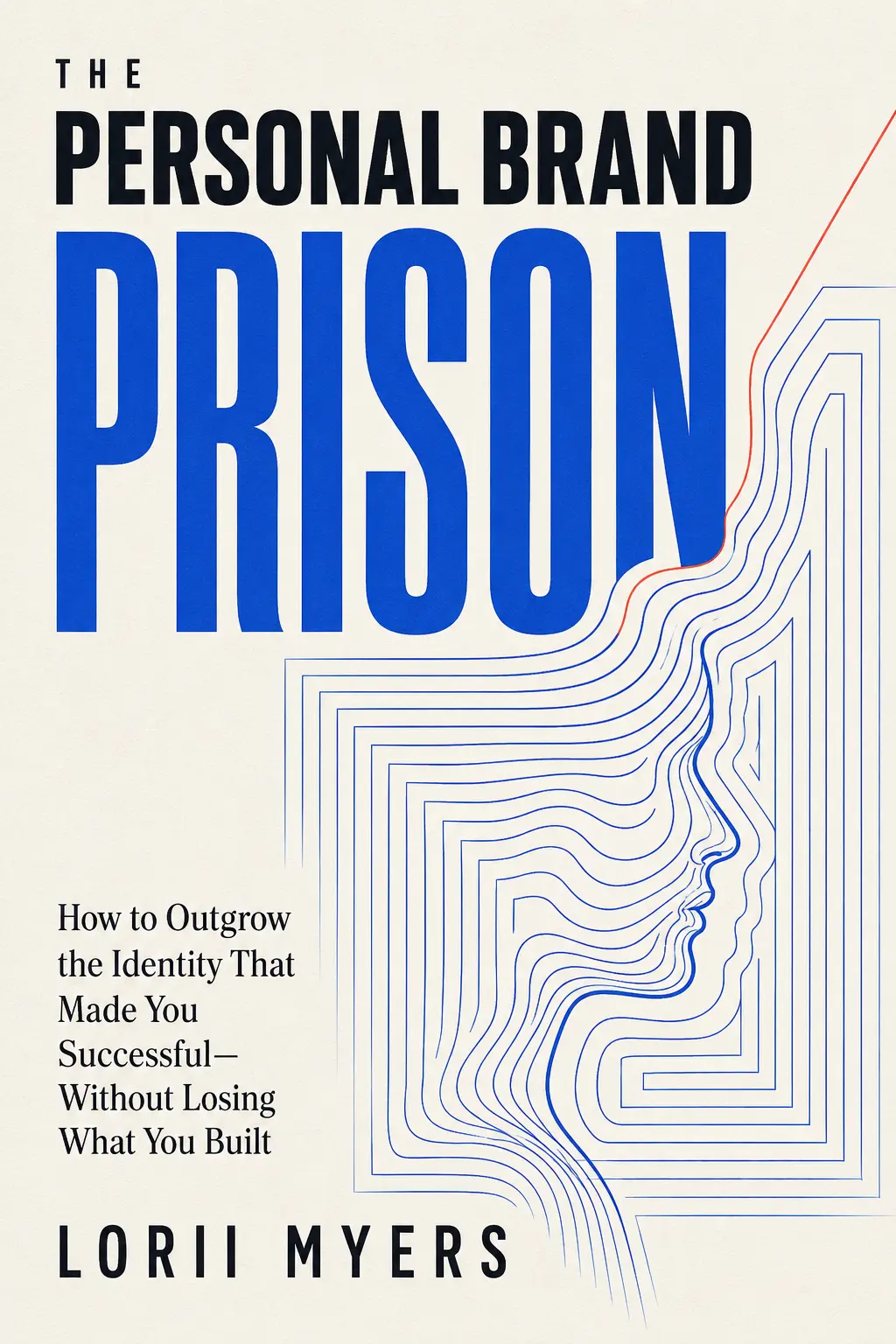
How to Outgrow the Identity That Made You Successful—Without Losing What You Built
Success teaches the world how to recognize you. Then recognition begins telling you who you are allowed to become.
A personal brand begins as a promise. When it succeeds, people trust it, reward it—and quietly begin requiring it. Audiences want the familiar. Markets reward the proven. Even those closest to you may mistake evolution for inconsistency. The more you have built, the more expensive it feels to outgrow.
You are still succeeding.
You are also disappearing inside the success.
In The Personal Brand Prison, award-winning author Lorii Myers exposes the Recognition Trap: how visibility becomes repetition, reputation becomes obligation, and past success gains authority over your future. She then offers the Credibility Bridge—a practical way to carry hard-won trust from who you were into who you are becoming.
This is not about destroying your reputation. It is about protecting what you built without letting it own you.
Stay trusted.
Stop staying the same.
THE PUBLIC PREMISE
Success can become a prison when the identity that earned recognition begins deciding what comes next. The Personal Brand Prison traces how visibility becomes repetition, obligation and captivity, then shows how the Continuity Core, Proof Portability and the Credibility Bridge can carry earned trust into a larger future.
How a useful signal can become reward, repetition, compression and eventually captivity.
The widening distance between present capacity and the version of a person the public still knows how to recognize.
How continuity, relevant proof and an honest credibility bridge can support responsible evolution without abandoning earned trust.
FULL SYNOPSIS
Success teaches the world how to recognize you. The danger begins when recognition starts telling you who you are allowed to become.
A personal brand begins as a useful promise. It helps people understand what you do, remember why it matters and know when to trust you. For founders, executives, creators, artists and established professionals, that clarity can generate opportunity, income and influence. But the more successfully an identity performs, the more people, systems and rewards become invested in its continuation—even after the person inside it has changed.
In The Personal Brand Prison, Lorii Myers examines the hidden progression through which recognition becomes jurisdiction. A clear signal attracts reward. Reward encourages repetition. Repetition compresses a multidimensional person into the most familiar, marketable version. Eventually, change begins to look reckless, inconsistent or disloyal.
Myers calls this cycle the Recognition Trap.
The book first exposes the Recognition Contract: the unspoken expectation that continued opportunity depends upon continuing to deliver the identity others already understand. It distinguishes what someone actually promised from what audiences inferred—and from the restrictions the successful person began enforcing without ever being asked.
As private development continues, Brand Lag widens the distance between present capacity and public perception. The emerging work feels real to its creator but sudden to everyone else. Meanwhile, the established work continues succeeding, making every departure appear irrational.
That success carries a hidden price. The Consistency Tax is paid through ideas never tested, language restrained, abilities left unproved and opportunities declined because they do not fit the recognized identity. Authenticity can become a costume when a once-truthful expression must be repeated after it stops representing the person producing it. Eventually, the audience moves inside: an imagined observer begins judging unfamiliar work before it has acquired enough form to deserve judgment.
Myers does not romanticize reinvention. Income, reputation, relationships, employees and obligations create legitimate transition risks. The Exit Penalty separates those measurable consequences from imagined catastrophe, while the Betrayal Illusion reveals that visible sameness is not the same as integrity. A person can change form without abandoning what made the work matter—and can continue producing the same form after its integrity has disappeared.
The final section offers a disciplined architecture for movement. The Continuity Core identifies the demonstrated standard, perspective or contribution that has travelled beneath changing roles. Drawing on her own life as a business founder, award-winning author, songwriter and creator working across nonfiction, fiction, music and stage concepts, Myers shows how one recognized identity can quietly become the judge of every other legitimate form.
Proof Portability determines which abilities and standards can honestly travel into new territory—and which authority must still be earned. The eight-stage Credibility Bridge then connects established trust to emerging work through bounded claims, target-field evidence, connective projects, clear communication, repeated signals and gradual rebalancing.
The book concludes with the Living Promise: a commitment people can trust without permanently fixing the form of the person or work. The accompanying Brand Freedom Charter defines what the public identity promises, what it never owns and how future evolution will remain possible.
The Personal Brand Prison is not an argument against branding, consistency or success. It is an argument against allowing recognition to acquire authority over the future.
A reputation should carry your growth.
It should never require your disappearance.
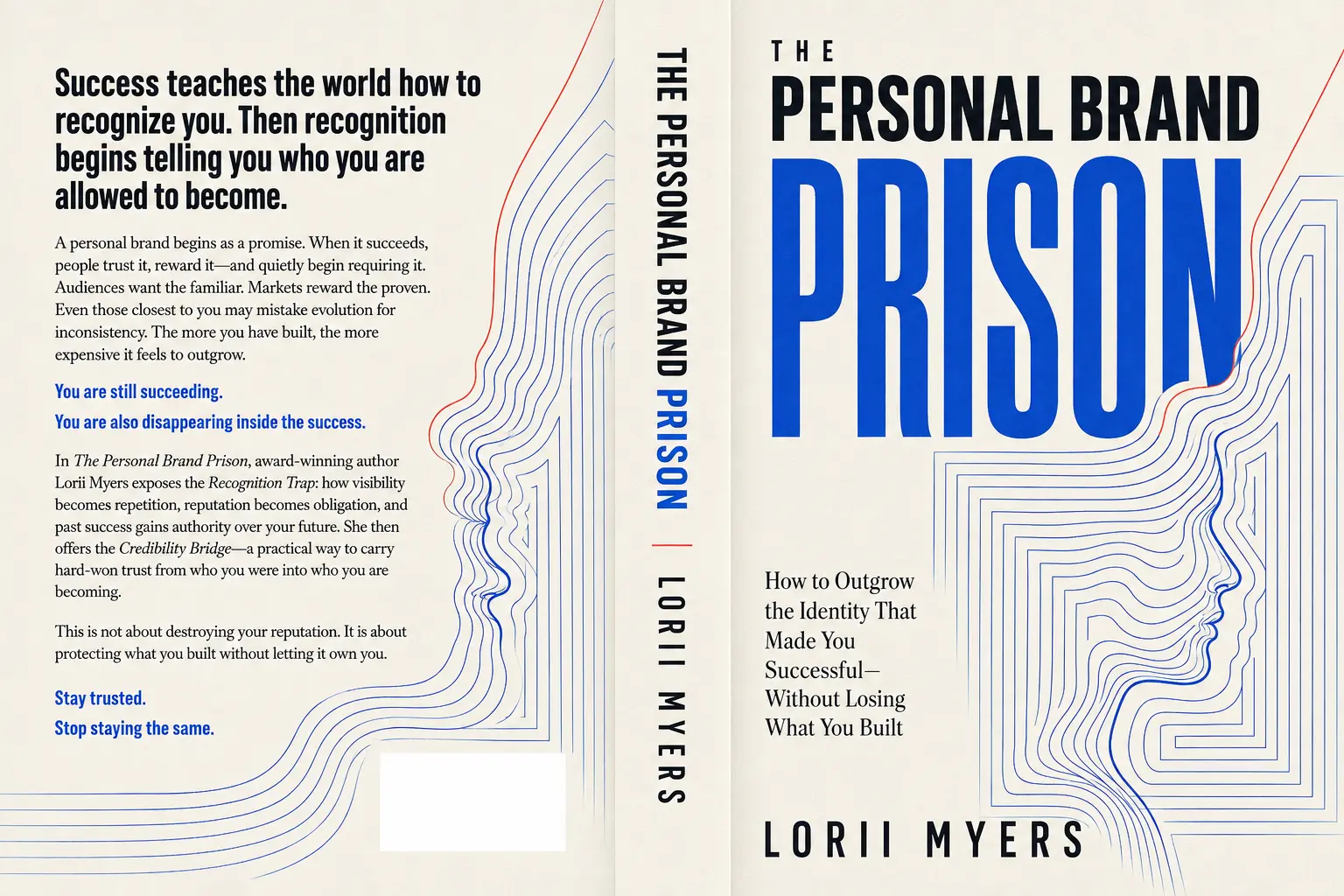
COMPLETE COVER
Website preview of the complete cover concept. Final print dimensions and spine width will be locked after production pagination.
READ THE OPENING SAMPLE
Presented from an author-approved author-review edition.
The most difficult prison to leave may be the one people congratulate you for staying inside.
Nothing about it looks like confinement at first.
It looks like traction.
People remember your name. They understand what you do. They know when to call you. Your work begins arriving in rooms before you do. A sentence can introduce you. A reputation can shorten the distance between doubt and trust.
This is what a personal brand was supposed to accomplish.
It was supposed to make value easier to recognize.
Then recognition began asking for more.
The sentence that introduced you became the sentence that contained you. The work that proved you could succeed became evidence that you should continue succeeding in exactly the same way. People didn’t merely learn what to expect from you. They began treating expectation as obligation.
Perhaps nobody said, Stay where we put you.
They did not have to.
The invitations made the request. The revenue made it. The applause made it. The ease with which familiar work was accepted made it. The uncertainty surrounding unfamiliar work made it again.
Success opened a door.
Then, quietly, it taught everyone which room to keep you in.
A personal brand begins as a promise.
This is what I do. This is how I do it. This is the standard I will meet. This is the value you can expect when my name is attached.
There’s nothing false or shallow about that promise. It can be an act of respect. Other people shouldn’t have to solve a mystery every time they encounter our work. Clarity reduces risk. Consistency earns confidence. A useful reputation carries evidence forward so it doesn’t have to be rebuilt from nothing in every room.
The danger begins when the promise is interpreted as a prohibition against becoming anything else.
The distinction matters.
This is not a book against reputation. It is not an argument for abandoning discipline, surprising an audience for sport, changing direction every time familiarity becomes less exciting, or demanding authority in a field where no proof has been earned.
It is not a celebration of confusion disguised as freedom.
Trust matters.
Standards matter.
History matters.
But history is evidence. It is not a sentence.
The problem is not that people know us for something. The problem begins when what they know acquires jurisdiction over what we’re allowed to become.
Jurisdiction is stronger than recognition.
Recognition says, This is where I know you from.
Jurisdiction says, This is where you belong.
Recognition remembers.
Jurisdiction rules.
Most personal-brand advice concentrates on the first problem: how to become legible in a crowded world. It teaches clarity, repetition, positioning, visibility and proof. Those instructions can work. That is why a second problem eventually appears.
What happens after recognizability succeeds?
What happens when the person keeps developing but the public identity does not?
What happens when the market continues rewarding a version of the self that the self can no longer fully inhabit?
The world may love the version of you that you’ve already outgrown.
Love does not make the version current.
The mechanism is gradual enough to feel rational at every stage.
First, there is a signal: a clear cue that makes the work recognizable and retrievable.
Then comes reward: attention, trust, status, opportunity, belonging or income attaches to the signal.
Reward encourages repetition. If something worked, it makes sense to do it again.
Repetition produces compression. One visible strength begins standing in for the whole person.
Compression becomes captivity when departure from the familiar begins to look reckless, false, ungrateful or disloyal.
Signal → Reward → Repetition → Compression → Captivity
Within this book, the Recognition Trap denotes the personal-brand sequence Signal → Reward → Repetition → Compression → Captivity.
The trap does not require a manipulative audience or a weak person. It can be built by reasonable people responding to real evidence.
An audience returns for what it enjoyed.
A client hires for what has already been proven.
An employer assigns the person most likely to deliver.
A platform distributes material similar to material that previously held attention.
A professional protects the income, access and credibility it took years to build.
Each decision can make sense on its own.
Together, they can turn a successful identity into a closed system.
The system becomes especially difficult to question because it rewards the person it restricts. Failure creates obvious pressure to change. Success can make change look irresponsible.
The cell is furnished with evidence.
The lock is made of reasons.
The prison may also be built from kindness.
A customer expresses gratitude for the work that helped. A reader says the familiar voice is exactly what they need. A colleague protects the role in which you’ve been most effective. A family member proudly introduces you through the achievement that made your life easiest to explain.
Nothing in those gestures intends harm.
But gratitude can still preserve a version.
Pride can still repeat a limit.
The people who benefited from who you were may not know how to welcome who you’re becoming, especially if your change alters what they receive from you.
This does not make them enemies.
It makes the negotiation real.
The most durable prisons aren’t always imposed by people who want less for us. Some are maintained by people who genuinely value what we’ve already given.
Value does not create permanent ownership of its source.
In my early sixties, I listened to a musical arrangement that had reached farther into sound than I could have carried it alone. By then I’d already written books, built businesses, played guitar and piano, and lived for decades with music that didn’t always have a practical route into full form. The file in front of me didn’t create the imagination behind it. It made more of that imagination available to judgment.
That distinction changed the account I’d been carrying of my own range.
The public record already had useful language for me. Business founder. Author of books about success. Those descriptions were true. They were supported by visible work, and visible work has an advantage: it can introduce itself. It can be held, cited, recommended and remembered. It gives another person a reason to know where to place you.
Music carried a different history. I’d written songs, played instruments and sung since I was young. I’d also learned to reduce some of what I heard to what the available route could support. A larger arrangement became chords and melody. An idea waited for collaborators, time, explanation or cost that the moment couldn’t justify. Practical decisions accumulated. Eventually the public evidence and the private range told different-sized stories.
When a broader production route became available, the surprise wasn’t that I’d suddenly become creative. The surprise was that an old description of my limit had been describing an interface. The work could now return with enough form for me to hear what it had misunderstood, what it had exaggerated and what it had made possible. The new route didn’t grant mastery of every field it touched. It reopened those fields as places where work could be tested, credited, corrected and learned.
This is one way success becomes a template.
The successful identity does not have to attack the emerging one. It only has to possess more evidence. Founder and author arrive with completed work behind them. Songwriter, producer, fiction writer and creator of stage concepts arrive carrying different amounts and kinds of proof. The categories do not have equal authority merely because they belong to one life, but neither should the earliest proven category be appointed to decide which later work is allowed to become real.
Success can tell us what the world had reason to reward before. It cannot tell us the full range of what a life has been preparing to examine next. Nor can private conviction settle the case. The emerging work still owes the world its own evidence.
The useful question is not, Which label contains me completely?
It is, Which description has become powerful enough to overrule work it has not yet allowed me to test?
Write the sentence that introduces you most efficiently. Place beside it one capacity, question or form that has accumulated privately. Do not promote the second sentence into a claim the work has not earned. Do not allow the first sentence to prevent the work that could earn it.
History should carry evidence forward.
It should not close the case.
Private development is often quiet.
A founder becomes fascinated by a problem outside the company. An executive develops a perspective that does not fit the role that made the executive visible. An artist’s technique changes before the audience has language for the change. An expert discovers that the question beneath years of work is larger than the field in which the answer first appeared.
Internally, the movement may feel coherent.
Externally, it can look sudden.
In this book, Brand Lag refers specifically to the distance between a person’s development and the audience’s current, evidence-based perception of that person.
Brand Lag is not proof that the public is hostile. It is a timing problem before it is a conflict. Other people cannot recognize evidence they have not yet seen. They continue using the clearest available account.
But the person living inside the lag may misread that delay.
No one sees me this way becomes no one ever will.
This new work is not yet trusted becomes this new work is not legitimate.
People still want the familiar becomes I owe them the familiar forever.
Delay becomes destiny when it is not named.
The obvious fantasy is rupture.
Delete the old identity. Announce a reinvention. Shock the audience into attention. Treat every question as resistance and every loss as proof of courage.
That can feel liberating for a week.
It can also destroy accumulated trust, confuse people who had good reason to believe the old promise, and substitute novelty for development.
Freedom without responsibility is not the answer to captivity.
The aim is not to become unrecognizable.
It is to become recognizable for something large enough to keep becoming.
That requires a different kind of consistency. Not permanent sameness of topic, title, tone, medium or role. Consistency of standard. Consistency of judgment. Consistency of consequence. A deeper promise that can survive a change in form.
Later, we’ll identify the Continuity Core beneath the visible form. We’ll examine how proof can travel without being exaggerated, how a Credibility Bridge can connect established authority to unfamiliar work, and how a Living Promise can preserve trust without fixing the future.
But we cannot build that bridge until we see the prison accurately.
We begin with the version people can find.
Then we examine the contract recognition creates, the rewards that train repetition, and the lag between present capacity and public belief. We’ll follow recognizability as it moves from access to expectation, from expectation to self-editing, and from self-editing to captivity.
The opponent must remain precise.
It is not branding.
It is not consistency.
It is not an audience that wants to understand.
It is the moment recognition stops describing the past and begins governing the future.
Your reputation should carry your growth.
It should not require your disappearance.
PART I
HOW RECOGNITION HARDENS
Someone asks what you do.
The question appears simple. The answer rarely is.
You may have thirty years of experience, six overlapping abilities, three kinds of work that matter to you, a perspective formed across industries and a new direction that hasn’t yet acquired a clean name.
The person asking does not want the archive.
They want a handle.
So you give them one.
I am a founder.
I am a leadership consultant.
I am a novelist.
I make films.
I help companies grow.
I write about relationships.
The answer is not necessarily false. It is incomplete in the way every useful answer is incomplete.
The problem begins later, when the handle is mistaken for the whole vessel.
What was a personal brand supposed to do—and when did it begin doing too much?
Human attention depends on compression.
We couldn’t move through the world if every encounter required us to consider every fact with equal weight. We use categories. We remember patterns. We attach people to the work, places, qualities and consequences through which we encountered them.
Research on categorization has long shown that categories are not experienced as flat lists of identical members. Some examples become more typical and easier to recognize because they share more of the features associated with the category. That is useful for understanding objects. It is also a warning when applied to people.
Once a person becomes a strong example of a category—founder, comedian, strategist, athlete, activist, expert—the category begins doing cognitive work on their behalf.
People no longer have to ask, What might this person contribute?
They retrieve the established answer.
That retrieval is often the point.
A personal brand can be a mercy offered to attention. It tells people where to begin. It makes the work easier to find, remember and recommend. It gives a colleague language for introducing you in a room you haven’t entered. It allows a reader to connect a name with a consequence. It helps a potential client decide whether further attention is warranted.
The brand is useful because it does not contain everything.
Compression is not the flaw.
Confusing compression with completeness is.
A cue helps memory reach what has already been associated with it. Classic research on memory demonstrated that retrieval depends not only on what was stored, but on whether the available cue connects effectively to the way the information was encoded.
The business implication is obvious enough. Repeated language, recognizable work and consistent evidence make a person easier to retrieve.
But the human implication is more important.
A retrieval cue is a point of access.
It is not a deed of ownership over the identity behind it.
Call this distinction The Retrieval Cue.
Your public signal has done its job when it helps someone reach relevant evidence about your work. It has exceeded its authority when it is treated as proof that unrelated or emerging evidence cannot also belong to you.
The difference can be seen in two sentences.
This is what people know me for.
This is what I am.
The first sentence reports recognition.
The second can surrender identity to it.
Often the surrender happens without drama. A person uses the public category so many times that it becomes the only answer available privately. The bio becomes an autobiography. The introduction becomes a self-concept. A useful summary, repeated often enough, begins to feel like an essence.
The person is not lying.
The person is disappearing through accuracy that is too small.
Digital life makes the confusion easier.
A name is entered. Results appear. The earlier work may rank higher because it has existed longer, earned more links, received more attention and accumulated a larger body of proof. The visible record is not neutral, but neither is it necessarily malicious. It is organized around what has already become legible.
In three experiments using an artificial accommodation platform, complete and partial digital-identity profiles increased participants’ ratings of hosts’ trustworthiness, credibility and sociability and, in some conditions, their stated propensity to rent.
That is the value of a public signal.
It allows trust to begin before full knowledge is possible.
It also reveals the limit.
The signal helps people decide whether to enter a relationship. It does not grant them full knowledge of the person entering it.
Online, however, visible evidence can feel total because invisible evidence leaves no blank space. The search result does not announce what it has omitted. The profile does not display the undeveloped interest, the unpublicized skill, the private study, the abandoned draft, the capacity never requested or the work not yet released.
Absence from the record begins looking like absence from the person.
This is how an archive becomes a border.
The public doesn’t say, “You’re forbidden to cross.”
It simply keeps directing traffic toward the roads already mapped.
The need to be findable creates pressure toward clarity.
Clarity is valuable.
But clarity becomes dangerous when we demand that it settle questions it was never designed to answer.
A useful public identity can answer:
• Why might someone seek this person’s work?
• What evidence has this person already produced?
• What standard can reasonably be expected?
• Where has this person created recognizable value?
It cannot answer:
• What is the full range of this person’s future contribution?
• Which private capacities are now ready to become public?
• What new form might express the same underlying standard?
• Which category will matter after the present one stops being sufficient?
Being findable is an operational achievement.
Being finished is an existential claim.
The first does not establish the second.
This seems obvious until money enters the room.
The work people can find is often the work they will fund. The work they will fund is the work that acquires more evidence. More evidence makes the work easier to find. The cycle can be productive for years.
It can also crowd out anything without an established trail.
The emerging work now competes not only with other people’s work but with the creator’s own proven identity. It must survive comparison with a version that already has distribution, language, testimonials, relationships and confidence.
The new work is not weak merely because it is early.
The old work is not current merely because it is strong.
People often defend narrow personal brands in the name of consistency.
The defence contains a truth.
Trust cannot accumulate around chaos. If a person changes standards whenever accountability becomes uncomfortable, abandons commitments without notice, claims expertise without evidence and treats every contradiction as growth, the problem is not a restrictive audience. The problem is unreliability.
Reliability deserves protection.
Repetition does not deserve the same immunity.
Reliability says the work will meet a standard.
Repetition says the work must keep taking the same form.
Reliability concerns what other people may fairly trust.
Repetition concerns what they have become accustomed to receiving.
Those can overlap. They are not identical.
A chef who opens a new kind of restaurant still owes diners safety, competence and an honest description of what is being served. The chef does not owe them the old menu forever.
A consultant who begins writing fiction still owes clients the work already contracted. The consultant does not owe the market exclusive ownership of imagination.
An executive who develops a public voice outside the company still owes the company appropriate judgment, confidentiality and performance. The title does not acquire every thought produced by the person holding it.
The fair promise must remain.
The accidental restriction can be released.
How can we tell when a retrieval cue has become an identity claim?
Watch what happens around unfamiliar evidence.
A healthy cue creates an entry point. New information can be added without threatening the original record.
An overextended cue acts as a filter. New information is rejected because it does not resemble the entry point closely enough.
The signs are ordinary.
Someone praises your new work by comparing it to the familiar work, even when the comparison doesn’t fit.
An introduction mentions an achievement so old that you’ve stopped recognizing yourself in the description.
A client assumes competence in every matter adjacent to the one you proved.
A colleague acts surprised by a capacity they’ve never needed from you.
You remove an idea from a conversation because it would require too much explanation about why it belongs to you.
That last sign matters most.
The public cue has moved inside.
You are no longer merely being retrieved through the old identity. You are pre-sorting your own possibilities according to whether the old identity can retrieve them.
The brand has started doing more than helping other people find you.
It is deciding which parts of you may be found.
There’s a familiar professional exercise: describe what you do in one sentence.
The exercise can be useful. It forces selection. It reveals whether a person can name the value of the work without hiding behind complexity.
But a one-line description should be judged by its purpose.
Is it a doorway or a floor plan?
If it is a doorway, it needs only to help the right person enter.
If it is treated as a floor plan, every room not named begins to look unauthorized.
This is why a larger brand is not necessarily a longer sentence. Adding every role can produce a list without producing meaning.
Founder. Speaker. Writer. Investor. Artist. Mentor. Strategist. Builder. Visionary.
The accumulation may feel expansive. It can still be another form of compression, now built from nouns stacked high enough to hide the person.
The answer is not to name everything.
The answer is to stop asking the public sentence to own everything.
A brand can remain specific while the person remains spacious.
You can say, “This is the work I’m offering here,” without saying, “This is the only work I’m allowed to offer anywhere.”
Context can carry clarity that identity should not have to carry alone.
Every established category has gravity.
It pulls interpretation toward itself.
When a comedian becomes serious, the seriousness may be heard as setup. When an athlete speaks about business, the business idea may be treated as celebrity extension. When a business leader makes art, the art may be called a hobby long after it has become disciplined work. When an artist builds a company, commercial judgment may be treated as an accidental skill.
The old category does not merely describe old evidence. It interprets new evidence before the new evidence has earned its own context.
This can benefit the person. Existing attention may transfer. Curiosity may open doors. A known name may receive a hearing that an unknown name would not.
It can also distort.
The new work may be overpraised because of the old reputation, or underexamined because the audience assumes it already knows what the work means. Both reactions prevent the new evidence from becoming accurate evidence.
The aim is not to escape all categorization. That is impossible.
The aim is to keep category from becoming destiny.
Useful compression selects what matters for a particular decision.
Identity Compression forgets that a decision was ever particular.
A hiring manager may need to know whether you can lead a complex integration. A client may need evidence that you can solve a defined problem. A reader may want to know what kind of book is being offered. A conference organizer may need a clear reason to place you on a stage.
Each context justifies selection.
None justifies reducing the person to the selected feature everywhere else.
Identity Compression occurs when the most marketable or memorable feature begins standing in for the multidimensional person.
The reduction usually follows three moves.
First, a specific strength becomes a general description.
“She built an exceptional company” becomes “she is a business person.”
Second, the general description becomes an interpretive frame.
Her creative work is now viewed primarily as something a business person made.
Third, the frame becomes a permission structure.
If the creative work is too serious, too ambitious or too independent to be treated as an extension of the business identity, it is judged as a departure that requires defence.
The category has travelled beyond its evidence.
This is how a fact becomes a jurisdiction.
The compression can also work through character.
A person known for optimism becomes responsible for the emotional temperature of every room. A person known for directness is expected to provide certainty before certainty is possible. A person known for compassion is treated as though boundaries contradict care. A person known for resilience is assigned more strain because others have learned that the person can carry it.
The praised quality becomes a work order.
This is where positive recognition can become difficult to challenge. The label is flattering. Refusing it sounds ungrateful.
But a compliment can still be too small.
“You’re so strong” may mean we’ve stopped checking what strength costs you.
“You’re the practical one” may mean we no longer expect to support your imagination.
“You always know what to do” may mean your uncertainty has become inconvenient to us.
The answer is not to deny the strength.
It is to restore its boundaries.
“I am strong” does not mean I require no care.
“I am practical” does not mean I possess no vision.
“I am decisive” does not mean every honest question is weakness.
“I am known for this” does not mean this is all that can be known.
Identity Compression survives by removing the phrase in this context.
Put the phrase back.
Context returns a total identity claim to the size of its evidence.
Established work can begin functioning like a surname attached to everything that follows.
The founder’s novel.
The athlete’s business.
The actor’s book.
The executive’s art.
The label may be factually correct. It can also prevent the new work from meeting the public directly. The earlier identity arrives first and explains the new evidence before the evidence speaks.
Sometimes the association opens a door. The work receives attention because the name already carries weight.
Sometimes it lowers the ceiling. The new work is treated as an interesting extension rather than judged as work capable of establishing its own authority.
Both effects can occur at once.
This is why expansion does not require pretending the earlier identity never existed. The history will travel. The task is to keep it from becoming the only available interpreter.
New work needs enough independent context to be understood on its own terms.
Not a denial of the surname.
A first name of its own.
The fear beneath expansion is often that multiple retrieval cues will create confusion.
Sometimes they do.
If every interest is announced with equal urgency, none is supported by proof and the person expects strangers to assemble the meaning, the result is not range. It is unfinished communication.
But the alternative is not one door forever.
A building can have more than one entrance and remain the same building.
Different people may retrieve you through different bodies of work. One knows the company. Another knows the books. Another encounters an idea without knowing either history. The identity doesn’t fail because every person lacks the same entry point.
The question is whether each door leads to a credible room.
Does the work behind the signal exist?
Is the promise clear in that context?
Can a person understand why the contribution matters without studying your entire history?
Does the standard hold even when the form changes?
Multiple cues become incoherent when they are only labels. They become range when each is attached to evidence and a deeper standard connects them without forcing sameness.
The public does not need one total explanation of you.
It needs an honest explanation of the work in front of it.
That distinction releases a great deal of unnecessary pressure. You don’t have to make every audience understand every dimension before any dimension may move.
You can build recognition in more than one place.
You can allow the connections to become visible through the work.
The goal is not maximum complexity in every introduction.
It is enough access points that no single introduction becomes a lock.
The proper function of a personal brand can be stated plainly.
It should help relevant people retrieve relevant value.
That is enough.
It does not need to contain the whole person. It does not need to forecast every future form. It does not need to resolve the tension between multiple capacities before any of them has had time to develop. It does not need to turn a life into a permanently coherent product line.
The demand for total coherence often pretends to be strategic. Sometimes it is only discomfort with human range.
A person can be coherent at the level of values and varied at the level of expression.
A body of work can contain turns without becoming dishonest.
An established strength can remain true after it stops being exclusive.
This is the freedom hidden inside The Retrieval Cue.
You don’t have to make yourself difficult to find in order to remain larger than what’s found.
You only have to refuse the false promotion of a signal into a sovereign.
Before asking whether your brand should change, ask what job it’s currently doing.
Write the clearest sentence other people use to retrieve you. Not the sentence you prefer. The sentence their introductions, invitations, requests and assumptions reveal.
Then examine it through four distinctions:
Access: Does this sentence help the right people reach relevant work?
Evidence: Does it describe proof you have actually produced?
Exclusion: Which real capacities become harder to see because the sentence is treated as complete?
Authority: What decisions are you allowing this sentence to make about work that does not yet resemble it?
Do not discard a useful cue because it is incomplete.
Every cue is incomplete.
Remove only the authority it was never meant to possess.
Your public identity may tell people where they have known you.
It does not get the final word on where they may know you next.
SELECTED WORDS FROM THE MANUSCRIPT
Approved quotations by Lorii Myers, selected to accompany this manuscript’s public blurb and synopsis.
“We do not honour an earlier truth by forcing it to survive beyond its accuracy.”
CURRENT STAGE
The approved book description, full synopsis, complete-cover preview and Prologue plus Chapter One sample are available here. The full working manuscript remains private. C designation is withheld pending the printed author review.