Examine the centre
Separate what is yours to authorize from what is shared, influenced or outside your control.
 LAMBO-MUSICARTIST · AUTHOR · LICENSING
LAMBO PUBLISHING · BIG-IDEA APPLIED PHILOSOPHY · LORII MYERS
How to Think for Yourself, Choose Deliberately, and Build a Life That Holds Together
A life can work—and still be running on instructions no one has examined.
THE CENTRAL PROPOSITION
Habit, role, urgency and borrowed authority can begin deciding before a choice feels like a choice. Self-governance starts by making that hidden authorship examinable.
Separate what is yours to authorize from what is shared, influenced or outside your control.
Test whether attention, capacity, limits and operating rules can carry the direction you claim to choose.
Ask what the choice created, permitted, displaced or required—and what must change on the next turn.
DRIVEN INTENTION
Driven Intention is not certainty, motivation or control. It is the discipline that moves examined judgment into conduct and keeps the result open to evidence.
THE READING EXPERIENCE
Locate examined judgment, accurate agency and the authority to authorize, refuse, promise and repair.
Expose the habits, systems, attention, capacity and limits already carrying the life.
Interrupt pressure, separate fact from first interpretation and make a deliberate yes.
Turn intention into observable action, evidence, revision, repair and return.
Measure coherence through the conditions conduct leaves for other people to navigate.
OFFICIAL BLURB
A life can work—and still be running on instructions no one has examined.
Habits become operating rules. Roles harden into identities. Urgency disguises itself as importance. Other people's expectations acquire your voice. The danger is not always failure. It is a capable life built around you, but not deliberately by you.
In The ME Project, Lorii Myers presents a practical philosophy of self-governance: reclaim the centre without making the self supreme. Her signature discipline, Driven Intention, converts inner authority into chosen direction. Permission opens the gate. Discernment tests the direction. Action makes the choice visible. Responsibility measures what it leaves others to carry.
This is not a promise of total control, perfect certainty, or a finished self. It is a method for examining what governs you, choosing what deserves to continue, and returning honestly when evidence requires revision.
Begin with yourself.
Do not end there.
SYNOPSIS
A life can work—and still be running on instructions no one has examined.
The ME Project asks what is directing the life already underway. Habits become rules, roles become identities, urgency overrides judgment, and expectations inherited from families, institutions, relationships, and earlier selves begin to sound like truth.
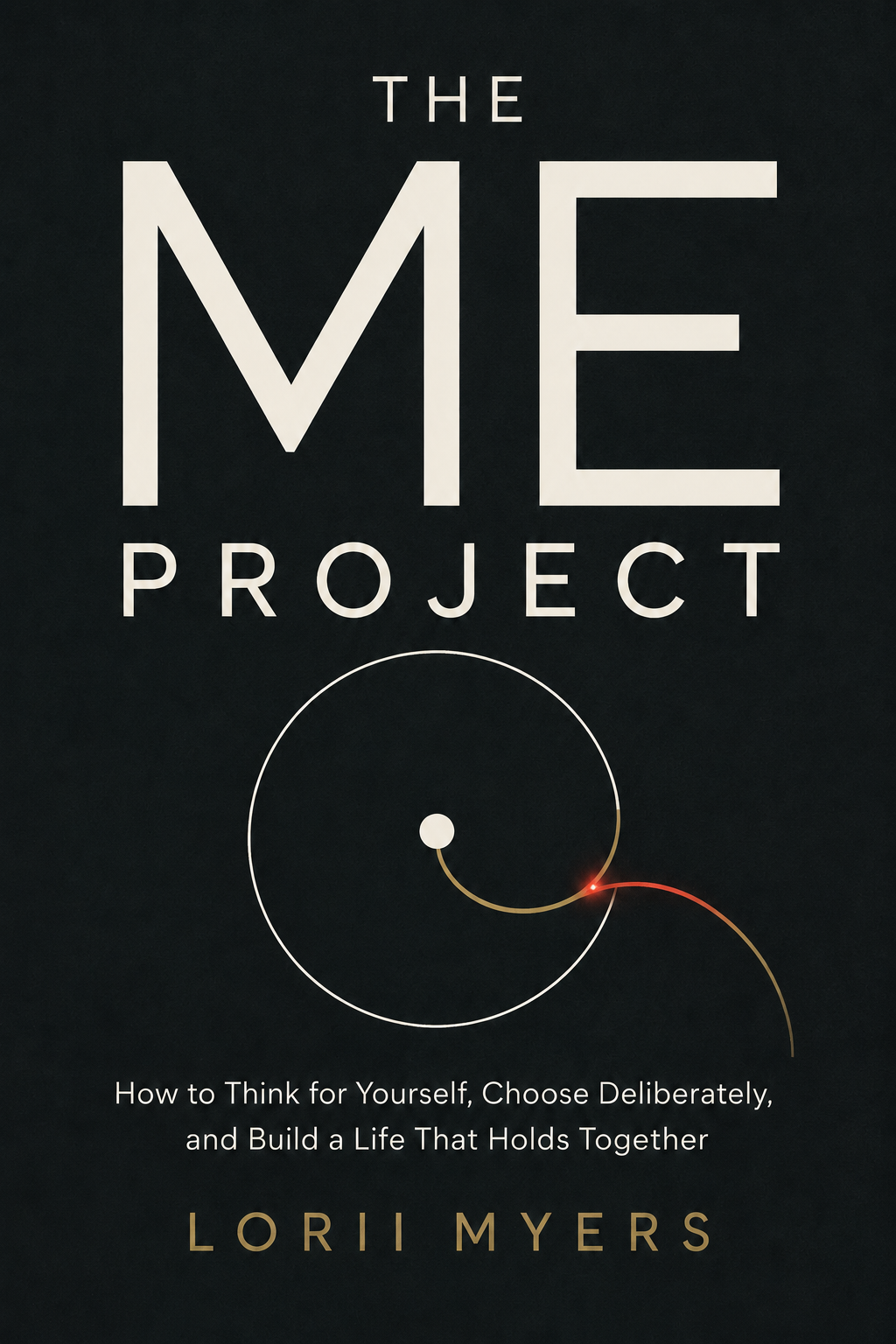
Lorii Myers builds a practical philosophy of self-governance from a simple image: a nucleus inside a track that becomes a spiral. The nucleus is the examinable self—the part able to authorize, refuse, promise, and repair. The track contains real conditions: obligations, relationships, systems, limits, and consequences. A trigger creates a trajectory; every trajectory leaves an echo and returns as evidence.
At the centre is Driven Intention—the disciplined conversion of inner authority into chosen direction. Permission opens the gate. Discernment tests the direction. Action makes the choice observable. Responsibility governs what follows.
Across five movements—Nucleus, Track, Trigger, Trajectory, and Echo—the book reveals how to uncover inherited operating rules, interrupt automatic reactions, make commitments that can be carried, and use consequence to guide repair and revision. It also confronts the limits of personal power: expertise, consent, unequal conditions, irreversible effects, and the agency of others.
Ultimately, self-governance extends beyond the self. Our conduct becomes part of the conditions other people must navigate.
This is not a promise of total control or a finished self. It is a method of return.
Begin with yourself. Do not end there.
READ THE OPENING SAMPLE
Presented from an author-approved author-review edition.
Prologue
I’d become the person everyone could rely on. I was less certain the life they relied on was one I’d chosen.
The calendar was full. I’d made the promises. Everyone knew I’d answer. I knew how to say yes, avoid disappointment, and keep the peace. I carried what was mine, and often what other people quietly left behind.
Then a question arrived that I could no longer avoid:
How much of this life did I actually choose?
The earlier title for this confrontation was blunter: Wake Up Already. I didn’t mean wake up to a superior version of yourself. I meant wake up inside the life that’s already answering for you. Notice what receives your yes before you arrive. Notice what your competence keeps alive. Notice where your own voice has become hardest to hear.
That question was not selfish. It was the beginning of responsibility.
I was doodling one day—a simple circle held within a larger one. Like a yolk resting inside the white of an egg, it sat perfectly in place.
As I lingered over it, the smaller circle became a nucleus and the larger one a track: the person at the centre of a life already in motion.
In the first draft, I called the signal at that centre an inner rhythm. I still value the phrase—not as a mystical frequency or an infallible instinct, but as the recognizable cadence of a life whose stated values and repeated choices are beginning to agree. Inner rhythm is what coherence feels like before it becomes visible in conduct.
The small circle did not make the person more important than everyone else. It marked the one place from which their own conduct could no longer be outsourced. Someone still answered the message, accepted the request, spent the money, postponed the work, kept the promise, or broke it. Even passivity entered the course. Even refusing to decide helped the existing arrangement continue.
The centre was not a throne. It was a location of answerability.
The larger circle stopped the idea from becoming cruel. No one stands at the centre of conditions they created alone. The track includes other people, obligations, health, history, institutions, culture, resources, chance, unequal power, and choices that belong to someone else. It includes what can be changed directly, what requires help or collective action, and what cannot presently be controlled.
Ignore the track and responsibility becomes fantasy: every constraint is recast as a failure of attitude. Ignore the centre and responsibility disappears in the opposite direction: the system explains everything while the person’s remaining authority goes unused.
The drawing held both truths on the same page. There is a centre from which attention, judgment, commitment, action, and repair can begin. There is a surrounding course that shapes what is available, costly, rewarded, punished, repeated, and possible. The centre affects the course. The course returns evidence to the centre.
That relationship is where agency becomes credible.
Competence can hide the need for such a review. A capable person becomes skilled at keeping the track moving. They solve, anticipate, accommodate, produce, protect, and continue. Their ability is real. So are the duties and pressures that ability serves.
Yet a functioning system can conceal a missing decision. A person can become exceptionally effective inside an arrangement they never examined. They maintain a role because they perform it well, preserve a commitment because others depend on it, or keep solving the same class of problem because being the solver has become the safest place to stand. The track looks productive. The centre has not been asked whether the course still deserves to continue.
Some tracks are enforced. A person may be choosing among constrained options, protecting safety, meeting care obligations, or preserving income. The question cannot turn every hard pattern into a mindset problem. It must begin with the facts.
But a system that produces acceptable results often escapes the review a breakdown would force. Praise can give repetition moral authority. Reliability can become automatic availability. Loyalty can become indefinite consent. Motion can begin to resemble direction simply because time and effort have been spent.
A circle returns to the same point. That can represent stability. It can also represent repetition without revision.
The image changed into a spiral.
The spiral did not promise ascent. A life does not improve merely because it moves. A spiral can widen, tighten, repeat, or carry error farther. Its value was simpler: a return need not be identical. The centre could enter the course. The course could return evidence. The next turn could begin with more truth than the last one.
That is the beginning of this project.
The ME Project is not about selfishness. It is about responsibility. It begins at the centre because that is where a person can examine what they are authorizing. It refuses to end there because every action enters conditions other people must navigate.
The first awakening is personal and unsentimental: My life will not move until I move. The next awakening is equally important: my movement is never mine alone to absorb.
A clearer centre that creates more damage is not a successful project. A stronger will that cannot receive correction has only become more efficient at protecting its own error.
The work is to see what is operating, decide what remains authorized, act within real conditions, and let consequence revise the next decision.
The self is the first responsibility, not the final destination.
Introduction
A life can work and still be running on instructions no one has reviewed.
The person meets deadlines, answers when needed, carries responsibilities, and keeps a complicated schedule moving. Their decisions are often competent. From the outside, the pattern looks deliberate.
Beneath it, several rules may be deciding first. Urgency receives attention before importance. Agreement is offered before cost is counted. Rest is permitted only after every visible demand has been satisfied. A change of mind is treated as weakness. Being needed settles whether a responsibility is truly theirs.
No single rule has to destroy the life in order to govern it. The cost may appear as narrowing: less room to think, more commitments maintained because they are already in motion, and a growing distance between the values the person names and the system their conduct keeps proving.
This is the contradiction at the centre of the book. A life can be functional and insufficiently examined. It can look chosen while being carried by instructions that received their authority from repetition, reward, fear, family, culture, role, or an earlier condition that no longer exists.
The project is already underway because repeated conduct is already creating direction.
The word project can suggest a temporary effort with a finish line. It can also suggest that the self is defective material awaiting improvement. Neither meaning governs this book.
A project is a disciplined field of attention. It can be observed, tested, revised, and carried forward. It has working assumptions rather than sacred conclusions. It produces evidence. It can absorb correction without declaring the whole person a failure.
That working distance matters. When identity and system are fused, a criticism of the system can feel like a verdict on the self. If a schedule fails, the person becomes unreliable. If a boundary is poorly designed, the person becomes weak. If a decision causes harm, the person must either become wholly bad or defend the decision as wholly right. Protecting the identity prevents useful diagnosis.
A project permits a more accurate sentence: This rule is producing a cost. I am responsible for examining it, but it is not the whole account of who I am.
The distance does not remove ownership. A project has an owner, and ownership includes the duty to look honestly at results.
Systems language has limits. A person cannot be reduced to inputs, routines, decisions, and outputs. Human life includes embodiment, relationship, culture, grief, humour, attachment, imagination, contradiction, and experiences no operating metaphor can contain. The metaphor is useful only while it makes repeated conduct easier to see. When it flattens the person, it has exceeded its authority.
Self-governance is the practice of examining and directing one’s participation within real conditions.
It is a practice, not a trait possessed by a superior kind of person. No one governs themselves completely. We act under pressure, miss facts, inherit duties, depend on others, and sometimes discover our governing reason only after conduct exposes it.
It involves examining because preference alone cannot establish what deserves authority. A desire can be worthy, reactive, borrowed, impossible under present conditions, or costly in ways not yet counted. Examination asks about source, evidence, incentive, constraint, and foreseeable effect.
It involves directing because reflection that never changes conduct can become sophisticated delay. Governance eventually appears in what is chosen, refused, resourced, repeated, corrected, or released.
It concerns one’s participation rather than command of the entire situation. Other people retain their agency. Institutions and material conditions can narrow the available range. Chance remains. Self-governance cannot guarantee the result; it can make a person’s contribution more deliberate and more answerable.
And it occurs within real conditions. Any method requiring an imaginary person with unlimited time, stable health, equal power, abundant money, no care responsibilities, and no risk has not governed the life that exists.
Self-governance can include asking for help, relying on qualified expertise, negotiating support, joining collective action, and recognizing when a problem cannot be solved at the personal scale. Autonomy is not isolation. A choice can be deeply relational and still be examined and self-endorsed.
Inner authority is examined judgment that remains open to evidence and consequence.
It is not certainty, confidence, opposition, or refusal of influence. A person can exercise inner authority by accepting another person’s better argument. They can surrender it while loudly insisting on independence.
Authority becomes trustworthy when it can answer four questions: What supports this judgment? What might I be missing? What cost will the decision create? What evidence would require revision?
The gap between examined judgment and lived direction is where this book’s signature discipline begins.
Driven Intention is the disciplined conversion of inner authority into chosen direction.
Permission opens the gate. Discernment selects the direction. Action proves the choice. Responsibility governs its consequences.
Permission matters because a person can gather sufficient evidence and still wait for someone else to authorize a decision that is legitimately theirs. Self-permission ends that transfer of authorship. It does not make the decision wise, erase another person’s consent, or manufacture the resources required to carry it.
Discernment tests desire against evidence, duty, capacity, cost, and the strongest credible alternative. Action gives the choice an observable form. Responsibility remains after the energy of deciding has passed: it counts effects, receives correction, repairs where possible, and revises the next turn.
This is why intention alone is too generous a measure. Effort proves expenditure. It does not prove authorship, accuracy, or worth. Driven Intention asks whether the effort has a governing reason, a credible route, and a responsibility that survives the launch.
It makes no promise that a worthy aim will succeed. Conditions can change. Other people can refuse. Resources can disappear. A careful decision can meet an outcome no one could reasonably have predicted. Direction is not destiny.
The book follows five movements rather than a staircase of self-improvement.
Nucleus locates the centre of answerability. What is mine to govern, influence, share, or witness? Which judgment am I authorizing, and on what evidence?
Track examines what carries the pattern. Which admissions, allocations, limits, incentives, and repeated conditions make one direction easier to continue than to reconsider?
Trigger reopens the compressed moment before action. What happened? What activation and interpretation followed? What is the first response trying to solve?
Trajectory turns decision into observable direction. What problem is the action aimed at? What result will count as evidence? How will the course be corrected or repaired?
Echo accounts for what conduct leaves beyond the chooser. What became easier, harder, safer, riskier, clearer, or more confused for someone else—and what must that effect teach the next decision?
The movements are not stages completed once. They are positions in a living review. The nucleus enters the track. The track meets a trigger. The trigger becomes a trajectory. The trajectory leaves an echo. The echo returns as evidence to the nucleus.
Driven Intention governs the movement among them.
The supporting questions and practices in the chapters are subordinate to this route. They are not personality tests, diagnoses, or rituals of self-surveillance. Use the lightest tool that reveals the next responsible decision. Serious consequences deserve deeper review. Ordinary choices should remain ordinary.
This is not a general theory of identity, reinvention, productivity, or technological possibility. Its territory is narrower and more practical: the operating governance of participation.
It asks how a person examines a rule, allocates attention and capacity, chooses under pressure, turns a decision into action, tests the result, repairs a breach, and accounts for downstream effects. Identity matters only when it changes what the system admits, repeats, funds, or protects. Possibility matters only when it becomes a decision with a cost and a consequence.
The book also refuses two flattering extremes. Total control ignores real constraint and shared agency. Total helplessness can conceal the authority that remains. The honest share varies by situation. Sometimes it is considerable. Sometimes it is painfully narrow. Accuracy matters more than grandeur.
The ME Project is applied philosophy. Research enters where it tests a claim, sharpens a distinction, or prevents an overreach. A laboratory task is not a whole life. A group average is not an individual diagnosis. Correlation does not establish cause. The source identifiers in the text connect research-dependent claims to the register at the back of the book, where scope and limitations remain visible.
Unless a passage is explicitly identified as personal or sourced, unnamed situations are illustrative. They make a consequence concrete; they are not disguised client stories, interviews, or reported events. No invented dialogue is presented as memory.
The reader’s task is not agreement. It is examination without self-prosecution.
An inherited or repeated rule may have been an intelligent response to earlier conditions. Its history deserves understanding. Its present authority still deserves review.
Inner authority remains yours to exercise, but ownership does not make it correct. Evidence, expertise, feedback, consent, and consequence retain the right to challenge it.
Compassion does not remove accountability. Understanding why conduct occurred does not erase what the conduct placed on others. Repair can be owed even when harm was unintended, and repair cannot guarantee forgiveness, renewed access, or restored trust.
In return, the book owes proportion. It will distinguish metaphor from mechanism, keep its claims within their evidence, and refuse to turn a complicated life into a slogan.
The recurring question is smaller than Who should I become?
What system is already operating—and what direction am I willing to authorize now?
Part I - Nucleus
The centre is not a throne. It is the first place from which responsibility can no longer be outsourced.
Nucleus is not a search for a truer identity. It locates the rule, authority, and permission from which a decision is being made.
Chapter 1 - The ME That Moves the World
Before breakfast, a message arrives that needs an answer. A schedule changes. Someone asks for help. A problem that should have been settled yesterday returns wearing a new name. By nine o’clock, the person has adjusted, reassured, solved, postponed, agreed, and moved three other people’s work forward. Nothing about the morning looks passive. In fact, it looks impressively managed.
Yet one question has not been asked: What direction is all this competence creating?
The contradiction is common. A person can be highly active while remaining strangely absent from the authorship of their life. They make decisions all day, but most of those decisions are local responses to conditions already in motion. They are central to everyone else’s operations and peripheral to their own. The track is busy. The nucleus has not been consulted.
This is why the circle on the page matters.
The drawing introduced in the Prologue began as a simple arrangement: a smaller circle inside a larger one, a nucleus held within a track. Its value is not that it explains a human life completely. No drawing could. Its value is that it places two truths beside each other.
There is a centre from which a person can examine, judge, authorize, commit, act, and repair. There are also conditions that no person created alone and cannot command alone: history, family, culture, material limits, health, institutions, luck, timing, and the independent choices of other people.
A credible account of agency requires both circles.
Leave out the track and the philosophy becomes fantasy. It suggests that anyone can think, intend, or discipline their way past every constraint. Leave out the nucleus and the philosophy becomes surrender. It treats the self as a place where things happen but from which nothing meaningful can begin.
The ME Project starts in the tension between those errors.
Many people hesitate at the language of self-centering for good reason. We’ve seen what happens when a person treats their own appetite as the measure of every consequence. They take up all the moral space in the room. Other people become instruments, obstacles, audiences, or collateral damage. The word me begins to sound like permission without limit.
That is not the centre this book defends.
To place yourself at the centre of responsibility is different from placing yourself above everyone else in importance. The first identifies the location from which your conduct can be governed. The second creates a ranking in which other lives count less. One is an operating fact. The other is a moral failure.
You already occupy the centre of your own perception and action. No one else can examine a belief for you in the moment it becomes obedience. No one else can make your promise credible, interrupt your reflex, confess your error, or perform your repair. Other people can advise, constrain, persuade, support, teach, and challenge. They may possess knowledge you don’t. They may see a danger you can’t yet see. Their influence can be decisive. Still, the point at which influence becomes your conduct is yours to examine.
That is not supremacy. It is answerability.
The distinction changes the moral meaning of the project. If the self is centred for gratification, the world is asked to orbit it. If the self is centred for governance, the person becomes responsible for what their orbit places into the world.
Putting yourself at the centre is not selfish when the centre accepts responsibility for every direction it creates.
The claim is demanding because it removes two familiar shelters at once. It does not allow the grandiose shelter of total control: Everything is mine to determine. It does not allow the convenient shelter of total passivity: Nothing is really mine. It asks for a more exact account.
Imagine receiving a decision that affects your future but was made without your consent. Perhaps a policy changes, a contract ends, a family obligation appears, or a physical limitation narrows what the next month can hold. The facts are not yours to revise by attitude. Any philosophy that responds with choose differently before acknowledging the loss has confused agency with denial.
But the presence of constraint does not settle every question that follows. There may still be an interpretation to test, a response to choose, an appeal to make, a boundary to set, a resource to seek, a harm to contain, or a new condition to design. The available authority may be large or very small. Small authority is not imaginary authority.
Skinner’s review of control constructs (1996) distinguishes objective control from a person’s belief that control exists, and separates agents, means, and outcomes that ordinary language often collapses. Bandura’s account of agency (2001) likewise includes direct, proxy, and collective action while locating all three inside social conditions. The evidence does not promise that identifying a controllable element will produce a desired result. It supports the narrower discipline of distinguishing what can be attempted directly, what requires others, and what is not presently controllable.
This is where responsibility becomes precise. It begins by refusing exaggerated claims in either direction.
Some matters are mine to govern. These include the promises I make, the evidence standards I use, the attention I assign where I have discretion, the meaning I endorse after examination, and the conduct I choose among genuinely available options.
Some matters are mine to influence but not command. A proposal, a relationship, a team decision, a public conversation, or a family pattern may change partly because of what I contribute. My influence can be real without being sovereign. The outcome remains shared.
Some matters are mine to witness. Another person’s choice, an irreversible loss, a larger injustice, or an event beyond my reach may demand attention, grief, testimony, adaptation, or solidarity without yielding to my will. Witness is not always passivity. It can be the most truthful refusal to pretend that control exists where it does not.
Confusing these categories creates predictable forms of damage. We try to govern what can only be influenced and become controlling. We treat what can be governed as merely observable and become evasive. We confuse witness with indifference, or influence with entitlement. We spend enormous effort in the wrong jurisdiction.
The circle needs a boundary, not because responsibility should be small, but because responsibility should be accurate.
Supporting lens — The Circle Test
The first mechanism in The ME Project is deliberately simple. When a situation feels total—when everything seems urgent, personal, and entangled—divide it into three fields:
Mine to govern. What decision, standard, commitment, response, or repair belongs directly to me?
Mine to influence. Where can my words, conduct, evidence, presence, or refusal affect what happens without determining it?
Mine to witness. What must I acknowledge, endure, learn from, document, grieve, or respond around without pretending it’s mine to control?
This is not a sorting exercise designed to make difficulty disappear. It often makes difficulty more visible. A person may discover that the one thing they can govern is also the thing they have avoided: the honest answer, the withdrawal of an unreliable promise, the admission that a plan has failed, the request for help, the first repair.
The test also prevents action from becoming self-flattery. We can mistake interference for care because influence feels too uncertain. We can call domination leadership because shared outcomes make us anxious. We can declare that something is “not mine” when what we mean is that the cost of responding is inconvenient.
Every category therefore needs an evidence question.
What makes this mine to govern? What limits my influence? What does responsible witness require?
The categories can change. A circumstance that was once only witnessed may become influenceable when new information, allies, authority, or resources appear. Something we thought we governed may prove dependent on another person’s consent. Accuracy requires review.
This is why the project is ongoing. Governance is not a single claim of power. It is the repeated work of locating responsibility honestly.
Any idea about personal authority contains a losing condition. This one is no exception.
The language of authorship can become a way of denying dependence. No one writes a life alone. Language, opportunity, care, knowledge, infrastructure, and culture arrive through other people. Even resistance is shaped by what it resists. Independent thought does not mean independent existence.
Self-authorship can also become retrospective cruelty. Looking back, a person may judge an earlier decision using information, capacity, safety, or freedom they did not possess at the time. Responsibility requires truth, but truth includes the conditions under which a choice was made. The point is to recover authorship where it exists, not invent guilt where it does not.
And the centre can become obsessed with itself. Endless examination may look responsible while functioning as avoidance. A person can become so interested in the purity of their motives that they fail to do the ordinary work their values require. The self becomes a permanent construction site closed to the public.
The safeguard is consequence.
If a philosophy of inner authority makes other people less visible, less safe, or less real, it has failed its own test. If it treats every limit as an insult, every disagreement as interference, or every desire as an unquestionable instruction, it is not governance. It is appetite equipped with better language.
The nucleus earns its place by becoming more answerable, not less.
In that morning, the person who has spent hours responding competently does not need to condemn the work already done. Some of it is necessary; some is generous, skilled, and important. The first act of governance is an accurate distinction, not a dramatic refusal.
Which response was mine to govern? Which demand could I influence? Which condition did I have to witness? Which agreement assigned future resources without examination? Which direction did the morning reinforce?
The answers may not transform the day at once. They do something more foundational: they restore the centre as a place of review.
From there, action can become deliberate. A request receives a later answer instead of an automatic yes. A recurring problem is examined as a system rather than solved again at the surface. A constraint is named without being moralized. A responsibility is accepted without expanding into total control. The track begins to reveal how it was built.
This is the movement from self-awareness to self-governance. Awareness notices what is happening. Governance identifies the authority, limit, and consequence inside it.
The ME that moves the world is not the loudest self in the room. It is the self willing to give an honest account of what begins there and what travels outward.
The language of responsibility can be heard as accusation, especially by people already carrying too much. If the self is placed at the centre, does every painful outcome become evidence of a private failure?
No. Blame asks who deserves condemnation. Responsibility asks who can answer, act, repair, or tell the truth about what happened. The questions sometimes meet, but they are not identical.
A person can be responsible for responding to harm they did not cause. They can be responsible for a role without being morally guilty for every result produced by the larger system. They can contribute to an outcome without controlling it. They can cause damage without intending it and still owe a repair. They can intend good and remain responsible for foreseeable effects.
The Circle Test becomes more accurate when it separates four forms of responsibility.
Causal responsibility: What did my action or omission help produce?
Role responsibility: What duty came with the position, promise, or authority I accepted?
Response responsibility: Given what is now true, what action belongs to me even if I didn’t create the condition?
Repair responsibility: What consequence can I address, reduce, restore, or prevent from recurring?
The categories prevent a common evasion: I didn’t mean it, so it isn’t mine. Intention matters, but it’s only one part of the account. They also prevent a common cruelty: You’re dealing with it, so you must have caused it. Response responsibility doesn’t transfer authorship of the harm.
This distinction is especially important when power is unequal. The person with the least control is often required to perform the most adaptation. Calling that adaptation “taking responsibility” can hide who created and benefits from the condition. An accurate account keeps the causes, roles, available responses, and repair duties separate.
The self at the centre is not asked to accept every burden. It is asked to name burdens truthfully.
The Circle Test should not make individual action the only honourable form of agency. Some problems exceed private capacity by their nature. Expertise, advocacy, institutions, community, and coordinated action may be the appropriate means.
Asking for help can therefore be an exercise of agency rather than evidence that agency has failed. So can delegating to someone with the right competence, joining with others who share the consequence, or relying on a trusted process when one’s own knowledge is incomplete.
The centre remains responsible for choosing the relationship to that help. It does not need to perform every part of the solution.
This enlarges the meaning of the spiral. Direction moves outward not only as personal influence but as participation in shared work. The ME Project begins with the self because that is where authorization becomes visible. It does not end with the solitary self attempting to move a world that was never solitary.
Shared agency creates a problem that private moral language handles badly. When several people, roles, or institutions contribute to an outcome, responsibility is rarely divided into equal pieces. It may not even be divided along one line. One party may have designed the conditions, another may hold formal authority, another may carry the practical knowledge, and another may live with most of the consequence.
Blame tends to compress this arrangement. It searches for one person who can stand in for the whole explanation. Self-blame performs the same compression inward: if I can locate the failure entirely in myself, the situation may feel painful but at least controllable. Both versions purchase simplicity by falsifying the distribution.
An accurate share is neither the smallest burden a person can defend nor the largest burden they can survive. It is the portion justified by cause, role, available authority, knowledge, and consequence. Those factors may point in different directions. A person with little causal involvement may have substantial repair responsibility because their role gives them the means to act. A person who contributed directly may still lack the authority to repair alone. Someone carrying the consequence may have a necessary voice in the response without becoming responsible for producing the condition.
This is why collective work needs more than the language of everyone doing their part. The phrase can conceal unequal parts, invisible labour, or the quiet transfer of accountability to whoever is most conscientious. Shared agency becomes credible only when the account can name who decides, who contributes, who benefits, who bears the cost, and who can revise the arrangement.
The centre remains important inside that complexity. It asks: What is my accurate share, and what would I be claiming if I took more or less? Taking too little may be evasion. Taking too much may displace another person’s authority, protect a failing institution from scrutiny, or turn helpfulness into control.
Solidarity offers a better image than rescue. Rescue makes one person the active centre of another person’s problem. Solidarity allows distinct centres to coordinate around a consequence none may be able to address alone. The work can include leadership, expertise, support, refusal, testimony, and care without pretending that all participants hold the same power or owe the same act.
Bounded responsibility therefore does not shrink moral seriousness. It makes seriousness assignable. Blame asks for a target. Responsibility asks for an accurate account and a credible next move. Shared agency begins when causes, duties, and next moves are allowed to remain plural and explicit.
The original circle placed wants, needs, and desires at the nucleus. That does not make them interchangeable.
A need may carry urgency because health, safety, dignity, or basic functioning depends on it. A want may express pleasure, preference, ambition, or possibility. Desire may reveal attraction toward a future, relief from the present, appetite for recognition, or the wish to escape a limit. Each can supply important information.
None becomes a governing instruction merely by being mine.
The responsible centre receives desire as a claim to examine. What does it ask for? What value does it express? What would fulfilling it require from the self and from others? What competing claim would it displace? Does the desire persist when its imagined audience is removed? Does it expand the life’s capacity for responsibility or demand exemption from it?
This protects the project from two errors. The first treats desire as dangerous and assumes maturity means suppressing it. The second treats desire as truth and assumes self-honesty means obeying it. Both avoid judgment.
Desire can be cultivated, redirected, deferred, declined, or chosen. It may point toward a life that has been unnecessarily denied. It may also point toward relief that creates a larger cost. The centre’s task is not to become desireless. It is to prevent desire from serving as its own evidence.
The same is true of need. People can misname preferences as needs to strengthen a claim, or minimize genuine needs to appear undemanding. Accurate self-governance refuses both inflation and erasure.
The nucleus is not a chamber in which every inner voice agrees. It is the place where those voices become answerable to a decision.
Intention alone is too generous a measure. Most people can identify worthy intentions. Fewer can show the conditions that carry those intentions when the day becomes crowded, the cost becomes visible, or approval moves in the opposite direction.
Driven Intention closes that gap.
It is the disciplined conversion of inner authority into chosen direction. Each word matters.
Disciplined means the choice is not protected from evidence, cost, repetition, or repair. It must survive more than a moment of conviction.
Conversion begins when self-permission changes an internal claim into an external arrangement. Time is assigned. An almost is refused. A limit becomes visible. A first move occurs. A review is scheduled. Something changes in what the system permits.
Inner authority means the judgment has been examined rather than borrowed blindly, performed for approval, or mistaken for infallibility.
Chosen direction means the movement is answerable to a governing reason. It is not merely fast, emotionally satisfying, or rewarded.
The framework does not glorify intensity. A quiet correction can be more driven than a dramatic declaration. A person who revises a promise after discovering that it cannot be kept may show more integrity than one who forces completion to preserve an image of determination. Direction is proved by the pattern created, not the volume of the launch.
This distinction matters because modern life offers abundant movement. Messages are answered. Lists are completed. Opinions are issued. New plans are announced. The system can produce so much motion that its direction escapes inspection.
The nucleus asks a different question: What is this movement building?
What is mine to govern now, and what remains shared, constrained, or outside my control?
THE FINAL PROVOCATION
The author-review manuscript is available for qualified professional review. Evidence review, title and market clearance, human copyediting and final proof remain before publication.
SELECTED WORDS FROM THE MANUSCRIPT
Approved quotations by Lorii Myers, selected to accompany this manuscript’s public blurb and synopsis.
“Focus offers a different freedom: not freedom from limits, but freedom from making every option equal.”