Difference becomes rank
A specific distinction in role, skill, responsibility or achievement begins carrying greater human weight.
 LAMBO-MUSICARTIST · AUTHOR · LICENSING
LAMBO PUBLISHING · BIG-IDEA NONFICTION · LORII MYERS
Why We Keep Rebuilding the Systems We Say We Want to Escape
Hierarchy is easiest to recognize when it presses down on us. It becomes harder to see when it begins protecting us.
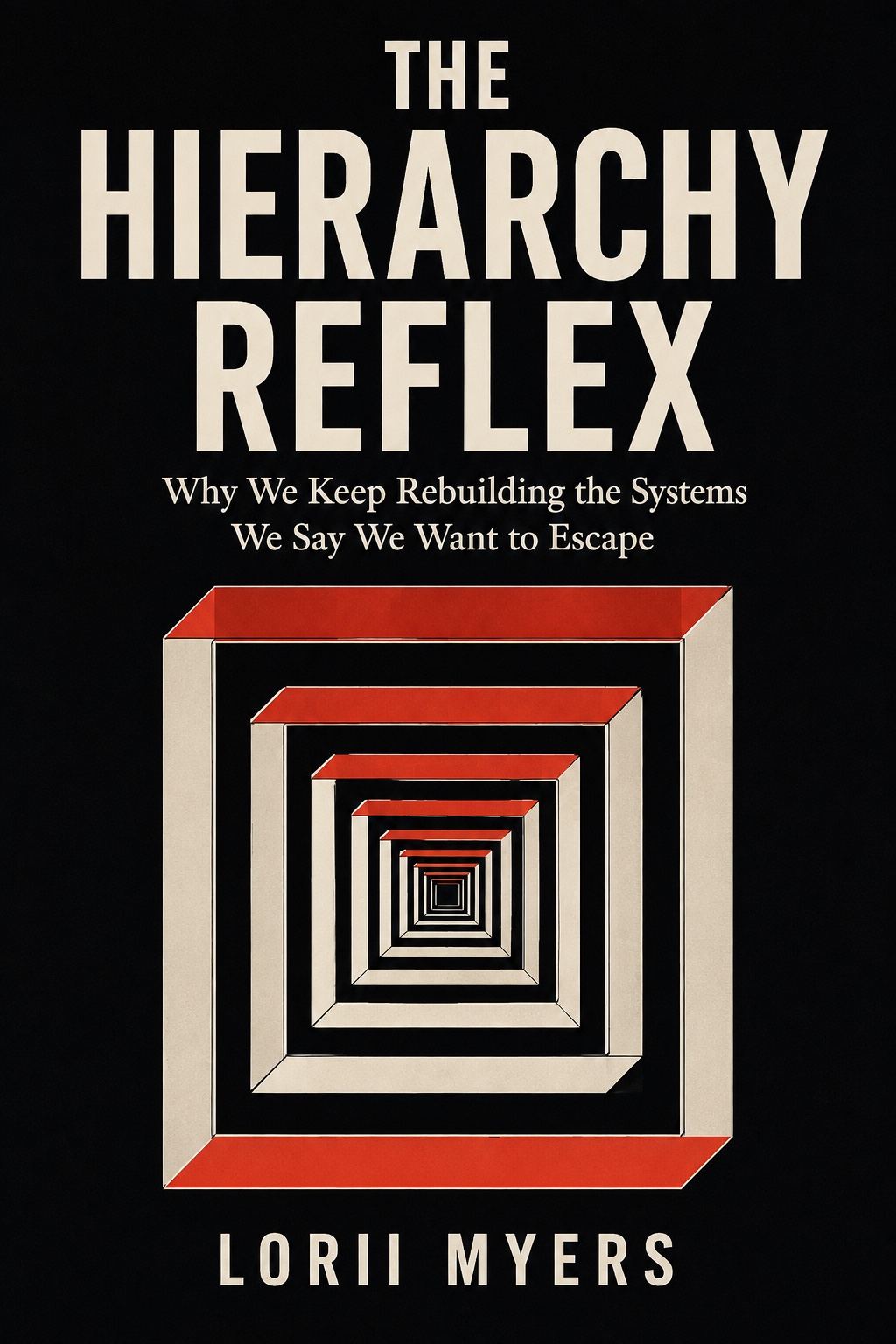
THE CENTRAL PROPOSITION
The problem is not difference itself. Organized life needs expertise, leadership, standards, boundaries and consequence. The reflex begins when a legitimate difference escapes its purpose and becomes a verdict about the whole person.
A specific distinction in role, skill, responsibility or achievement begins carrying greater human weight.
Position changes who may interrupt, decide, fail, demand explanation—or expect another person to absorb the cost.
Harm is contained without revising the system, allowing hierarchy to return through new occupants and better language.
THE GOVERNING SEQUENCE
The six-stage framework follows hierarchy from an ordinary distinction to the conditions that allow it to reconstruct itself.
THE READING EXPERIENCE
Difference, comparison, rank and the moment position begins generating permission.
Systems without villains, inherited advantages, denial and rebellion that rebuilds the throne.
Families, workplaces, belonging and good causes where function quietly becomes human rank.
The Permission Audit, accountable authority, room redesign and dignity without sameness.
OFFICIAL BLURB
We recognize hierarchy when it presses down on us. We are slower to see it when it begins protecting us.
Expertise becomes exemption. Responsibility becomes ownership. Belonging becomes a gate. Moral certainty becomes permission. The occupants change. The ladder returns.
The Hierarchy Reflex reveals the sequence beneath that return:
Difference → Rank → Permission → Harm → Denial → Reconstruction.
Across families, workplaces, institutions, communities, and reform movements, Lorii Myers shows how hierarchy can survive without a villain—and why changing who holds power rarely changes the permissions attached to it.
This is not an argument against leadership, standards, expertise, or consequence. It draws a sharper line: function may differ; human worth does not.
Escaping a system that diminished us is only the beginning.
The harder test is whether we can stop rebuilding it for someone else.
SYNOPSIS
Hierarchy is easiest to recognize when it presses down on us. It becomes harder to see when it begins protecting us—or when those who opposed it inherit its permissions.
In The Hierarchy Reflex, Lorii Myers examines how legitimate differences in expertise, responsibility, achievement, and authority become rankings of human worth. The book traces that conversion through an original six-stage framework: Difference → Rank → Permission → Harm → Denial → Reconstruction.
At the centre of the sequence is permission: what position allows one person to do, what it requires another to tolerate, and what the surrounding room agrees not to question. Expertise becomes exemption. Responsibility becomes ownership. Belonging becomes a gate. Moral certainty becomes permission.
Hierarchy does not require a single villain. It can emerge through ordinary people following reasonable rules, protecting valued contributors, preserving familiar systems, or performing only one small part of a harmful sequence. Its benefits are easily mistaken for normality, while its costs disappear into the lives of those expected to wait, adapt, explain, or remain silent.
Even resistance can reproduce the structure it opposes. A leader is removed, an excluded group gains entry, or power changes hands—yet the permissions attached to position remain. Denial then completes the cycle by acknowledging harm without allowing it to change the system. The occupants change. The ladder returns.
Moving through families, workplaces, communities, institutions, and good causes, Myers shows how care becomes ownership, value purchases protection, belonging requires an outsider, and moral clarity becomes moral rank.
The book's final section turns from recognition to redesign. It separates function from worth, protects expertise without making experts unquestionable, and preserves standards and accountability without humiliation. Its Permission Audit helps readers identify the difference being noticed, the rank assigned, the permission granted, the person carrying the consequence, and the condition allowing the structure to return.
The Hierarchy Reflex is not an argument against leadership, excellence, boundaries, or consequence. It is an argument for keeping each within its legitimate reach.
Escaping a system that diminished us is only the beginning.
The harder test is whether we can stop rebuilding it for someone else.
READ THE OPENING SAMPLE
Presented from an author-approved author-review edition.
We recognize hierarchy when it presses down on us. We’re slower to see it when it begins protecting us.
From below, its architecture is obvious. Someone else speaks first, decides more, receives the benefit of the doubt, survives mistakes that would disqualify us, and calls the arrangement natural. We see the ladder because we’re carrying its weight.
From above, hierarchy often disappears into ordinary language: experience, standards, efficiency, tradition, fit, common sense. We stop seeing an arrangement and begin seeing reality.
That blind spot helps hierarchy survive exposure. More unsettling, people who reject a particular hierarchy may preserve the reflex that created it.
We remove one gatekeeper and appoint another. We dismantle an old inner circle and create a more morally impressive one. We reject reducing people to categories while sorting them into the enlightened and the irredeemable. We challenge power that refuses scrutiny, then call scrutiny disloyal when the power becomes ours.
The occupants change. The ladder returns.
This book begins inside that return.
This is not an argument that every hierarchy is identical or every structure a form of domination. A surgeon and a patient do not enter an operating room with interchangeable responsibilities. A pilot and a passenger do not hold equal authority over a flight. Parents carry duties young children do not. Teams may need leaders. Expertise is real. Experience matters. Accountability sometimes requires someone to decide.
Difference is not the problem.
The problem begins when a difference in function becomes a difference in worth. A role becomes a rank; the rank grants permissions unrelated to the role that created it. Expertise becomes exemption. Responsibility becomes ownership. Belonging becomes a gate. Moral certainty becomes permission. Money becomes credibility. Popularity becomes innocence. Need becomes a reason to remove someone’s authority over their own life.
That conversion is the hierarchy reflex.
The reflex needs no secret meeting or single villain. It can move through ordinary people following ordinary incentives: policies designed for consistency, families organized around care, workplaces committed to performance, communities protecting belonging, and movements resisting injustice. It may be deliberate or emerge without announcement.
This is why good intentions are not enough to prevent it.
A hierarchy of human worth does not become harmless because its architects believe themselves kind. Nor does every unequal outcome prove such a hierarchy caused it. The work is more exacting than accusation: identify the difference, the rank attached to it, the permission that followed, the harm someone carried, the denial that blocked correction, and the conditions that allowed reconstruction.
The full sequence is:
Difference → Rank → Permission → Harm → Denial → Reconstruction
Not every difference becomes rank. Not every rank creates harmful permission. Not every unequal result is unjust. Each arrow must be examined rather than assumed.
The arrows describe a logic, not a stopwatch. In life, stages can overlap, repeat, or become visible out of order. Denial may begin while harm is still unfolding; reconstruction may start before reform is complete. The sequence is useful because it reveals what each move makes possible, not because every room follows a perfect timetable.
That discipline matters because a framework for exposing hierarchy can become hierarchical when it places its users above investigation. The purpose is to make the reflex harder for any of us to hide—especially when it is serving us.
The most consequential moment in the sequence is often permission.
Hierarchy becomes dangerous through what standing higher allows someone to do, what standing lower requires someone else to tolerate, and what the surrounding room agrees not to question.
An executive’s anger is renamed passion while another person’s is called instability. A parent’s responsibility expands into ownership of an adult child’s choices. An expert treats disagreement as proof that someone else is unqualified to speak. An admired contributor’s value purchases insulation from the harm they cause.
These are permission problems.
This is why removing a title, changing a rule, or replacing a leader may not be enough. If rank still purchases exemption, the next person at the top inherits the same bargain. If belonging still requires someone beneath us, welcoming one outsider merely creates another.
The structure reconstructs itself because its operating logic was never retired.
The chapters ahead follow that logic: first through the reflex itself, then through reconstruction, the ordinary rooms where it hides, and the work of separating function from worth.
The goal is not a world without leadership, standards, excellence, consequence, or distinction. It is a world in which none of them becomes proof that one person is more human than another.
Escaping a structure that diminished us is only the beginning.
The harder test is whether we can stop rebuilding it for someone else.
PART I — THE REFLEX
The meeting hasn’t officially begun, but the room is already arranging itself.
One person takes the chair at the head of the table without checking whether anyone else intended to sit there. Another sets down a notebook and waits to be asked to speak. The twenty-year employee is greeted by name. The newest person receives a quick smile and no question. Before an idea is offered, the room has begun assigning weight.
Some of that arrangement may be practical. Someone called the meeting. Someone carries responsibility for the decision. Someone has knowledge the others do not. A room without roles can become a room without movement.
But practicality does not explain everything that happens next.
It does not explain why the most senior person is allowed to interrupt while the least senior person apologizes for finishing a sentence. It does not explain why confidence is heard as competence in one person and arrogance in another. It does not explain why a mistake becomes a difficult day for the person with influence and a character flaw for the person without it.
The differences in the room are real. The ranking of human worth is not.
Hierarchy rarely introduces itself as hierarchy. It arrives disguised as an observation.
She has more experience.
He has less education.
They’re unusually talented.
That person is difficult.
This family has money. That family does not. This role carries authority. That role provides support. One person speaks quickly; another needs time. One has a title people recognize. Another does work nobody notices until it is left undone.
Those statements may contain useful information. None tells us how much dignity a person is owed.
Yet we readily turn distinction into elevation. We notice a difference, attach meaning to it, then behave as though the meaning had been there all along. Description becomes position. Position becomes permission. Permission shapes conduct and produces harm. Harm is denied or distributed until responsibility disappears. Even after the system is challenged, its logic can return in a new form.
Difference → Rank → Permission → Harm → Denial → Reconstruction
That is the governing movement of the hierarchy reflex.
The reflex is not the existence of difference. It is the speed with which difference is converted into a ladder.
Any serious challenge to hierarchy meets an immediate objection: people are not identical.
Of course they are not.
People differ in ability, preparation, judgment, temperament, experience, strength, desire, reliability, opportunity, health, confidence, timing, luck and thousands of other ways. A child and an adult should not carry the same responsibility. A trained pilot should fly the aircraft. A surgeon’s years of preparation matter in an operating room. A person who has studied a problem for thirty years may see what a newcomer cannot. Someone who repeatedly breaks a promise should not receive the same trust as someone who has repeatedly kept one.
To deny these distinctions would not create dignity. It would create confusion and, in many settings, danger.
The argument against hierarchy is therefore not an argument against expertise, leadership, standards, earned trust or consequence. It is not a request to pretend that every contribution is identical or that every opinion deserves equal influence in every decision. Equal human worth does not require equal function.
It requires something both simpler and more demanding: that function remain function.
A pilot’s authority in the cockpit is real; it does not make the pilot more human than the passengers. A judge’s lawful power does not turn personal preference into justice. A parent’s duty to decide for a young child does not make dependence evidence of lesser dignity. A brilliant performer may deserve the leading role, not a licence to humiliate the crew.
The danger begins when a valid difference in function leaks into a verdict about the person.
We recognize this leakage by its effects. Accomplishment becomes presumed wisdom beyond the field of accomplishment. Wealth becomes proof of judgment. A service worker becomes part of the setting rather than a participant in it. A person needing help is discussed in the third person while sitting in the room. The young are asked to wait for adulthood before an observation can be true; the old are expected to surrender relevance while they still possess it.
A narrow difference has expanded into a total rank.
This is one of hierarchy’s most efficient moves: it takes something specific and makes it comprehensive.
Good at this becomes better than.
Responsible for this becomes entitled to more.
Unfamiliar with this becomes incapable of anything.
Dependent here becomes negligible everywhere.
The expansion is rarely announced. It appears in whose time may be wasted, whose explanation is required, whose anger is considered information, whose discomfort alters the plan and whose discomfort is treated as the price of participation.
Human rank is not established only by grand declarations of superiority. It is established in the daily allocation of consequence.
Imagine two differences.
In the first, one person can read music and the other cannot. The difference matters if they are being hired to sight-read a score. Outside that purpose, it may matter little. It says nothing about who is more generous, more perceptive, more capable of learning, more trustworthy or more deserving of being heard.
In the second, one person supervises the work of another. The difference matters when priorities conflict or a decision must be made. It may justify directing the work, evaluating performance and accepting responsibility for results. It does not justify ridicule, intrusion or casual disregard.
The facts create a horizontal distinction: different skills, different roles, different responsibilities. We create the vertical meaning.
That vertical meaning can feel so natural that we mistake it for reality. We say someone is above or below another person when what we actually know is that the two people occupy different positions in a particular arrangement. Language quietly completes the ladder for us. The office is higher. The job is lower. A person rises into importance or falls out of favour. Those near the top are visible; those beneath them are expected to support the structure.
Metaphors do not cause hierarchy on their own, but they reveal how easily position becomes identity. Once we say a person is above us often enough, it becomes easier to imagine that looking down is part of the role.
The pattern is not confined to institutions. Families rank the successful child, the responsible child, the difficult child, the one who stayed, the one who left. Friend groups establish a centre and a margin. Communities decide whose traditions define normal life and whose require explanation. Movements opposing exclusion can create their own purity tests, insiders, and disposable people.
Even private relationships develop hidden ladders. One person’s work is treated as immovable and the other’s as adjustable. One person’s preferences become the starting point; the other’s become requests. One person’s fatigue closes the conversation; the other’s fatigue is an inconvenience. There may be affection in the relationship. There may also be rank.
The ladder is not proved by difference. It is revealed by what the difference is allowed to authorize.
That gives us a more precise way to examine hierarchy. Instead of asking only, Who has more? Who leads? Who decides? we can ask, What becomes permissible because of that position?
The answer tells us whether a necessary distinction has remained contained or has begun to alter the value of the people involved.
Hierarchy often defends itself by claiming to be natural.
People organize. Groups need coordination. Some individuals lead more readily than others. Skills are unevenly distributed. Resources are limited. Children begin life dependent on adults. Institutions cannot ask every person to approve every action. These facts are used to suggest that vertical human ranking is not only inevitable but sensible.
The defence works by blending two different claims.
The first is that organized life requires structure.
The second is that structure requires superior and inferior people.
Only the first claim holds.
We can assign decision rights without assigning human worth. We can reward exceptional work without treating ordinary work as evidence of an ordinary person. We can recognize earned authority while limiting its reach. We can respond to harmful behaviour without making a person untouchable forever. We can respect mastery without borrowing the master’s opinions on every subject. We can follow a leader without becoming smaller in the act of following.
This is not a fantasy of perfect equality. It is disciplined containment.
The surgeon’s expertise belongs in the surgery. The executive’s authority belongs within the responsibilities of the role. The teacher’s judgment belongs in the teaching relationship and remains accountable to the purpose of education. The parent has authority for the child’s care, not ownership of the child’s future self.
Hierarchy grows when boundaries disappear.
An advantage in one domain becomes a presumption in another. Temporary authority becomes permanent deference. Recognition becomes insulation. Need becomes subordination. The person with the most becomes the person who defines what counts.
This expansion is seductive because it simplifies the world. It relieves us of the effort of judging one matter at a time. If a person is high enough, we can assume the person is right. If a person is low enough, we can assume the person’s objection is self-interest, envy, ignorance or ingratitude. A total ranking system can feel cognitively efficient. It tells us whom to trust, admire, blame, follow, dismiss and fear before the evidence is complete.
But efficiency is not truth.
The ladder saves us from thinking precisely by asking people to live beneath its imprecision.
There is another objection worth taking seriously. If every person has equal worth, does that mean nobody can lose authority, access or trust? Does dignity erase accountability?
It must not.
Equal worth is not equal entitlement to every role. A person can be removed from a position for failing to meet its obligations. A relationship can end. Access can be restricted. A promise can cease to be believed. A person who causes harm may face consequences that another person does not face. None of this automatically creates a hierarchy of human value.
The distinction lies in purpose and reach.
Accountability responds to conduct. Degradation converts conduct into a licence to treat the person as less human.
Accountability says: You cannot continue in this role under these conditions.
Degradation says: Because you failed here, anything done to you is easier to justify.
Accountability can be firm, public and consequential. It can include removal, restitution, repair and loss of privilege. It still refuses the dangerous leap from this action was unacceptable to this person no longer qualifies for dignity.
That refusal matters most when sympathy is low. Almost everyone can defend the dignity of people they admire. A culture reveals its relationship to hierarchy in what it permits itself to do to people it has decided not to admire.
This does not mean every action must be gentle. It means every action must remain answerable to a legitimate purpose. Consequence should protect, correct, repair or contain. Humiliation exists to establish position. Cruelty seeks more than safety. It asks the person below to feel below.
The two can be confused because punishment is often surrounded by moral certainty. Once someone has been labelled irresponsible, disloyal, unintelligent, troublesome or bad, the label can begin to authorize treatment unrelated to the original conduct. Their ideas are discounted even when sound. Their privacy matters less. Their mistakes are remembered longer. Their successes are recast as exceptions. Their exclusion becomes easy to explain.
The person is no longer facing a consequence. The person has been assigned a level.
Hierarchy does not require hatred at the beginning. It requires conversion.
Difference is converted into rank.
The conversion can happen in a second. An accent is heard. A school or neighbourhood is named. A job title appears beneath an email signature. Clothing is read as expensive, unfashionable, formal, or out of place. A body appears young or old. A family name opens recognition or closes curiosity. Race can be one such trigger, though racial prejudgment has a specific history and mechanism that deserves full treatment of its own. The broader reflex examined here takes any difference and asks it to reveal who matters more.
Sometimes the ranking advantages us, and that’s when it’s hardest to notice. We experience prompt service, assumed competence, the benefit of ambiguity. We call the interaction normal because nothing obstructed us. We may never see that someone else, entering the same space, was required to establish legitimacy before receiving what we were given on arrival.
Sometimes the ranking disadvantages us, and we feel it immediately. Our idea is translated into the language of someone more credible. We’re told to be patient by a person who doesn’t have to wait. We bring evidence and receive reassurance. We do the work and someone else embodies the achievement.
But even then, we may not oppose the ladder itself. We may oppose only our place on it.
Here the reflex becomes durable. People pushed downward often dream first of rising, not of removing the power of height to determine worth. The excluded group gains admission and protects the same door. The overlooked employee becomes a manager and adopts the old tone. The controlled child becomes an adult who treats obedience as gratitude. A movement that challenged one elite builds another from the language of liberation.
We can sincerely resist a hierarchy and still carry its architecture.
That is why changing the people at the top is not enough. A ladder remains a ladder when different feet stand on it.
The work begins earlier, at the first conversion: the moment we take a real difference and add a claim it can’t support.
This person knows more about the matter. That may be true.
Therefore this person may define everyone else’s reality. That does not follow.
This person has caused harm. That may be true.
Therefore harm done to this person no longer counts. That does not follow.
This person needs assistance. That may be true.
Therefore this person has less to contribute. That does not follow.
This person leads. That may be true.
Therefore others exist in lesser relation to the leader. That does not follow.
Hierarchy lives in the distance between the fact and the conclusion.
If we learn to see that distance, difference becomes available again—not as a threat to equality or proof of superiority, but as information. We can use different roles, skills, and responsibilities without turning people into levels.
The first question is not whether differences exist.
They do.
The first question is what story we tell about them.
Because the moment comparison begins to answer not only What is different? but Who is worth more?, the ladder is no longer a metaphor. It has entered the room.
THE FINAL DISTINCTION
Authoritative Master v0.7-F and its public opening sample have passed portfolio synchronization. Title, market, evidence and rights review, independent human editing, copyediting and proof remain before submission or publication.
SELECTED WORDS FROM THE MANUSCRIPT
Approved quotations by Lorii Myers, selected to accompany this manuscript’s public blurb and synopsis.
“Expertise is strongest when it can lead without requiring reality to approach on its knees.”
“Over time, people learn not only what they may say but what they may notice.”
“Change the occupant without retiring the permission, and hierarchy survives with a new moral argument.”
“We challenge power that refuses scrutiny, then call scrutiny disloyal when the power becomes ours.”