Liberation and capture
How lower barriers expand creative access while attention systems install new gates around visibility and reward.
 LAMBO-MUSICARTIST · AUTHOR · LICENSING
LAMBO PUBLISHING · CREATIVITY · TECHNOLOGY · CULTURE · LORII MYERS
How Platforms, Algorithms, and AI Turned Imagination into an Endless Supply Chain
Creativity was liberated from the gatekeepers—then captured by the feed.
For the first time, more people can make, publish and distribute work without waiting for permission. That liberation is real. So is what followed.
A song is no longer only a song. It is a release plan, a clip, a caption, a thumbnail, a data point and proof that its maker is still active. A book becomes a campaign. A private experiment becomes content before it has had time to become itself. The tools save hours—then the system claims the saved hour.
In The Creativity Industrial Complex, award-winning author, songwriter and entrepreneur Lorii Myers names the machinery that turns imagination into an endless supply chain. She reveals the downstream gate, Content Conversion, the Abundance Ratchet, Feed Pace, Format Gravity, Metrics Ventriloquism, the First-Draft Surplus and the Total Creator Burden—the hidden second occupation of making the work continuously visible, measurable and market-ready.
This is not an argument against platforms, algorithms or AI. It is an argument against confusing creative possibility with permanent production obligation.
The book culminates in the Human Pace Standard: a test for whether tools and systems serve the work and the people who make it—or whether both are being reshaped to serve the feed.
The machine does not need your creativity. It needs your output.
The work deserves the difference.
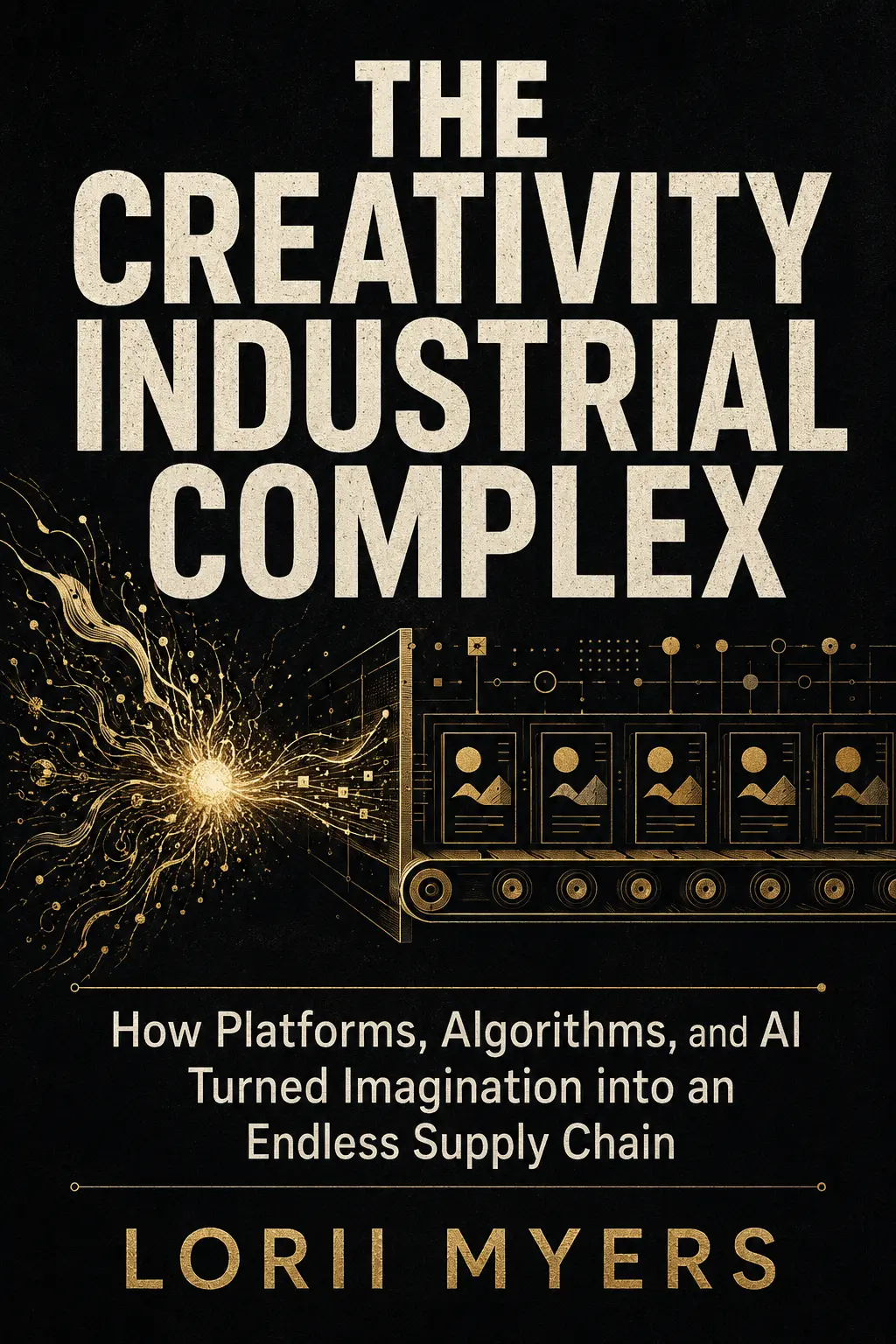
THE PUBLIC PREMISE
Creative technology has opened extraordinary routes from private imagination to public work. It has also built an economy in which the work is rarely allowed to be finished: every song, book, image and idea becomes material for the next post, metric, campaign and machine. The Creativity Industrial Complex traces how liberation becomes capture through downstream gates, Feed Pace, Format Gravity, Metrics Ventriloquism, the First-Draft Surplus and the hidden Total Creator Burden. Drawing on Lorii Myers’s experience across books, music and business, it argues for powerful tools without surrendered judgment—and establishes the Human Pace Standard for keeping technology, markets and visibility in service of the work rather than allowing the feed to decide what creativity is for.
How lower barriers expand creative access while attention systems install new gates around visibility and reward.
Why finished works can become interchangeable units inside a distribution system that must always continue.
Standards for retaining intention, human pace and accountable tool use inside an economy built for continuous output.
FULL SYNOPSIS
Creative technology has delivered one of the great liberations of modern life. A person can make a song, publish a book, distribute an image, build an audience or test an idea without first winning permission from a traditional gatekeeper. The achievement is real. But the open door did not eliminate power. It moved power downstream—into discoverability, recommendation, format, measurement and the conditions of continued arrival.
The Creativity Industrial Complex examines the system that emerged on the other side of that door. Its central argument is not that more creativity is a problem. It is that imagination, identity and ordinary experience are increasingly treated as renewable industrial inputs: material expected to be produced, packaged, circulated, measured and replenished without a natural point of enough.
Part I traces the Liberation-Capture Cycle. Access widens, supply accelerates, attention becomes scarcer, and new gates form around encounter rather than entry. Myers distinguishes an audience from a route to an audience and names Content Conversion: the process by which a primary creative work becomes raw material for the continuous labour required to keep it visible. The Abundance Ratchet explains why every tool that saves time can also raise the expected volume, speed and variety of output.
Part II shows how the system teaches creators what to reward before they have consciously agreed to its terms. Feed Pace makes publication cadence feel like creative discipline. Format Gravity bends ideas toward containers a distribution system can easily recognize. Metrics Ventriloquism gives partial measurements the authority of judgment. The Total Creator Burden collapses the work of artist, publisher, marketer, analyst, archivist and community manager into one person while continuing to describe that person as independent.
Part III turns to the costs. Generative systems create a First-Draft Surplus in which plausible beginnings multiply faster than human attention can verify, deepen and complete them. Creative Latency—the protected interval in which an experience or idea develops before public performance—is squeezed by the demand to explain, announce and circulate too soon. As systems learn from what is already legible, culture can begin repeating itself without anyone choosing repetition. Questions of ownership then extend beyond copyright into contracts, training, data, visibility, bargaining power and who can continue creating after value appears.
The book remains pro-human and pro-tool. AI is not cast as the villain, and older gatekeeping is not romanticized. The problem is obedience: allowing technical capability, market appetite or machine prediction to acquire authority over purpose, pace and judgment. Tools Without Obedience separates what a system can do from what it should be permitted to decide.
The final argument introduces the Human Pace Standard. Origin, tempo, form, judgment, custody, rights and pace must remain answerable to human purpose. Efficiency is evaluated by where the saved time goes. Metrics are evidence, not verdicts. Creative latency becomes protected infrastructure. The right to stop, revise, refuse, remain unfinished or make something that does not feed the next cycle is treated as part of creative freedom rather than evidence of failure.
Drawing on Myers’s lived experience building a catalogue across music, books, visual concepts and business systems, The Creativity Industrial Complex offers a language for a pressure many creators already feel but have not fully named. It asks not whether technology will make more creativity possible. It asks who controls the conditions of that possibility—and what human imagination is for when every system around it is hungry.
READ THE OPENING SAMPLE
Presented from an author-approved author-review edition.
Introduction — A Factory Without Walls
The modern creative factory has no gates, no whistle, and no single owner.
It travels in our pockets.
Its workday begins whenever attention becomes available. Its raw material includes ideas, expertise, memory, personality, taste, observation, frustration, joy, grief, curiosity, skill, appearance, relationships, and ordinary life. Its products may be songs, books, videos, images, essays, podcasts, performances, courses, designs, explanations, reactions, demonstrations, or fragments too small to have once been considered work at all.
The factory doesn’t require everyone to call themselves an artist. It only requires more human experience to become publishable.
This is one of the defining economic and cultural shifts of the digital era: creativity is no longer treated only as the capacity to produce particular works. It’s increasingly treated as a renewable supply of material capable of sustaining platforms, markets, brands, communities, and machines.
The shift hides inside a word that sounds neutral.
Content.
A song is something someone made.
A book is something someone wrote.
A film is something someone directed.
Content is what any of them become when viewed from the needs of a distribution system.
The word does not tell us what the work is, why it exists, what it required, or what it changes. It tells us that the work can fill a space. It can enter a slot, hold attention, trigger response, produce data, carry advertising, maintain activity, and be replaced by the next unit.
This doesn’t make all content empty or all creative work sacred. It reveals a change in vantage point. The creator sees an idea becoming form. The system sees a unit becoming flow.
Once creative work becomes flow, the governing problem changes. A publisher once needed enough strong books to sustain a list. A broadcaster needed enough programming to fill a schedule. A label needed enough recordings to develop and distribute. These institutions could be controlling, exclusionary, biased, slow, expensive, and wrong. They could prevent extraordinary work from entering public life.
Digital distribution broke open many of those limits. That was not an illusion. People previously excluded from studios, publishers, galleries, newsrooms, stages, and broadcast channels gained direct routes to audiences. Communities could form around work too specific for mass distribution. Creators could test an idea without first persuading an institution that it deserved to exist. A person could move from private imagination to public evidence with astonishing speed.
But removing the old scarcity didn’t remove power.
It relocated power into discoverability.
When publishing becomes nearly universal, being published no longer guarantees being found. When shelves become infinite, placement becomes decisive. When output expands faster than human attention, the system that allocates visibility becomes the new gate.
The old gate often said no before the work entered.
The new gate can say yes to everything and still decide what will be seen.
This is the first movement of what I call the Liberation-Capture Cycle.
Access. A new tool or platform lowers a barrier. More people can make, publish, distribute, or participate.
Acceleration. The time and cost required to produce a first form fall. Creative supply expands.
Oversupply. Human attention doesn’t expand at the same speed. More work competes for the same finite capacity to notice, understand, trust, and care.
Optimization. Systems sort abundance through measurable signals: clicks, completion, watch time, saves, shares, comments, repeat visits, conversion, velocity, consistency, and predicted response.
Standardization. Creators learn which lengths, openings, tones, topics, images, cadences, and identities move most easily through the system. Work begins bending toward what can be recognized and rewarded.
Internalization. External demands no longer need to be stated. Creators carry the anticipated platform response inside the creative decision. The system becomes an imagined audience present at the birth of the idea.
Extraction. More of creative life becomes available as output, data, intellectual property, training material, advertising inventory, subscription value, or market intelligence. The creator may gain reach and income, but the system gains scale.
Then a new tool arrives promising liberation from the burden created by the previous expansion. The cycle begins again.
This cycle is not inevitable in every creative practice, nor does every stage occur with equal force. It is a way of seeing how genuine emancipation can produce new dependence without cancelling the emancipation that came before it.
That matters because our public conversation tends to choose one half of the truth.
One side celebrates democratization. Everyone can create. Everyone can publish. Everyone can build an audience. Everyone can become visible.
The other side describes collapse. Standards are disappearing. Machines are replacing artists. Platforms are flattening culture. Nothing means anything because there’s too much of everything.
Both accounts recognize something real. Neither is large enough.
Access can widen while power concentrates.
Output can improve while culture narrows.
Creators can gain instruments while losing time.
Audiences can receive more choice while repeatedly encountering the same forms.
An individual can make better work with assistance while the collective field becomes more similar.
A platform can enable a livelihood while making that livelihood dependent on rules the creator didn’t set and can’t fully inspect.
Contradiction is not confusion. It is the subject.
Industrial systems are built to convert variation into repeatable production. They standardize parts, sequence tasks, reduce idle time, measure performance, predict demand, and increase throughput. Those methods can produce extraordinary reliability. They can also become destructive when applied to forms of value that require uncertainty, privacy, waste, wandering, maturation, and refusal.
Creativity is not opposed to discipline. Serious creative work often depends on routines, deadlines, iteration, technique, and sustained production. But a creative process cannot be understood only through throughput because its apparent inefficiencies may be part of the work.
The walk that produces no visible result may alter the chapter.
The abandoned draft may teach the standard the final work must meet.
The month without publication may contain the change in perception from which the next body of work emerges.
The private experiment may be valuable precisely because it isn’t yet required to represent the creator publicly.
The idea that refuses the available format may be protecting its actual form.
An industrial system sees unused capacity and asks how to activate it. A creative life may see protected capacity and understand why it must remain unclaimed.
Faster tools don’t end the workload by themselves. They move the baseline. When cheaper production raises expectations for volume, speed, variation, or frequency, I call the result the Abundance Ratchet. Chapter 4 follows where the saved time goes.
The result is a peculiar modern exhaustion: people possess tools their predecessors would have considered miraculous yet experience themselves as perpetually behind. The contradiction makes sense once capacity is measured not against an older task but against a system capable of generating new demand as quickly as old friction disappears.
Output is becoming abundant. Attention, trust, memory, discernment, meaningful difference, and the willingness to remain with a work are not.
When beginnings become cheap, the scarce work moves later: choosing, deepening, integrating, verifying, finishing, contextualizing, sustaining, and refusing. Chapter 9 names the resulting First-Draft Surplus; Chapter 3 begins with the attention that must receive it.
AI accelerates this condition. It didn’t invent it.
The phrase industrial complex can suggest a coordinated scheme. That isn’t my claim.
The creativity industrial complex is better understood as an alignment of incentives that produces system-level consequences no participant needs to intend alone. Platforms need activity. Creators need access. Audiences want discovery. Advertisers want attention. Brands want cultural relevance. Tool companies want adoption. Investors want scale. Distributors want predictable supply. Everyone can act reasonably within their own role while collectively creating unreasonable pressure on the creative process.
This is why moral accusation is too small for the problem.
Creators are not weak because they check metrics. The metrics may affect whether they can continue their work.
Platforms are not uniquely corrupt because they sort abundance. Some method of selection is unavoidable when supply exceeds attention.
Audiences are not shallow because they use familiar signals. Nobody has time to investigate everything.
AI users are not fraudulent because they use expanded tools. Assistance has always been part of complex creation.
The issue is not individual purity. It is whether the system’s incentives have become mistaken for the natural laws of creativity.
They are not natural laws.
They are design choices, business models, habits, contracts, defaults, interfaces, cultural expectations, and learned responses. What has been designed can be examined. What has been learned can be named. What has become normal can still be refused, revised, or bounded.
The obvious questions are economic. Who is paid? Who owns the rights? Who controls distribution? Who receives the data? Who can survive a policy change? Who absorbs the risk while someone else captures the scale?
These questions are essential, and this book won’t avoid them.
But the deepest question arrives earlier.
What happens to human imagination when it begins anticipating industrial demand before it has discovered its own necessity?
That’s the point at which an external system becomes an internal condition.
An idea may now arrive already carrying questions about its opening seconds, searchable language, thumbnail, audience segment, brand fit, monetization path, posting cadence, and potential to produce the next idea.
Those questions are legitimate. They’re simply early.
When distribution enters too early, it can become authorship by pre-emption: the creator still chooses, but from a field already narrowed by anticipated performance.
Part II examines how the clock, container, dashboard, and hidden operational load enter that choice. The metric remains real. The meaning assigned to it may not be.
The industrial complex exerts power through a relationship that doesn’t fit our older language of work.
The platform is not the creator’s employer. It does not assign a formal shift, guarantee a wage, provide tools, cover development time, or assume responsibility for whether the work can continue. The creator remains free to leave.
Yet the system can still shape conduct in ways that resemble management.
It can determine which performance indicators matter. It can alter the conditions of visibility. It can reward consistency, velocity, response time, audience retention, conversion, and compliance with preferred forms. It can make an earlier strategy less effective without warning and require the creator to discover the change through declining results. It can encourage unpaid experimentation, ask the creator to interpret incomplete data, and turn every successful adaptation into the baseline for what must happen next.
This is not employment in the legal sense. It is management without employment: behavioural direction without the reciprocal obligations that usually accompany managerial authority.
The distinction explains why creative independence can feel both real and strangely conditional.
The creator owns the decision to participate but doesn’t own the conditions through which participation becomes visible. There may be no person issuing instructions, yet the reward structure makes some actions far easier to justify than others. There may be no formal performance review, yet the dashboard updates continuously. There may be no dismissal, yet discoverability can fall far enough to create the economic effect of exclusion.
Old creative industries also imposed demands. Publishers wanted marketable books. Labels wanted promotable recordings. Broadcasters wanted programs that fit schedules. Galleries wanted work that could be shown and sold. The difference is not that influence has suddenly appeared. The difference is that influence can now be continuous, personalized, automated, and present at every stage of production.
The old gatekeeper could reject the work.
The new system can train the creator to pre-reject it.
That’s a more intimate form of power because it doesn’t always feel external. The creator learns the likely penalty for silence, difficulty, unfamiliarity, length, ambiguity, or inconsistency and begins making adjustments before the system has to respond. The work is managed by anticipated consequence.
This arrangement also moves business risk downward. The creator supplies the idea, equipment, time, development, production, packaging, promotion, audience care, experimentation, and recovery from failure. The platform supplies access to infrastructure and potential discovery. When the work succeeds, both may benefit. When it fails, the creator usually absorbs most of the lost time and expense while the system retains the activity and data produced by the attempt.
Again, the access can be valuable. The relationship can be worth entering. Some creators build durable livelihoods and communities through it. The concern is not that the exchange exists. It is that the language of empowerment can hide how unevenly its obligations are distributed.
Calling everyone a creator doesn’t mean everyone has gained creative power.
Some have gained instruments.
Some have gained markets.
Some have gained a second unpaid occupation maintaining access to both.
The distinction will matter throughout this book. Whenever a system claims only to distribute creative work, we must also examine what it teaches creators to produce, how often it expects them to appear, which risks it transfers, and whose labour keeps the opportunity functional.
Distribution can manage production without ever admitting that management has occurred.
This book defends creative abundance.
It defends access for people denied traditional routes.
It defends creators who want commercial success and those who don’t.
It defends popular work, experimental work, disciplined schedules, prolific output, collaborative production, new tools, old crafts, and forms that haven’t yet found their public name.
What it refuses is the claim that every expansion of output is an expansion of freedom.
Freedom requires more than the ability to produce. It requires meaningful authority over purpose, pace, form, judgment, visibility, rights, and consequence.
A creator is not free merely because no one stops the work from entering the system.
The creator is free when the system cannot become the only reason the work exists.
The final section of this book develops a Human Pace Standard for creative systems and practices. It is not a demand that everyone work slowly. Human pace can be fast, prolific, energetic, collaborative, and technologically amplified. The standard asks a different set of questions:
Origin. Can the intention become legible before the system assigns it a format?
Tempo. Is the pace chosen in service of the work, or inherited from the appetite of distribution?
Form. Does the form carry the idea, or has the available form decided which ideas can proceed?
Judgment. What standards remain when the metrics disagree, disappear, or cannot measure what matters?
Custody. Who retains the rights, learning, responsibility, and consequence produced by the work?
These questions apply to a single creator deciding what to publish. They also apply to publishers, platforms, studios, labels, funders, educators, employers, policymakers, and AI companies designing the conditions under which creative work will be made.
The purpose isn’t to restore an imagined golden age. The old system excluded too much, concentrated too much authority, and confused institutional permission with worth. We shouldn’t rebuild it.
The purpose is to prevent liberation from becoming merely a more efficient form of capture.
The gates fell.
That was progress.
Now we must decide what we’re willing to build in the open space—and what we won’t allow the conveyor belt to carry away.
PART I — HOW CREATIVITY BECAME INFRASTRUCTURE
The open door matters. This part begins on the other side of it.
Once creative access widened, the decisive questions changed. Could this person publish? became Will the work be encountered? What did they make? was joined by What else can circulate around it? How much can the shelf hold? gave way to Who receives the next available second? And What can a faster tool do? became Who claims the time it saves?
These are questions of architecture. They concern the routes, measurements and incentives that organize participation after permission has been granted. They explain how an upload becomes a ranked candidate; how a finished work becomes an indefinite supply of content; how unlimited storage intensifies the value of limited attention; and how a new capacity becomes a new baseline.
The chapters that follow trace that conversion at ground level. The Liberation-Capture Cycle is not a verdict that access was false. It is a way to see what access set in motion—and why a freedom can remain real while the systems around it learn to collect more from everyone who uses it.
The old problem was getting through the door.
The new one is what the building asks of you once you’re inside.
Chapter 1 — Gatekeepers Fell, New Gates Appeared
On April 23, 2005, a nineteen-second video was uploaded to a new website.
There was no programming executive to approve it. No broadcaster’s carriage permission or schedule slot was required. The clip didn’t need to justify the cost of a national transmission network. A person stood in front of a camera, a file moved to a server, and a public medium began to reveal what it could become.
Twenty years later, YouTube reported that more than twenty billion videos had been uploaded to the service. On an average day, another twenty million arrived.
That’s more than growth. It’s a reversal of cultural logistics.
The scarce broadcast slot became an almost limitless intake pipe. The audience didn’t have to be assembled in advance. The creator didn’t have to prove that millions of people would care before being permitted to discover whether a few thousand might. The cost of failed publication fell so dramatically that failure itself could become information. Try something. Watch what happens. Make another.
Books crossed a similar threshold. Amazon’s Kindle Direct Publishing tells an author that ebooks, paperbacks, and hardcovers can be self-published without an upfront publishing charge, placed on an Amazon product page, and listed in supported Amazon marketplaces for readers in multiple territories, subject to the selected distribution options and current program rules, while the author retains rights to the book. Whatever one thinks of Amazon’s influence, this capability is real. A manuscript can become an orderable book beyond its local market without first surviving an agent’s inbox, an acquisition meeting, a seasonal list, and a sales forecast.
Music moved from pressing plants and store buyers to distributors and streaming services. In its 2025 figures, Spotify reported paying more than eleven billion US dollars to the music industry, with roughly half of the royalties generated by independent artists and labels. It also reported that more than 13,800 artists generated at least $100,000 from Spotify alone that year, while more than one third of artists above the $10,000 level were independent do-it-yourself artists or had begun that way.
Those numbers come from Spotify and should be understood as a platform’s account of its own economy, not a neutral verdict on the entire music business. Still, they reveal something the old system could not plausibly claim: substantial careers can now emerge without the same institutional path that once appeared compulsory.
The victory is not imaginary.
An argument that treats every platform as merely a new oppressor misses why people came. They came because something opened. They stayed because something worked. Audiences found forms, voices, languages and subcultures that were previously uneconomic to distribute. Creators built businesses around small but committed publics. A person in one country could release work tonight and be discovered in another tomorrow. The old gate didn’t simply regulate quality. It also filtered by geography, class, capital, fashion, relationships and institutional confidence. Much of what it excluded wasn’t inferior. It was inconvenient.
Digital access made inconvenience less decisive.
In my own work, that difference isn’t theoretical. I can move a song, a book, or a visual idea into public form without waiting for an institution to decide whether the risk is acceptable. That’s freedom. But I can own the work and still not own the road by which anyone finds it. The file is mine; the route is conditional. Both statements can be true at once: the gatekeeper is gone, and the gate remains.
Then success created the next problem.
When twenty million videos arrive each day, the upload button cannot be the final gate. Someone—or something—must decide which small fraction appears on a home screen, in search results, after another video, inside a playlist or in a notification. The technical capacity to hold everything creates a sorting problem larger than any editorial department. Recommendation becomes infrastructure.
This is the first conceptual turn:
The old gate decided who could enter. The new gate decides who can be encountered.
The shift looks like freedom because almost no one is stopped at the door. The ranking happens after entry, often continuously, and usually differently for every audience member. The creator may be public and functionally absent at the same time.
Permission moved downstream.
That matters because the new gate is harder to see. An editor can reject a manuscript. A label can decline a demo. A gallery can say there’s no place in the program. The decision may be unfair, but it’s legible. A recommender system doesn’t usually issue a rejection. It assigns probabilities. It runs tests. It predicts which person might respond. It adjusts after watch time, completion, skipping, sharing, saving, hiding or returning. It can grant a burst of visibility, withdraw it and grant another burst somewhere else without declaring that a gate has opened or closed.
YouTube’s own explanation of its recommendation system describes signals that include viewing and search history, subscriptions, watch time, likes, dislikes and shares. The weight of a signal can vary by user; there is no single formula a creator can simply satisfy. TikTok similarly explains that its For You feed learns from likes, shares, comments, watch time, follows and searches, while applying additional choices around such factors as recency, local creators, length and sound.
These systems aren’t crude popularity contests. That’s part of their value. A new creator can sometimes reach a large audience without first accumulating followers. A highly specific work can be matched with a highly specific appetite. Recommendation can rescue culture from the bluntness of the bestseller table.
But matching is also power.
The power is not only the ability to remove a work. It is the ability to determine the conditions under which a work becomes findable, and to change those conditions faster than creators can fully understand them. A platform does not need to dislike the work. It only needs to predict that something else will perform better for this person at this moment.
The distinction between censorship and allocation is essential. Most creators aren’t being censored when their work receives little reach. They’re being allocated little attention. The experience can feel similar because both end in invisibility, but the systems operate differently. Censorship asks whether expression is allowed. Allocation asks whether expression is worth presenting now.
The first question belongs to rights.
The second belongs to infrastructure.
Once allocation is automated, a creator faces a gate without a gatekeeper’s face. This can make the system feel objective. Numbers arrived. Viewers behaved. The result appears to have emerged from the public itself.
But a measurement system is never the public in pure form. It’s a designed interpretation of public behaviour. Someone chooses which signals count, over what period, toward which objective, subject to which safety and commercial constraints. Completion rate privileges one kind of response. Meaningful-survey results privilege another. Clicks, saves, comments, rewatches and session length aren’t interchangeable windows into value. They’re different definitions of what the system is trying to notice.
The algorithm does not discover value as if value were waiting in the data.
It operationalizes a theory of value.
This is why European lawmakers now treat recommender systems as matters of public accountability. The European Union’s Digital Services Act requires covered online platforms using recommender systems to explain their main parameters and the options by which recipients can influence them; covered very large online platforms and search engines must also provide at least one recommender option not based on profiling. Regulation of this kind does not assume that recommendation is inherently corrupt. It recognizes that when ranking systems organize what millions of people see, their design is no longer a minor product feature.
It is cultural architecture.
The architecture changes the creator’s labour long before a work reaches the screen. Under the old gatekeeping model, the creator anticipated a buyer, editor, producer or curator. Under the platform model, the creator anticipates a field of predicted responses. Will the opening hold? Will the thumbnail clarify? Is the format native? Will the first seconds survive the swipe? Does the title carry the searchable phrase? Can the work be divided? Can it travel without context? Will a pause be mistaken for disappearance?
None of these questions is foolish. Many are ordinary acts of communication. A novelist thinks about a title. A filmmaker thinks about an opening. A musician thinks about sequence. Art has always been made for forms, settings and audiences.
The change is in the density and velocity of the feedback.
A newspaper columnist once knew the dimensions of the column and the rhythm of publication. A platform creator may face multiple formats, shifting recommendation practices, global time zones, evolving monetization rules and a dashboard that updates before the meaning of the last work has settled. The gate is not crossed once. It is crossed with every item.
The old gatekeeper concentrated authority. The new system distributes evaluation while concentrating infrastructure.
That is not the same as distributing power.
The new power resembles a zoning authority more than a doorman. It doesn’t need to inspect every building. It determines what may be built, where traffic will flow, what qualifies for commercial activity and which changes require everyone to renovate.
A platform sets the available formats. It defines the limits, labels, categories and technical specifications. It determines which actions count as engagement and which forms of engagement can become income. It may introduce a feature, place it prominently, invite creators to adopt it and later reduce its importance. It can alter a recommendation objective across an entire field faster than any traditional editor could revise a list.
This scale creates genuine benefits. A common standard allows billions of files to move reliably. Safety rules can limit fraud, abuse and material that people did not choose to see. Copyright systems, payment systems, moderation and technical requirements make mass participation possible. Infrastructure without governance would not be freedom. It would be disorder controlled by whoever could exploit it fastest.
The question is not whether rules should exist.
It is whether dependence on the rules is matched by meaningful visibility into them, recourse under them and alternatives to them.
The old gatekeeper’s power was severe but bounded. A publisher controlled one route to the book market. A label controlled a contract and catalogue. A broadcaster controlled a schedule. Other gates might be equally difficult, but they were visibly separate. The platform can combine several functions that once restrained one another. It can host the work, recommend it, sell advertising around it, measure the audience, administer payment, define eligibility and supply the creator with advice about improving performance.
Vertical integration becomes psychological integration. Because the same system provides the opportunity and the diagnosis, a creator can find it difficult to distinguish a weakness in the work from a change in the environment.
The platform may know that a format is losing audience interest across millions of accounts. The individual creator sees that their last release travelled less far. The platform may be testing a new ranking objective. The creator sees a decline and makes a different opening. The platform possesses population-level knowledge. The creator receives account-level consequence.
This is not proof of bad faith. It is a difference in position.
Infrastructure sees the field.
The participant sees the weather.
The power shift is especially clear in the relationship to an audience. A creator may spend years gathering followers on a service, but following does not necessarily guarantee delivery. The platform still decides how the relationship appears in the interface and how strongly a follower’s earlier choice should influence the next recommendation. A creator can retain the original file and lose the route through which people found it. The work is portable. The accumulated conditions of encounter often are not.
This means “building an audience” can describe two very different assets. One is a direct relationship the creator can reach through channels they control. The other is a platform-mediated probability of future distribution. Both can be valuable. Only one travels easily when the infrastructure changes.
The distinction explains why creators can simultaneously possess more independence and more exposure to a single decision system. They no longer need advance permission from an editor, yet they may need continuing cooperation from an environment that owes no individual work sustained reach. The contract is replaced by conditional access. The rejection letter is replaced by variance.
New-gate power is therefore not best measured by how many people are allowed to upload. It’s measured by how many consequential decisions are made after they do—and how little bargaining power any one participant has when those decisions change.
This is why transparency rules such as those in the Digital Services Act matter even to people who never read a regulation. They begin from the premise that ranking parameters, profiling and user choice have become part of the terms of public participation. The goal is not to turn an algorithm into a fixed recipe that can be gamed. It is to recognize that invisible governance is still governance.
The door can be open while the building remains privately planned.
To see the power clearly, separate the moments that the word access compresses.
First there is admission: may the file enter the system? Then legibility: does it fit the formats, categories, metadata, and policies through which the system can recognize it? Then allocation: to whom will it be shown, how often, and under what test? Then settlement: can the activity become money, at which thresholds and on what terms? Finally there is portability: if the creator leaves, which parts of the accumulated relationship can leave too?
The upload button answers only the first question.
The new gate operates across all five.
A creator can be admitted but poorly legible because the work doesn’t fit a favoured format. It can be legible but weakly allocated. It can be widely allocated but ineligible for revenue. It can generate income while the audience relationship remains difficult to carry elsewhere. Each stage offers a real benefit. Each remains conditional on infrastructure the creator doesn’t command.
This is more than a semantic distinction. It changes where power can be exercised. The old publisher made a large decision at the beginning and lived with many of its consequences: an advance, an edition, a sales effort, shelf space, a contract. The platform can make small decisions continuously. A ranking adjustment doesn’t have to end the relationship to alter its value. A new format doesn’t have to prohibit older work to redirect participation. A change in eligibility doesn’t erase the audience to change what reaching that audience is worth.
Conditional access is powerful because it’s renewable.
The participant qualifies again with each release, each policy revision, each shift in audience behaviour and each change in the system’s objective. Success yesterday may provide useful data and reputation, but it doesn’t produce a permanent claim on tomorrow’s route. What feels like a market position can therefore behave like a series of temporary permissions.
Variability is part of the product. It lets recommendation respond to changing interests, test unfamiliar work, and protect users from a static feed. Company accounts also make clear that the signals and their importance change rather than forming one fixed recipe.,
The same variability produces dependency for the supplier. A follower count records a relationship; it doesn’t give the creator an address or guarantee delivery through it.
This is the difference between an audience and a route to an audience.
When the route becomes economically essential, a change in allocation can alter demand, marketing cost, and income without a corresponding negotiation. Power doesn’t require a promise. It requires the capacity to alter someone else’s practical choices.
Conditional access therefore needs governance: clarity about which conditions are stable, which are provisional, how consequential decisions can be contested, and what a participant can carry away. Transparency is not a demand for the secret recipe. It is a demand that dependence stop masquerading as ownership.
The creator usually sees the result of allocation, not its counterfactual. They know how many people were reached. They don’t know who might have been reached under a different test, how comparable work was treated, which system objective changed or whether an apparent audience response was partly an exposure decision. The asymmetry is informational before it’s financial.
That’s why the new gate can’t be understood through takedowns alone. Removal is dramatic, but ordinary infrastructural power is quieter. It sets the width of the passage, the speed of traffic, the price of visibility and the degree to which yesterday’s investment survives tomorrow’s design.
The old institution owned the means of publication.
The new infrastructure governs the conditions of continued arrival.
Consider the difference between owning a printing press and being permitted to place a file on someone else’s shelf. The creator may control the file, but the platform controls the route, interface, ranking environment, audience data and often the commercial terms. Access can be broad while dependency remains concentrated. The field has many more producers and a small number of essential passages.
The result is a peculiar kind of democracy: almost everyone can stand for election, but the ballot is rebuilt every second.
Chapter 1 supplies the cycle’s first turn: access widens, acceleration increases supply, and scarce attention makes optimization rational. The remaining turns—standardization, internalization and extraction—will emerge across the chapters that follow.
Nothing in that sequence proves exploitation in every instance. A platform that hosts, stores, recommends, secures, transcodes, bills and distributes work provides real infrastructure. It’s entitled to have a business. A creator who studies an audience isn’t betraying art. Commerce and creativity have been companions for centuries.
This is not an argument for making less merely because less appears purer. Volume can be an artistic language. Repetition can be practice. A disciplined release schedule can free rather than diminish a creator. Commercial ambition is not creative corruption. Popular forms are not inferior forms. Metrics are not meaningless. Algorithms can introduce work to people who would never have found it through traditional gatekeepers. AI can restore access, widen reach and help long-carried ideas enter the world.
The issue is not whether exchange occurs.
The issue is where the risk accumulates.
Platforms can benefit from aggregate abundance even when most individual items go unseen. A streaming service doesn’t require every song to succeed. A video service doesn’t require every channel to become viable. The enormous pool is valuable because it increases the chance that something will hold each audience member, in each moment, at global scale. The system’s portfolio is diversified. The creator’s life isn’t.
One platform contains millions of bets.
One creator may contain only the next one.
That asymmetry explains why advice framed as opportunity can be experienced as pressure. The platform can say, accurately, that someone new is discovered every day. The creator can observe, also accurately, that being discoverable requires repeated exposure to a mechanism they don’t control. The exceptional breakout proves that the gate is permeable. It doesn’t prove that the passage is stable.
Spotify’s own data offers both sides. The company estimates that about thirteen million people have uploaded at least one song, while roughly 250,000 artists may be pursuing music professionally or aspiring to do so under the indicators Spotify selected. In 2025, the 100,000th-highest-earning artist generated more than $7,300 from Spotify, far above the equivalent ranking a decade earlier. This is remarkable expansion. It is also an immense field competing beneath the visible thresholds.
The right conclusion is not that streaming failed. It is that entry and livelihood are different achievements.
The system repeatedly invites us to use one as evidence of the other.
“Anyone can publish” is a statement about access.
“Anyone can build a sustainable creative life” is a statement about distribution, bargaining power, attention, income stability and time.
The distance between those statements is where the new gate stands.
For a creator, the practical consequence isn’t simply that the competition increased. Competition existed before. The deeper consequence is that publication no longer completes the work’s passage into culture. It begins a second production process: the manufacture of visibility.
The creator must now make the thing and make the conditions under which the thing can be found. The latter task is open-ended because visibility can decay. Yesterday’s arrival doesn’t reserve tomorrow’s attention. A work may remain available indefinitely while one route to the audience disappears in hours.
The shelf is permanent.
The front window moves.
This is a better system than the locked building it replaced in many important ways: more porous, more global, more responsive, and often more surprising. The answer cannot be to put the old guards back at the door and call scarcity quality. Yet a door is not a path. Continuously ranked attention gives creative work a second obligation: to produce evidence that it deserves to keep moving.
The gatekeeper has fallen. The gate is everywhere.
SELECTED WORDS FROM THE MANUSCRIPT
Approved quotations by Lorii Myers, selected to accompany this manuscript’s public blurb and synopsis.
“The container is never merely holding the idea; it proposes what the idea should become.”
“The work acquires depth not because the creator added more, but because reality was given time to answer back.”
CURRENT STAGE
The approved front cover, book description, full synopsis and revised Introduction plus Chapter One sample are available here. The complete NF-16-F manuscript remains private and is not submission-ready. Independent editing, fact-checking, permissions and specialist legal review, title and rights clearance, copyediting and final proof remain.