Forecast authority
A prediction about the future begins directing present investment, staffing and design before evidence has earned that power.
 LAMBO-MUSICARTIST · AUTHOR · LICENSING
LAMBO PUBLISHING · FUTURE-OF-WORK NONFICTION · LORII MYERS
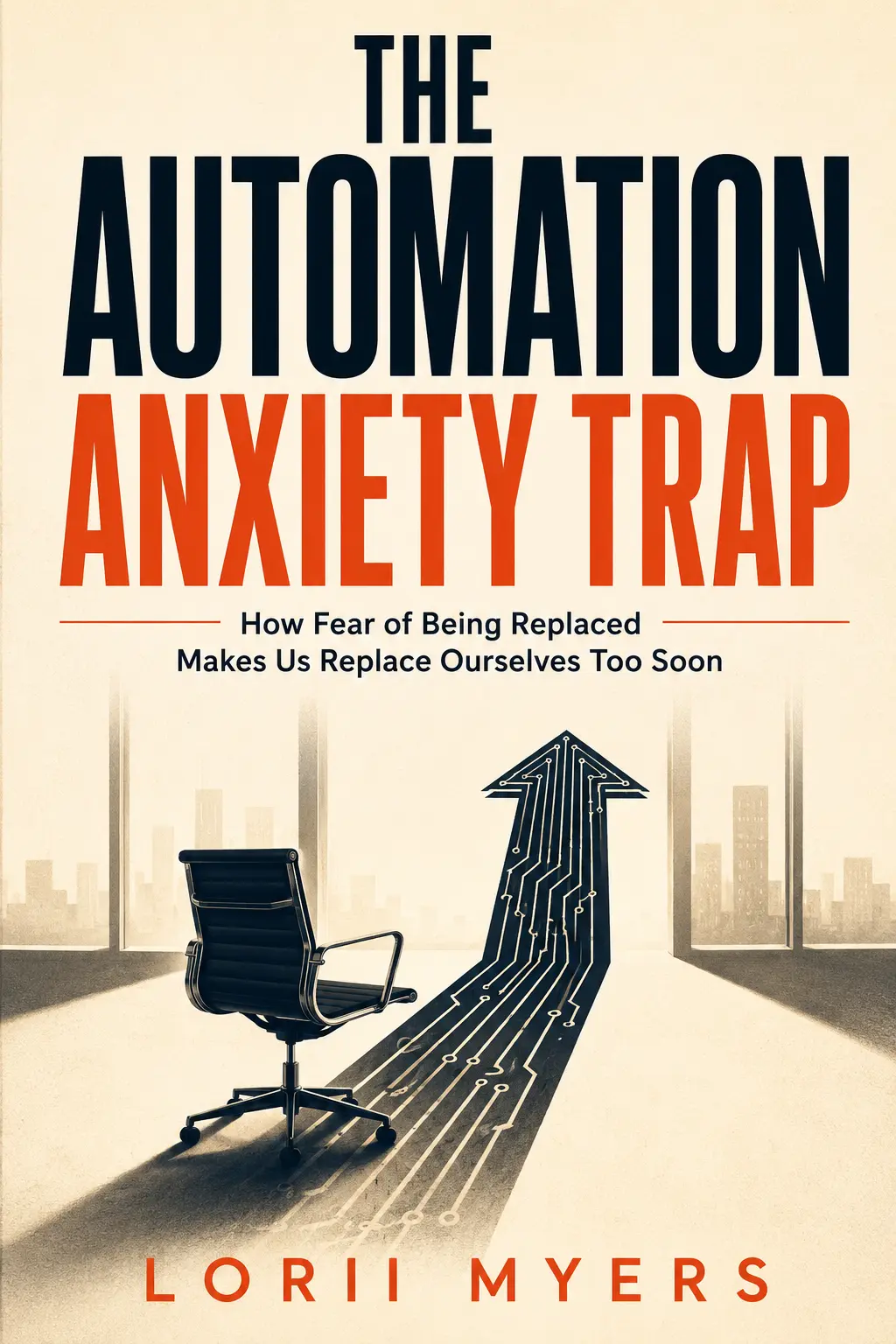
How Fear of Being Replaced Makes Us Replace Ourselves Too Soon
A prediction becomes dangerous when we begin obeying it before it becomes true. Technology becomes an opportunity when it expands what people can understand, decide and become.
THE CENTRAL PROPOSITION
The greatest automation risk is not simply that technology may replace people. It is that anticipated replacement can remove training, judgment and alternatives before technology has earned that authority—and prevent us from building the more capable future it could support.
A prediction about the future begins directing present investment, staffing and design before evidence has earned that power.
Practice, apprenticeship and retained knowledge disappear, weakening the human capacity later used to judge whether automation worked.
A system becomes easy to adopt but increasingly difficult to challenge, correct or replace as human alternatives are allowed to decay.
THE PREEMPTION LOOP
Automation anxiety becomes self-fulfilling when a prediction is allowed to redesign the conditions later used to assess it.
THE READING EXPERIENCE
How forecasts become permission and anticipated obsolescence begins reorganizing the present.
Friction, apprenticeship, judgment, reversibility and the capability developed through continued practice.
The Panic Dividend, automated alibis, proxy decisions and human oversight that has become ceremonial.
Delegation thresholds, live benchmarks, funded apprenticeship, decision ledgers and retained know-how.
OFFICIAL BLURB
Before a job disappears, organizations stop hiring, training and investing in human expertise. Judgment weakens through disuse. Dependence grows. That dependence is then offered as proof that replacement was inevitable.
The Automation Anxiety Trap exposes this self-fulfilling cycle: the Preemption Loop.
Drawing on more than three decades of business leadership, Lorii Myers reveals how prediction becomes permission, efficiency conceals capability debt and people surrender meaningful work before technology has earned the authority to take it.
This isn’t an argument against automation or a defence of every existing job. It asks a more urgent question: how can people and institutions use technological progress to become more capable, informed and free to choose?
Original, timely and practical, The Automation Anxiety Trap offers a framework for using technology to strengthen judgment, develop human capability, preserve accountability and expand what becomes possible.
The future will automate more.
We can choose to become more.
SYNOPSIS
A technological forecast enters a meeting: a new system will soon perform much of the work. No layoffs have been announced. The technology has not been purchased or tested against the organization’s actual conditions. Yet vacancies are frozen, training is postponed and employees begin documenting knowledge as though their own disappearance has already been decided.
The Automation Anxiety Trap examines how fear of technological replacement can help manufacture the future it predicts. Lorii Myers names this mechanism the Preemption Loop: replacement is forecast; institutions withdraw hiring, practice, training and investment; human capability declines; dependence on automation grows; and that dependence returns disguised as proof that replacement was inevitable.
The book does not romanticize human work or deny genuine displacement. Some tasks should disappear. Some systems are faster, safer and more accurate than the people or processes they replace. The central distinction is whether automation has demonstrated its authority—or whether fear, urgency and visible savings have been allowed to decide more than the evidence supports.
Across four parts, Myers traces what disappears before the worker does. Routine friction once revealed anomalies. Entry-level work formed future experts. Repetition kept judgment calibrated. Independent practice preserved an organization’s ability to challenge, recover and refuse. When those functions vanish, the apparent efficiency gain can create Capability Debt, eliminate the route back and leave humans responsible for exceptional cases they are no longer equipped to judge.
The argument then turns toward power. Inevitability has sellers. Anxiety produces a Panic Dividend by accelerating adoption, suppressing resistance and encouraging workers to transfer knowledge without bargaining over the future being built from it. Jobs may disappear as counterfactual vacancies—positions never filled and careers never begun. Automation may become an alibi for commercial choices, while ceremonial humans remain close enough to absorb blame without retaining meaningful authority.
The final part establishes Automation without Abdication: a Delegation Threshold, design for genuine refusal, living independent benchmarks, funded routes into expertise and a Missing Ledger that follows savings, displaced work, risk and responsibility beyond the automated task.
The book ultimately asks a more consequential question than whether machines can perform the work: how can people and institutions use technological progress to strengthen judgment, develop expertise, preserve accountability and remain free to choose?
The future will automate more. We can choose to become more.
READ THE OPENING SAMPLE
Presented from an author-approved author-review edition.
PROLOGUE
THE EMPTY CHAIR ARRIVED FIRST
The meeting was not about layoffs.
No one had proposed them. The new system hadn’t been purchased. Its results hadn’t been tested against the work the department actually performed.
Still, by the time the presentation ended, several people had begun speaking about themselves in the past tense.
The slides had been polished enough to make uncertainty look settled. A diagram showed requests entering one side of a platform and completed decisions leaving the other. Between them, the work that currently required knowledge, negotiation, correction, memory, and judgment had been reduced to a clean arrow.
The arrow was labelled automation.
It did not show the unusual case that arrived without the information the system expected. It did not show the customer who used the wrong word for the right problem. It did not show the experienced employee who knew that two identical entries could carry very different consequences. It did not show who would notice when the pattern changed, challenge an answer, explain a refusal, or repair the result after the ordinary route failed.
Those things were not denied. They were simply absent.
Absence did the work.
Once the future had been presented as inevitable, the present began reorganizing itself around that certainty. A vacant position was left unfilled. Training was postponed because the process would soon be different. A junior role was redesigned around monitoring the system rather than learning the work beneath it. The most experienced people were asked to document what they knew, as though knowledge became complete when converted into instructions.
Nothing had yet been replaced.
But something had already been surrendered.
The empty chair often arrives before the machine.
This is the part of automation anxiety we rarely examine. We speak about fear as a reaction to technological change: a worker sees a capable system, imagines a shrinking future, and worries about what will remain. That fear can be entirely rational. Tasks do disappear. Jobs are redesigned. Some forms of expertise lose value. Some communities carry transition costs that optimistic forecasts barely acknowledge.
But fear is not only a feeling produced by the future.
It can become a force that helps produce the future.
An organization expects automation, so it stops investing in people. Because it stops investing, human capacity thins. As capacity thins, dependence on the system grows. That dependence is then offered as evidence that people were no longer capable of doing the work.
The prediction appears to have been proved.
What disappears from the account is that the comparison was altered while it was being measured.
The machine may have improved. The people were also being made less able.
This book names that mechanism the Preemption Loop: replacement is forecast; institutions stop hiring, teaching, practising, or investing; human capability declines; dependence increases; and the dependence returns disguised as proof that replacement was inevitable.
The loop does not require bad intent. It can be built by reasonable people responding to real pressure. A leader fears being late. A board expects visible savings. A worker wants to prove adaptability. A vendor describes technical possibility in the language of destiny. Each decision can sound prudent on its own.
Together, they can create a surrender no one remembers choosing.
Technological change carries a particular humiliation: the fear of being the person who failed to recognize it.
No leader wants to be remembered for defending a process that the future made absurd. No employee wants to sound threatened by a tool that colleagues describe as obvious. No organization wants to discover that competitors learned faster, moved sooner, and reduced costs while it protected familiar work from necessary change.
So anxiety doesn’t always look like resistance.
Sometimes it looks like enthusiasm.
People volunteer to automate work they haven’t yet examined because hesitation could be mistaken for irrelevance. They translate their knowledge into tasks a system can perform, then omit whatever can’t be cleanly translated. They call the remainder inefficiency. They begin proving their modernity by participating in the narrowing of their own role.
This surrender happens in anticipation: practice, judgment, investment, or authority is relinquished because replacement is expected rather than because replacement has earned the right to occur.
It can happen long before employment ends. A person may keep the title while losing the work through which the title acquired meaning. They remain present, but the difficult decisions move elsewhere. They approve rather than understand. They monitor rather than interpret. They become responsible for outcomes they’re no longer equipped or authorized to shape.
The job survives as a place where accountability can be left.
The work has already gone.
The easy response is to defend the human.
Humans are creative. Humans are empathic. Humans understand context. Humans bring values, relationships, and moral responsibility that machines do not possess.
Each claim contains truth. None is enough.
Human capability is not preserved by praise. Judgment that is never exercised weakens. Context that is never gathered disappears. Responsibility without authority becomes ceremonial. Creativity reduced to choosing among supplied options can remain expressive while becoming less practiced.
Declaring people irreplaceable does not keep them capable.
Nor should every task be protected simply because a person once performed it. Some work is dangerous, demeaning, repetitive, or unnecessarily slow. Some human decisions are inconsistent, prejudiced, exhausted, or poorly informed. Automation can expand access, reduce error, expose patterns, and remove burdens that no meaningful account of human dignity should romanticize.
Machines will do more.
The harder question is what must remain understood, practised, contestable, and accountable as they do.
That question is harder because it doesn’t permit loyalty to either side. It refuses the comfort of technological inevitability and the comfort of human exceptionalism. It asks what the work contains beyond its visible tasks. It asks who benefits when a forecast becomes policy. It asks what will happen during the exception, the outage, the dispute, the unfamiliar event, or the result no one can explain.
Most of all, it asks whether we’re measuring the future honestly.
The department in that meeting has two possible futures.
In one, the system works well enough that the early warnings look foolish. Output rises. Fewer people are needed. The remaining employees learn to operate the interface. For a time, every visible measure improves.
Then conditions change.
A new kind of request arrives. A provider changes its model. A rule conflicts with a real circumstance. An answer is technically consistent and substantively wrong. The people closest to the result feel its wrongness but can’t reconstruct how it was reached. The senior employees who once understood the complete process have left. The junior employees were never taught it.
The organization discovers that automation was installed quickly, but abandoned competence can’t be restored at the same speed.
In the other future, automation still occurs. Routine steps disappear. Roles change. Some positions may not remain.
But the organization doesn’t treat present fluency as proof that knowledge can be discarded. It spends some of the gain on a live comparison, new learning, and the ability to challenge or recover. That capacity has a carrying cost.
This version may look less clean on a slide.
It is more capable when the slide stops being true.
The difference is not whether one future welcomed technology and the other resisted it. Both used the machine.
Only one preserved the capacity to understand and contest the work.
The future will not inherit what we claimed people could do. It will inherit what we continued to let them practise.
INTRODUCTION
THE FUTURE WE OBEY IN ADVANCE
Every technological forecast carries two meanings.
The first is descriptive: this capability may become possible; this task may change; this occupation may contract; this system may outperform the current method.
The second is political: invest here, stop hiring there, teach this, abandon that, trust these people, reduce the authority of those people, and organize the present around the future we’ve just described.
The first meaning can be uncertain while the second becomes immediate.
That is forecast authority: the power granted to a prediction when this may happen quietly becomes we must behave as though it already has.
Forecast authority explains why automation can alter work before its performance has been established. A plausible demonstration becomes a staffing assumption. A prototype becomes a budget reduction. A broad estimate of task exposure becomes a conclusion about a particular worker, team, or profession. The distance between possibility and policy disappears.
By the time evidence arrives, the conditions required for a fair comparison may already be gone.
This book is not an argument against concern.
People have good reasons to worry about automation. Economic transitions aren’t experienced as historical abstractions. They arrive as lost income, changed status, weakened bargaining power, disrupted communities, and the demand to learn a new role while carrying the cost of the old one disappearing.
Telling people to become optimistic doesn’t distribute that cost more fairly.
Neither does telling them to become adaptable, as though adaptation were a personality virtue detached from time, money, health, caregiving, geography, education, and opportunity. A person can be willing to learn and still be offered no credible bridge. A community can understand the future and still be damaged by the route taken to reach it.
The Automation Anxiety Trap begins elsewhere.
It begins when rational concern is converted into permission for premature surrender. Fear of being replaced makes workers conceal hesitation, leaders overstate certainty, and institutions treat investment in people as money spent on a vanishing asset. What began as a warning becomes an operating decision.
Anxiety can pay before displacement occurs. It can induce an employee to transfer knowledge without bargaining, a manager to freeze a vacancy, and an institution to receive the benefit of a smaller future before making a smaller workforce explicit. Later, this book calls that return the Panic Dividend.
The trap is not every fearful response. It begins when fear acquires operating authority before the evidence has earned it. Sometimes that authority protects a failing past. More often in these pages, it accelerates surrender: people and institutions withdraw practice, investment, and alternatives to prove that they understand the future.
When this book says we replace ourselves, the we is institutional, not accusatory. Workers don’t design the budgets, markets, metrics, and permissions inside which they respond. Anxiety becomes causal when power converts it into policy.
Discernment refuses both premature resistance and premature surrender. It does not obey the past. It does not obey a forecast.
Automation discussions often begin by dividing a job into tasks.
This is necessary. It is also incomplete.
A task inventory can show what occurs. It may not show what the repetition of that task teaches, what adjacent information it reveals, which relationships it sustains, what anomalies it helps a person recognize, or how it prepares someone to handle a harder case later.
The visible action may be routine. Its developmental function may not be.
Consider the ordinary work given to a beginner. Much of it can appear beneath their eventual level: preparing a first analysis, checking standard clauses, reconciling entries, reviewing simple cases, tracing a defect, answering common questions. The output matters, but the work is also building a mind. The beginner is learning which details remain stable, which differences matter, how error announces itself, and when the apparent rule stops being enough.
If a system removes the routine work, it may improve immediate efficiency while weakening the route through which future experts are formed.
An organization can therefore retain experienced people for years while dismantling the route through which experience is formed.
The same problem appears at the other end of expertise. Automated systems can leave humans with only rare, ambiguous, high-stakes exceptions. Yet routine practice is often what keeps judgment calibrated. Remove that practice, then demand perfect performance during an unfamiliar failure, and the human has been assigned the hardest work under conditions designed to make them worse at it.
The person is left with a concentrated remainder and less of the practice that once prepared them for it.
When weakened performance is later compared with automated consistency, the system appears to have proved its superiority. The missing part of the comparison is the policy that weakened the person.
Organizations understand financial debt because it creates an obligation that can be named. They understand technical debt because a quick solution leaves future systems harder to change.
They rarely account for the future recovery cost created when present efficiency is purchased by allowing human knowledge and practice to decay.
That future obligation remains invisible during normal operation. That’s why it’s easy to accumulate.
If the system handles ordinary conditions, retained expertise can look redundant. The person who still understands the process beneath the platform appears expensive beside a tool that performs it instantly. Manual checks look slow. Parallel methods look duplicative. Training people in work the system already performs can look irrational.
Then the system fails, the vendor changes, the environment shifts, or the organization needs to contest a result.
The supposed redundancy becomes capacity whose value was hidden precisely because the conditions requiring it hadn’t yet arrived.
Not every organization should preserve every former skill. That would turn resilience into accumulation and make change impossible. Skills expire. Methods improve. Some knowledge should become historical.
But disposal requires a more complete ledger than immediate labour savings. It must include the time required to rebuild, the consequence of failure, and whether anyone still owns an independent account of the work.
Automation does more than rearrange tasks. It changes where decisions are framed, where acceptable error is defined, and where the cost of disagreement is placed.
A person can remain at the final step without being the author of the arrangement that produced the result. Their signature may be visible while the goals, evidence, pace, and permitted alternatives were settled elsewhere. The presence of a person does not turn an institutional choice into a human one.
The political question is where power accumulated. If leaders selected the purpose, scope, and terms of use, responsibility can’t be deposited entirely on the worker nearest the consequence. If a system narrowed what could be seen or challenged, the final click can’t carry the whole moral meaning of the process.
This book uses authority in that broader sense: the capacity to shape which future is built and whose uncertainty may be spent to build it. A system can expand the available options. It can’t decide which people will be taught, which losses will be accepted, whose objection will be expensive, or who will absorb failure.
Automation delegates action. Institutions allocate power around that delegation. The language of efficiency shouldn’t make that allocation disappear.
This argument operates at three levels. A worker can protect contact with the evidence, distinguish review from signature, and name what would make disagreement real; a worker cannot repair an incentive system alone. A manager can decide whether saved time funds greater volume or greater judgment. An institution can preserve the benchmark, the learning route, and the authority to refuse. Responsibility should follow the level at which the power to choose actually sits.
Part I follows automation anxiety before the machine arrives. It examines how forecasts acquire authority, how visible savings erase hidden losses, and how the Preemption Loop manufactures evidence of inevitability. It also confronts the jobs that genuinely disappear, because a serious argument can’t build credibility by minimizing real displacement.
Part II asks what leaves before the worker does. It recovers the developmental, institutional, and resilience functions hidden inside ordinary work: friction, apprenticeship, retained judgment, and the ability to return after failure.
Part III turns toward power. It asks who benefits when inevitability becomes an economic instrument, why augmented human alternatives are often less seriously funded than replacement, and how automation can absorb blame without surrendering the authority of those who selected it.
Part IV establishes an alternative: automation without abdication. It does not offer a promise that every worker, task, or profession can be preserved. It offers a standard by which substitution must earn authority—and by which capability, challenge, learning, accountability, and recovery can remain real while technology advances.
The aim is not to slow the future until it becomes familiar.
It is to stop weakening ourselves in order to make one version of the future look inevitable.
A prediction about obsolescence becomes a policy of deskilling, then returns disguised as proof.
PART I
BEFORE THE MACHINE ARRIVES
CHAPTER 1
THE MEETING WHERE THE FUTURE IS ANNOUNCED
The meeting is scheduled for forty-five minutes. It needs only twelve.
On the screen is a demonstration of software that can classify requests, draft replies, route exceptions, and produce the reports a service department now assembles by hand. The presentation is polished. The limitations are mentioned, but briefly. What holds the room is the direction of travel. The system will improve. The price will fall. The work will change.
No one announces that a job is ending.
Yet before the meeting is over, the department has already begun to disappear.
This and the unnamed workplace scenes that follow are composites. The decisions inside them are ordinary. A vacancy that was expected to be filled is left open. A training intake is postponed. A supervisor is asked to identify tasks that could be transferred. The most experienced employee is assigned to document the process so the software can learn it. People who had been arguing for better staffing stop arguing. People who had planned to master the work begin wondering whether mastery would be wasted.
The technology has not failed or succeeded. It has not even arrived.
But the forecast has.
We tend to imagine automation as a visible exchange. A machine enters. A person leaves. The old process ends and a new one begins.
That is often the last stage, not the first.
The first replacement may be the replacement of investment with expectation. An institution no longer asks what its people could become because it has been told what the technology will become. It moves money, attention, training, and authority toward the predicted future. The present workforce is still there, but its future has been withdrawn.
Anticipatory surrender begins before redundancy.
Anticipatory surrender occurs when a forecast of replacement changes present behaviour before replacement has earned its authority. The institution stops cultivating the capability it expects not to need. Employees reduce their commitment to work they have been told has no durable value. Managers interpret that hesitation as evidence that the work has already lost momentum. Each response makes sense from close range. Together, they weaken the human side of a comparison that has not yet been made.
The distance between technical possibility and observed displacement is already visible in the evidence. The ILO–NASK global index published in 2025 estimated that one quarter of employment sits in occupations with some generative-AI exposure, yet only 3.3 percent falls within its highest-exposure category; its central conclusion was that transformation is more likely than complete automation. In the United States, an author working paper from the Census Bureau’s Center for Economic Studies analyzed the Bureau’s late-2025 and early-2026 Business Trends and Outlook Survey supplement and found that 18 percent of firms reported using AI in a business function. Among AI-using firms, two thirds reported using it only to augment tasks, and 2 percent reported an AI-related employment decrease. Neither finding proves that displacement will remain small. Both show why exposure, adoption, and replacement must not be collapsed into one event.
Exposure is a map of possible change. It is not a photograph of a vanished job. Confusing the two lets a forecast collect authority before reality has paid the bill.
The effect doesn’t require a deceptive vendor or a ruthless executive. It requires only a plausible prediction and a series of locally reasonable reactions. A finance leader avoids adding permanent cost. A manager doesn’t want to train people for yesterday. An employee doesn’t want to build an identity around work carrying an expiry date. No single decision appears decisive.
That is precisely why the change is difficult to see.
The machine can begin replacing human possibility before it replaces a single human task.
An expectation becomes consequential when it enters a budget.
The service department in the opening scene still has the same obligations after the presentation. Customers still need answers. Complicated cases still require interpretation. Errors still have consequences. But the organization has begun to fund two different futures unequally. The automated future receives implementation money, leadership attention, vendor support, and permission to improve. The human future receives a hiring pause.
Six months later, the comparison will no longer be between a developing system and a developing team. It will be between a developing system and a team that has been held in place, thinned out, or asked to train its probable successor.
If the system then looks stronger, the result may be real. It may also be partly manufactured.
This matters because investment does more than reward capability. It creates capability. Technologies improve through use, correction, integration, and sustained institutional attention. People do too. If one side receives a learning environment and the other receives a countdown, their later performance can’t be treated as a neutral test of their original worth.
The imbalance reaches beyond formal training. People learn when they’re trusted with increasingly difficult work. Teams learn when they have enough continuity to recognize patterns. Institutions learn when they keep a record of why exceptions were handled as they were. A hiring freeze can interrupt all three without producing an immediate failure. The work continues. It simply stops renewing itself.
The message also changes behaviour before anyone is dismissed. Employees who expect the work to vanish may stop proposing long improvements and focus on surviving the transition. Those with mobility may leave first, taking experience with them. Managers then encounter a team that looks less committed and less stable than it did before the announcement. That decline can be read as a property of the workforce rather than a response to the institution’s withdrawal from it.
This is not a criticism of employees for protecting themselves. It is evidence that forecasts act through people as well as budgets. When an institution declares that a capability has little future value, it cannot expect everyone to continue investing in that capability as though nothing changed. The forecast alters the behaviour later offered as proof that the forecast understood the workforce correctly.
The organization may then recruit differently, valuing platform familiarity over domain formation. That choice looks responsive, but it further changes the population being compared. The people best positioned to improve the former practice leave; the people arriving are selected for the replacement environment. Within a short period, the workforce appears naturally suited to the future that staffing policy helped create.
The loss remains quiet because it occurs in the future tense. No one can photograph the expert who will not exist three years from now. No report lists the judgments that will not be formed. The organization records the money it did not spend. It rarely records the capacity it did not build.
Leaders cannot ignore credible technological change until every uncertainty has disappeared. Waiting can be expensive. A company that hires for work likely to vanish may mislead employees and burden the organization with costs it cannot sustain. A public institution cannot preserve every process merely because someone knows how to perform it. Preparation is not betrayal.
The distinction lies in what uncertainty is allowed to destroy.
Prudent planning creates options. Anticipatory surrender removes them. Planning tests the technology, defines the standard it must meet, protects the ability to compare outcomes, and decides what knowledge must survive any transition. Surrender treats the forecast itself as the completed test. It begins dismantling the alternative before evidence can accumulate.
That distinction doesn’t require hostility toward automation. It requires intellectual honesty about sequence. If an organization stops teaching a skill, strips discretion from the people who hold it, and directs every investment toward its automated replacement, it can’t later point to weakened human performance as though nothing influenced it.
The fair comparison is not machine progress against human stillness.
Nor is the fair response to insist that people remain untouched while tools improve around them. Work should change when a better method becomes available. Repetitive burdens can be lifted. Delays can be shortened. Some functions can be transferred completely. The question is whether the decision follows demonstrated capability or whether the expectation of capability is permitted to make its own evidence.
That is an institutional question, not a motivational one. Telling employees to be adaptable doesn’t correct a comparison distorted by investment. Telling them to embrace the future doesn’t tell us whether the future being purchased is sound. Anxiety may influence how individuals respond, but the trap is built through budgets, permissions, staffing decisions, and definitions of value.
After the meeting, the department returns to work. Nothing looks different. The same people sit at the same desks. The same queue waits. The software is still being configured.
Yet a decision has been made beneath the visible decision. The institution has begun treating one future as an asset and the other as a cost.
That choice will shape what’s available when the formal decision arrives. There may be fewer employees to consult, less current expertise to measure, no incoming apprentices, and less appetite to question the system. What appears later as acceptance may be exhaustion. What appears as inevitability may be the closing of every other door.
The danger is not that organizations imagine the future. They must. The danger is that imagination acquires operational force without assuming evidentiary responsibility.
A prediction should be allowed to begin an inquiry. It should not be allowed to end one.
But predictions rarely announce that they are seeking authority. They enter as neutral descriptions: the market is moving, the technology is coming, the role is changing. Soon those descriptions become reasons. The organization no longer says, “This may occur.” It says, “Because this will occur, we must act.”
The future has crossed a line: anticipation has become instruction.
THE FINAL DISTINCTION
The manuscript offers a practical standard for using automation to deepen learning, strengthen judgment, preserve accountability and expand human possibility. It is available for qualified professional review; independent editing, title and rights clearance, copyediting and proof remain before publication.
SELECTED WORDS FROM THE MANUSCRIPT
Approved quotations by Lorii Myers, selected to accompany this manuscript’s public blurb and synopsis.
“The ceremonial human becomes most useful to power when the organization can point to the person without looking through them.”