Hidden capacity
Visible achievement has often reflected access as much as talent. Lowering the cost of execution allows more human possibility to be tested rather than merely imagined.
 LAMBO-MUSICARTIST · AUTHOR · LICENSING
LAMBO PUBLISHING · IDEA-DRIVEN NONFICTION · LORII MYERS
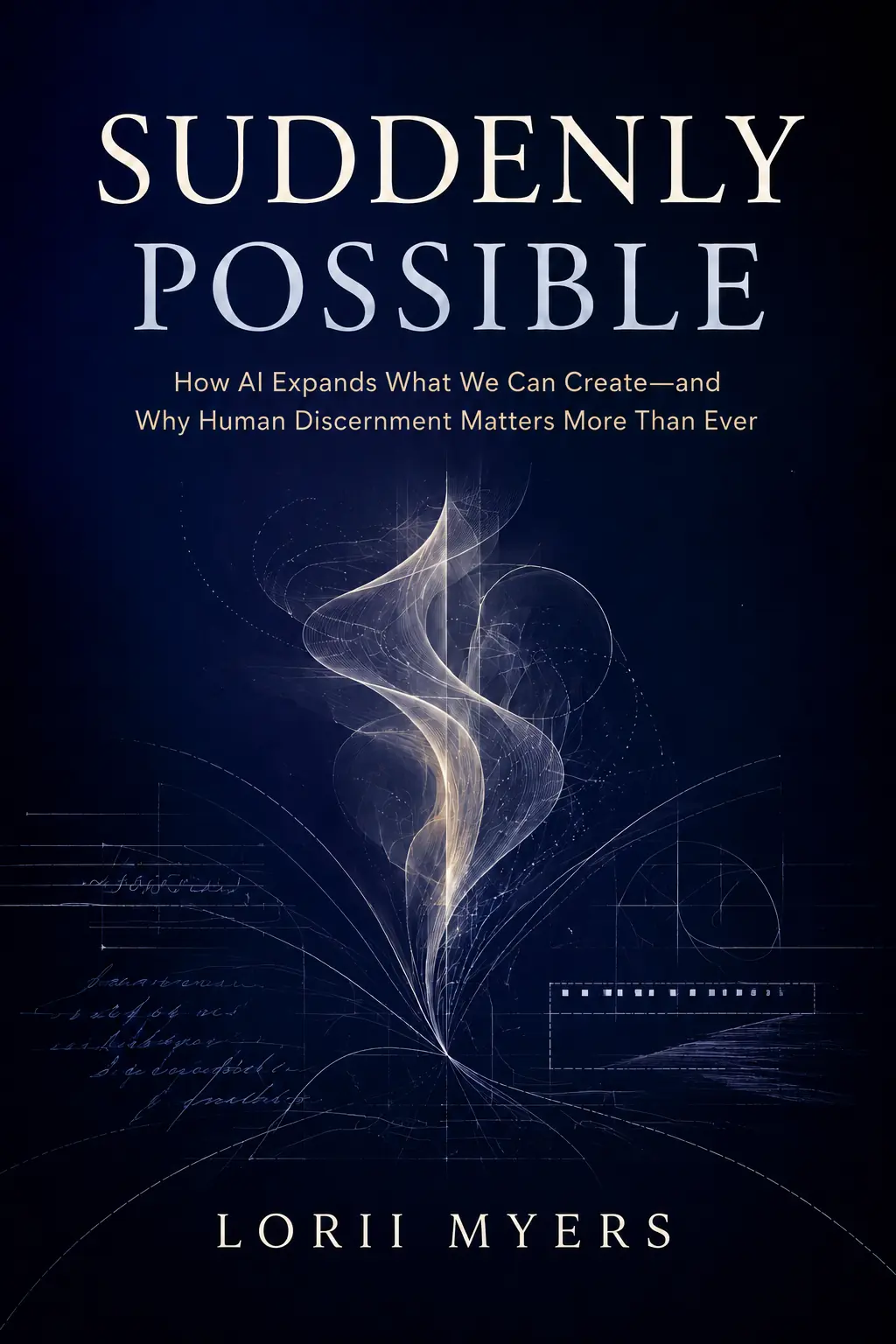
How AI Expands What We Can Create—and Why Human Discernment Matters More Than Ever
What if the idea or dream you set aside was never impossible—only beyond your reach at the time?
THE CENTRAL QUESTION
Songs, books, designs, businesses, inventions and solutions have often remained unrealized because the necessary time, training, money, physical access or institutional permission was missing. SUDDENLY POSSIBLE asks what changes when those constraints no longer decide which gifts can enter the world.
Visible achievement has often reflected access as much as talent. Lowering the cost of execution allows more human possibility to be tested rather than merely imagined.
AI can shorten the distance between intention and a first viable form, allowing an idea to answer back sooner and helping its creator learn faster.
More options increase the value of taste, verification, refusal and responsible direction. Possibility creates power; discernment decides what deserves to proceed.
THE ESSENTIAL DISTINCTION
The tool can multiply options without determining what matters, what truth must survive, whom the work may affect or whether the result deserves attention. The manuscript keeps intention, meaning, authorship and accountability where they belong: with the person directing the work.
THE READING EXPERIENCE
Why talent and access have been mistaken for the same thing.
How lowered barriers can reopen creative territory and even an entire life.
Why abundance moves the difficult work into discernment.
How direction, learning, revision and retained memory create development.
Why provenance, attention, trust and accountability grow with capability.
OFFICIAL BLURB
The most important thing AI may reveal is not what machines can do. It is how much human ability has been hidden by the cost of making it visible.
For generations, an idea had to survive the cost of training, instruments, teams, gatekeepers and time before anyone could judge it. Now more people can hear the song, see the scene, test the design or shape the argument that once remained beyond reach.
That changes who gets to begin. It does not decide what deserves to continue.
In Suddenly Possible, award-winning author and multidisciplinary creator Lorii Myers explores the shift from scarce execution to abundant first attempts—and the judgment it now demands. She separates reach from mastery, fluency from understanding, and capability from permission.
AI can help an idea answer back. What happens next is still human.
SYNOPSIS
Suddenly Possible asks a larger question than what AI can do: how much human ability remained unseen because making it visible required resources most people did not have?
Lorii Myers begins with her own experience of hearing music beyond what she could independently perform or produce. AI did not create her imagination or judgment. It allowed an intention to become audible soon enough to test, reject and refine.
From there, Myers examines how talent has been confused with access. She separates the development of ability from its production and recognition, revealing how equipment, training, collaborators, money, institutions and time determined whose ideas could enter the world.
As those barriers fall, a new distinction becomes urgent. Reach is not mastery. A polished result can arrive before understanding, and abundant first attempts can multiply unfinished thinking as easily as they accelerate learning. The human advantage shifts toward discernment: recognizing what matters, testing what is true and refusing what should not proceed.
Drawing on music, business, accessibility, engineering, education and Indigenous data governance, Myers explores reverse apprenticeship, rapid development and the ethics of borrowed power. Capability may expand, but permission, accountability and consequence remain human concerns.
The book resolves around four responsibilities: intention determines why the work should move; reach gives it form; discernment decides what survives; and responsibility keeps it answerable to the world it enters.
Suddenly Possible is not a celebration of effortless creation. It is an exploration of newly visible human capacity—and the judgment required when more people can finally bring what they carry into form.
READ THE OPENING SAMPLE
Presented from an author-approved author-review edition.
PROLOGUE
The First Version Was Wrong
The recording sounded finished. By the second line, I knew it had misunderstood me.
The voice entered with confidence, but the feeling I wanted needed hesitation. The tempo carried the song past a moment that should have been allowed to breathe. The arrangement announced what I’d meant to reveal slowly, and a familiar resolution arrived where I’d heard surprise. Nothing was obviously broken. That was the problem. The track was fluent, polished, and unmistakably not the song I’d carried.
I stopped it. Until that moment, stopping a complete-sounding recording had never been part of my creative life. I could hear what a song wanted to become, but hearing and producing lived on opposite sides of a practical distance. Now the distance had narrowed enough for disagreement. I could point to the hurried entrance, remove the crowded layer, ask for restraint, and listen again.
The first result had failed, but it had failed outside my imagination. That made it useful.
Before there was a file, the song could remain complete in the only place it existed. I could feel the hesitation at the opening and the turn I wanted the arrangement to earn, but no one—including me—could return to the same second and ask what had actually happened. Imagination preserved the intention beautifully. It also preserved it beyond cross-examination.
The recording changed that. I could replay the entrance, hear precisely where confidence had arrived too early, and separate a problem in the song from a problem in the performance of it. Critique acquired coordinates. I no longer had to defend a whole invisible arrangement in order to protect one necessary feeling. I could keep the feeling, refuse the version, and ask the work to come closer.
That was the disorienting part of release. A dream that stays private can be judged only in the absolute: either it’s special, or I was mistaken to carry it for so long. A version makes the judgment smaller and more honest. This entrance is hurried. This layer is crowding the voice. This resolution belongs to another song. The work can be wrong in one place without making the imagination fraudulent. Once error becomes specific, revision can replace self-defence.
Songs have often arrived in me larger than I could perform alone. Guitar and piano let me find the emotional centre; beyond my hands, I heard instruments, voices, silences, and turns of arrangement that remained farther from evidence.
Repeated long enough, a practical delay can masquerade as identity. The arrangement gets smaller. The ambition becomes a note in a folder. Eventually, we stop describing the work as unfinished and begin describing ourselves as people who don’t make it.
The obstacle may be real. The identity built around it may not be.
I was in my early sixties when the route widened. The imagination wasn’t new; the evidence was. An intention could become audible before every old condition had been satisfied. AI didn’t provide the memory behind the song, the reason it mattered, or the years of listening that told me when a result was merely competent. It made the work available to judgment earlier.
The first surprise was not what the tool could do, but what I still had to say.
The screen offered no ceremony. There was only a progress bar, a new file, and the ordinary click that began another listen. Yet the room had changed. A musical decision that once would have required a chain of explanations was now audible enough to accept or refuse. The change felt less like receiving an answer than gaining access to an argument I’d been having privately for years.
I listened first for the obvious things: tempo, balance, the shape of the vocal entrance. Then the less obvious differences began to surface. One version treated the lyric as certainty; another allowed it to arrive as recognition. One arrangement made the emotion larger by adding sound. Another made it larger by leaving a small pocket of silence where the listener could arrive. Both were competent. Only one belonged to the song I meant.
That distinction couldn’t be requested once and delivered intact. I had to hear the wrong emphasis before I could name the right pressure. I had to discover that a part I had imagined as supportive was competing with the centre, and that a polished transition was solving a tension the song needed to keep. The work wasn’t waiting for a single instruction. It was teaching me how to direct it.
Effortless making breaks down here. A fast version lowers the cost of the first encounter; it doesn’t remove the need for one. Because the surface arrives polished enough to conceal its errors, attention becomes more—not less—important. I had to stay past the first impression, past relief, and past the temptation to reward the tool merely for sounding finished.
The most important change was personal. I was no longer asking whether I had the right to imagine the full arrangement. I was asking which arrangement carried the truth of the song. The practical barrier had moved, and a more demanding responsibility had taken its place. My imagination could finally be contradicted by sound—and therefore improved by it.
Before a work can answer, conviction must keep the invisible idea alive. Repeated long enough, that protection can harden until uncertainty feels like betrayal.
An audible version gave uncertainty somewhere useful to go. I could be wrong about tempo without being wrong about having heard a song, and one mistaken choice no longer had to condemn the whole.
Creative authority became quieter and stronger. I could protect the emotional centre while allowing the version built around it to change.
I slowed the song and listened. I cleared space around the vocal and listened again. Each correction uncovered another decision that imagination alone had allowed me to avoid. Was the restraint essential or merely familiar? Did the chorus earn its lift? Was the line honest, or only elegant? The tool could return another version within minutes, but it couldn’t tell me which answer belonged to the work.
This was not effortless creation. It was the beginning of a more demanding conversation. Fast execution made weak choices visible sooner. It also made evasion easier: another version could always be summoned before the last one had been understood. Speed became valuable only when the next attempt remembered what the previous one had taught.
Many of us carry something that has never reached this kind of encounter. It may be a book reduced to a title, a design kept as a sketch, a business described only in conversation, or a solution whose technical route was unavailable. Responsibility, illness, money, physical access, and the need to protect a working life can teach us to stop pressing on a closed door. The dream grows quiet, but quiet is not the same as gone.
Some long-held ideas will prove thinner than we imagined. Others will expose knowledge we still need or consequences we failed to see. The opening doesn’t certify the work; it gives the work somewhere to disagree.
That’s why possibility becomes a human responsibility. The tool can widen the route. It can’t decide what’s true, what’s ready, or what deserves another person’s attention.
What if the idea or dream you set aside was never impossible—only beyond your reach at the time? Changed conditions don’t guarantee the work. They do justify a fresh verdict.
The most important thing AI may reveal is not what machines can do. It is how much human ability has been hidden by the cost of making it visible.
PART I
THE EVIDENCE WE MISTOOK FOR TALENT
At the moment of recognition, a life is compressed into a clean story. A name is announced, a finished work is held up, and arrival looks sudden. The photograph captures the evidence. It cannot capture the years when the work had no audience, no route, or no language others recognized.
Public success encourages us to read backwards. We treat visible achievement as proof that ability arrived fully formed and earlier silence as proof that little existed. But development, production, and recognition follow different schedules.
Visible achievement hides the conditions that made it possible: what development had already built, what execution still cost, and why the date the world notices is not the date a human capacity began.
CHAPTER 1
What the World Could Not See
The jar will not open. One hand braces it against the kitchen table while the other slips from the lid. Beside it sits a sketch: a broad base, a locking ring, and a lever designed by someone who knows exactly where ordinary openers fail.
The insight is real because the problem is lived. What is missing is everything required to make the insight visible to anyone else: engineering language, modelling software, materials, a prototype, testing, manufacturing, and enough money to learn from the first design rather than defend it.
Elsewhere, a less perceptive idea enters a workshop. A team gives it dimensions, tests what breaks, changes the weak joint, calculates cost, and puts a working object in front of buyers. Soon one design circulates while the other remains paper on a table.
The visible difference is easy to misname. One maker appears inventive and ready; the other appears to have only an explanation. Yet the gap may not be imagination. It may be execution capital: the accumulated tools, craft, time, money, collaborators, access, and permission that allow an intention to become evidence.
A prototype does more than prove an idea to the world. It gives the idea resistance. Resistance tells the maker what imagination alone could not: whether the need was understood, whether the form works, and what must change next.
The first prototype does not need to be impressive. It may be cardboard cut from a cereal box, a strip of rubber, and a lever borrowed from another household tool. On the kitchen table, the maker presses the jar into the rough base and discovers that the locking ring slides before enough force reaches the lid. The idea has not failed. It has done something imagination could not do by itself: it has identified the exact place where the idea is still incomplete. A private conviction has become a mechanical question.
That shift changes the maker’s relationship to the problem. Before the model existed, every objection could feel like disbelief: perhaps people didn’t understand the difficulty of opening a jar with one reliable hand. Now the maker can point to the slip, alter the angle, widen the base, and try again. The conversation becomes less about whether the need is legitimate and more about what the design must survive. Being understood still matters, but evidence gives lived knowledge a second language. The model lets the problem speak to people who have never experienced it.
When the rough mechanism finally catches and the lid begins to turn, the event is almost too small to carry the history behind it. There is no launch, no patent, no buyer. A jar opens on a kitchen table. Yet the motion returns something ordinary that the original problem had made uncertain: the ability to complete a small task without asking another person to enter it.
The model is still awkward. It may fail on the next container, pinch a hand, cost too much, or reveal a problem more difficult than the first one. The maker hasn’t proved that the design is ready. What has changed is the quality of the doubt. The need no longer depends entirely on one person’s ability to describe it persuasively. The object can now show where it helps and where it doesn’t.
That is a modest but important restoration of dignity. People whose experience has been treated as anecdotal are often asked to prove both the problem and the solution in the same breath. A prototype separates those burdens. The need can be real while the mechanism remains unfinished. The maker can accept correction without allowing a weak hinge or unstable base to erase the knowledge that made the problem visible in the first place.
Across town, another maker begins with access to a fabrication studio, a product designer, and materials left from an earlier project. By the end of the week, that idea has passed through three versions. Each version teaches something the original sketch could not. This is not proof that the second maker is less imaginative or that the first design would have been better. It is proof that development accumulates through encounters. The person with more ways to make an idea answer back receives more opportunities to become right for better reasons.
A prototype is therefore more than a miniature product. It is a conversation among intention, material, use, and consequence. The handle resists. The user hesitates. The cost estimate exposes a beautiful feature that cannot survive manufacturing. An engineer notices a load the maker did not know to calculate. Each response can deepen the work without replacing the perception that began it. Collaboration is strongest here: not as a rescue of an empty idea, but as an architecture through which one person’s insight meets forms of knowledge it needs in order to become trustworthy.
There is fair counterpressure in this account. A hidden idea is not protected from being ordinary simply because its maker lacked access. Some sketches conceal contradictions that no amount of sympathy can solve. Some answer needs that other products already meet more safely or simply. The case for wider execution is not that every private idea deserves a market. It is that quality should be tested as quality, not inferred from whether the maker happened to possess the route into testing. A fairer doorway does not promise a favourable verdict. It makes a real verdict possible.
Imagine two envelopes arriving at a small fabrication shop on the same morning. Each contains a thoughtful sketch. One is accompanied by a digital model, a materials specification, money for two trial runs, and an introduction from a previous client. The other includes a careful description and a phone number. The shop owner may be generous, but the first project is easier to price, schedule, and trust. The difference has already begun to look like readiness, even though much of what appears to be readiness was assembled before the shop ever saw the idea.
That assembled advantage is execution capital. It includes the obvious resources—money, equipment, software, and specialist help—but it also includes quieter forms of leverage. Time that can be protected. Health that permits sustained attention. Language that makes an idea legible to a professional. A reputation that earns a returned call. Experience from a previous attempt. A friend who knows whom to ask. The confidence to enter a room without first using half the meeting to prove that one belongs there. Any one of these may be modest. Together they determine how soon an intention can meet resistance.
Execution capital compounds because completed work produces more than a result. It leaves vocabulary, files, relationships, templates, judgment, and a memory of where difficulty actually lived. The second project doesn’t begin from the same place as the first. A trusted collaborator answers faster. A previous buyer provides evidence of demand. One successful test makes the next experiment easier to fund. What the world later calls prolific talent may partly be the return on an invisible infrastructure that has learned how to carry the person’s ideas. The output is real, but so is the route that made output repeatable.
Its absence compounds too. When every attempt requires rebuilding the route, even a resourceful maker spends creative energy on admission. The designer learns grant language instead of design. The musician spends the available hour coordinating schedules. The writer keeps re-explaining a cross-category book to people who need it to resemble something they already know how to sell. Repeated obstruction can become self-editing. We shorten the project before anyone rejects it. We translate the strange part into a familiar one. Eventually the affordable version begins to feel like the only version we ever imagined.
None of this makes difficulty worthless. A serious medium has demands that money and access cannot remove. Materials have tolerances. Readers notice evasions. Audiences hear when a song has borrowed feeling instead of earning it. Training can protect a maker from costly confidence and reveal possibilities unavailable to instinct alone. The point is not to eliminate every threshold. It is to stop treating thresholds as if they measure only commitment. Some friction teaches the work. Some protects other people. Some merely tests whether the maker arrived with advantages the field has learned to mistake for talent.
Now place the jar-opener sketch beside an executable tool. The maker describes the grip limitation, the need for one-handed use, the size range, and the fear that force could tip the container. A rough rendering appears. It looks convincing enough to create excitement—and it quietly assumes that a second hand will steady the jar. The system has reproduced the very condition the design exists to remove. Because the error is visible, the maker can reject it immediately. Lived experience has become an active design constraint rather than a story told before the technical work begins.
The next version may still be naive. The lever could apply force at an unsafe angle. The base could be impossible to clean. The mechanism might work for one jar and fail across the range sold in an ordinary grocery store. Yet each visible mistake improves the questions the maker can take to an engineer. Instead of arriving with only a wish, the maker can say: this motion matters, this assumption failed, these dimensions remain uncertain, and this is where professional analysis must begin. Earlier execution does not replace expertise. It lets expertise encounter a better-developed intention.
That changes the social balance of collaboration. People who have long depended on specialists to translate an idea may know the cost of watching nuance disappear during the handoff. A preliminary artifact gives them something to defend, alter, and question. It can expose the gap between what they said and what the other person heard. It can also reveal that the specialist’s objection is not resistance but knowledge. The maker retains the reason for the work while becoming more able to recognize where the work needs another mind. Agency grows through a more exact dependence, not through the fantasy of doing everything alone.
Early evidence carries a new danger: polish can make a provisional object look settled. A persuasive rendering may attract praise before safety, cost, ownership, durability, or usefulness has been tested. The maker can begin defending the picture because other people have already admired it. This is the first discipline of expanded reach: name the status of the artifact honestly. A visual direction is not a manufactured device. A simulation is not field performance. A plausible explanation is not established fact. The earlier the evidence arrives, the more carefully we must distinguish what it demonstrates from what its surface merely suggests.
Even with that caution, the gain is profound. A person who once needed a company before learning whether an idea merited a company can reach an informed no sooner. That no may save years. It may free the maker to change the mechanism, join the insight to another project, or let the idea go without wondering whether lack of courage was the true cause. A yes becomes more useful as well. It is no longer only private certainty. It is a direction that has survived its first encounter with form and has earned a more demanding one.
A blocked idea rarely announces that it is changing the person carrying it. It simply returns to the same closed door. The arrangement needs musicians who are not available. The prototype requires equipment that cannot be afforded. The manuscript asks for months that already belong to work, care, and ordinary responsibility. Eventually the mind becomes efficient. It stops walking all the way to the door.
This is more than postponement. Imagination begins negotiating with anticipated execution. A musical idea arrives smaller because the larger version has nowhere to go. A business concept is reduced to what the current team can build. A writer stops developing a form that has repeatedly proven too expensive to test. The adaptation can look like realism, and often it is. It can also become an invisible curriculum in wanting less.
Over time, imagination begins presenting only what has an obvious route.
The loss is difficult to count because no finished object goes missing. There is no rejected manuscript, failed prototype, or abandoned recording to point toward. What disappears is development itself: the extra movement never followed, the strange form never given enough attention to become coherent, the question dismissed before it acquired language. A practical life can become highly accomplished while an entire category of possibility remains underdeveloped inside it.
When the route widens, the first task may not be retrieving an old idea. It may be learning to notice the uncensored version before practicality makes it smaller. At first, that version can feel excessive or unrealistic because the old limits are still speaking in the maker’s own voice. Changed access doesn’t instantly change self-permission. Imagination may need time to discover that it’s no longer required to arrive pre-reduced.
Creative self-belief and creative behaviour influence one another. In an experiment using deliberately altered feedback, changes in participants’ momentary creative self-efficacy were accompanied by changes in originality.1 That finding does not mean praise manufactures talent or that every abandoned ambition conceals exceptional work. It supports a narrower and more useful point: what people believe they can do can affect what they risk expressing.
A changed interface can therefore release more than an old project. It can reopen a category of thought the person had learned not to elaborate. The first return may feel disproportionate to the object produced because the deeper event is not the song, page, or prototype. It is the restoration of permission to imagine at full scale.
Most creative lives contain a folder that has begun to feel like evidence against the person who keeps it. Titles without books. Melodies without arrangements. Product notes without prototypes. A business described repeatedly but never placed in a form someone could test. The folder can look like indecision from the outside and feel like a private accusation from within. After enough years, unfinished work stops being described as unfinished. It becomes a conclusion about identity: I have ideas, but I’m not someone who brings them into the world.
Expanded execution does not guarantee a kinder answer. It offers a more accurate question. What happens when this particular intention receives one honest form? Perhaps the melody depends on a borrowed turn and needs deeper work. Perhaps the business solves a problem no customer considers urgent. Perhaps the book contains one necessary chapter and twelve repetitions. These discoveries can disappoint, but disappointment after contact is different from resignation before evidence. The person is no longer defending an ideal object or condemning an untested self. They are learning from a work that can finally disagree.
Some long-carried ideas will prove worthy only of private play. That’s not failure. A person may make the family history so that three people can hear voices that would otherwise disappear, explore a visual idea for the pleasure of seeing it, or complete a song with no ambition to build a career around it. Commercial reach is one possible consequence of creation, not the measure that gives every act permission. The barrier lifting matters even when the work enters only a room, a relationship, a small community, or the maker’s own understanding.
The fresh verdict is therefore neither hidden genius nor effortless abundance. It is testability. The right next move is not always to make the largest possible version. It is to identify the smallest honest encounter that can teach what imagination alone cannot. A rough recording may be enough to test the emotional centre. A short prototype may expose the central assumption. A conversation built around a visible model may reveal whether the need belongs to anyone else. Execution capital becomes transformative when it buys learning rather than merely the appearance of completion.
Once we stop using absence as a complete measure of ability, timing becomes harder to read and more humane to interpret. The finished object tells us that something became visible. It doesn’t tell us when the person first perceived it, how long the route remained closed, or which forms of capital finally allowed the work to arrive. To understand apparent suddenness, we need more than a publication date or a moment of applause. We need to separate the clocks that have been collapsed inside the single word talent.
Execution capital does its deepest work when evidence turns self-protection into inquiry. A developed first form lets another person respond to the actual intention—and lets the maker receive resistance without hearing the whole capacity dismissed.
Talent was often access made visible.
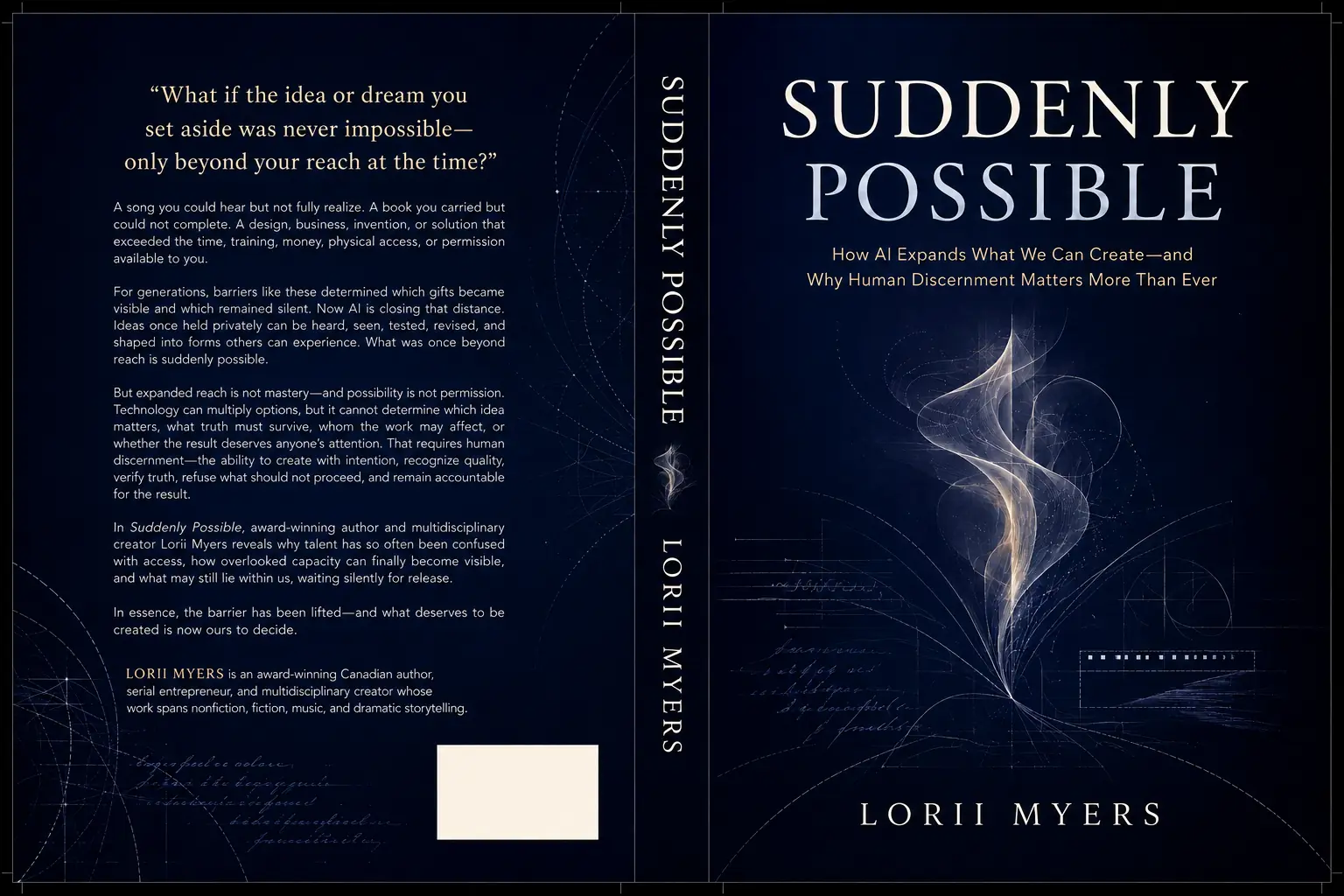
FULL-COVER PREVIEW
The final production wrap will be rebuilt from the printer's template after human editing establishes the final page count, spine width, bleed, paper stock and ISBN barcode.
THE FINAL PROVOCATION
The author-review manuscript is available for qualified editorial review. Independent human editing and final proposal alignment remain before publication.