The signal
A disclaimer or premature retreat tells others that resistance may be enough to move the position.
 LAMBO-MUSICARTIST · AUTHOR · LICENSING
LAMBO PUBLISHING · BIG-IDEA NONFICTION · LORII MYERS
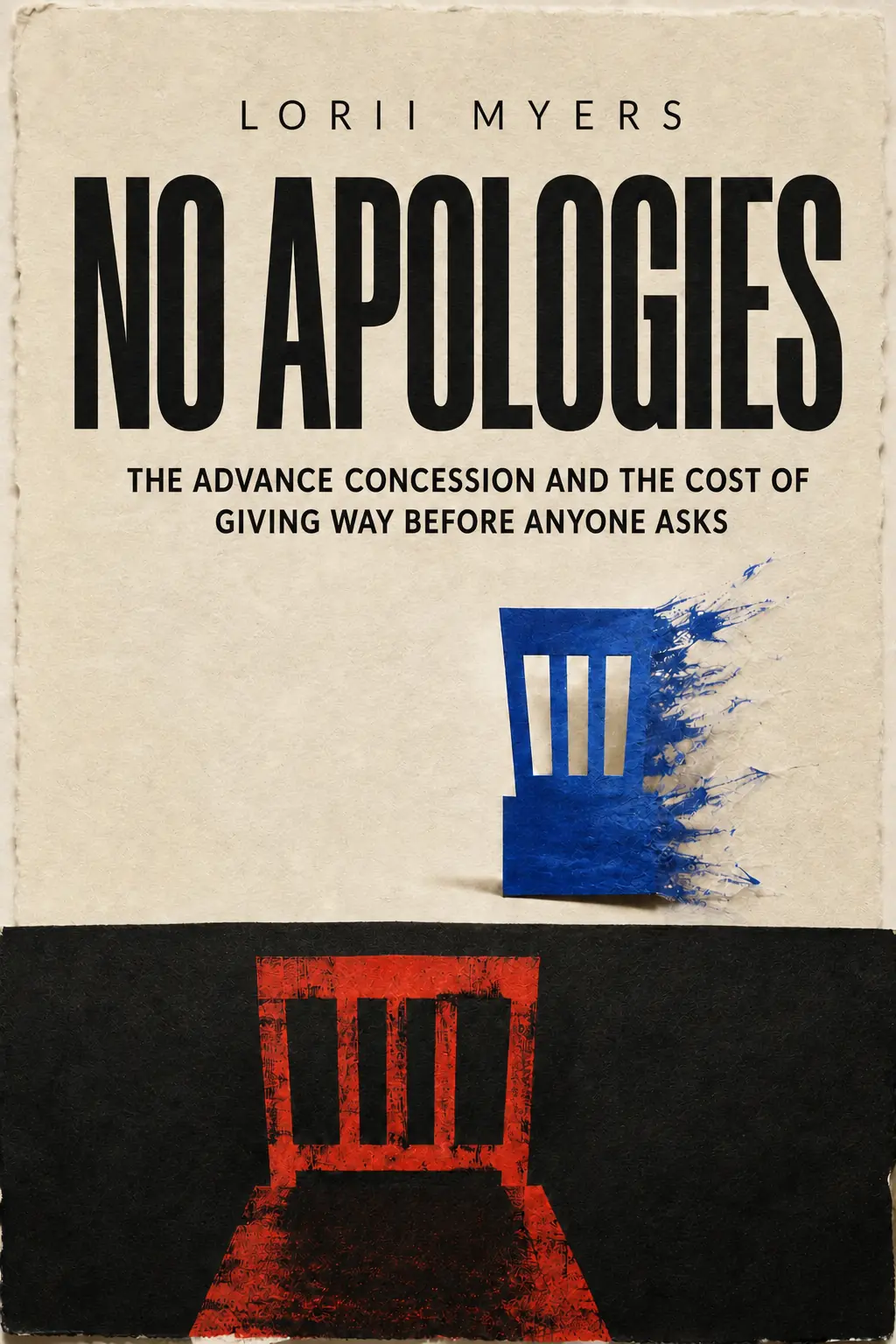
The Advance Concession and the Cost of Giving Way Before Anyone Asks
An apology can surrender authority before anyone has challenged it.
THE CENTRAL PROPOSITION
An unnecessary apology does more than soften a sentence. It changes the starting position—making an idea, price, boundary or decision appear negotiable before anyone has tested it.
A disclaimer or premature retreat tells others that resistance may be enough to move the position.
What sounds courteous can discount authority before the idea, limit or decision receives a fair hearing.
Repeated accommodation becomes familiar, then expected, until its original cost disappears from view.
THE ESSENTIAL DISTINCTION
The book separates actual harm from disagreement, disappointment, inconvenience and change. Genuine accountability remains non-negotiable. Invented guilt does not.
THE READING EXPERIENCE
False guilt, softened positions and the private cost of remaining easy to accommodate.
What genuine apology repairs—and why responsibility becomes stronger when it is specific.
Ideas, prices, boundaries and completed decisions tested by disappointment and resistance.
How repeated concessions become expectations, precedents and eventually systems.
OFFICIAL BLURB
An unnecessary apology can concede the negotiation before it begins.
It appears before the idea, beside the price, inside the boundary and after the decision. No harm has occurred, yet the speaker has already suggested that their position may be excessive, inconvenient or open to reversal.
No Apologies argues that this reflex is not harmless politeness. It is an advance signal of surrender—and repeated often enough, accommodation becomes expected.
The question is not whether we apologize too much.
It is how much authority we surrender before anyone asks.
SYNOPSIS
An apology can surrender authority before anyone has challenged it.
It may appear as a disclaimer before an idea, a discount attached to a price, an explanation buried inside a boundary, or a decision reopened because someone dislikes it. No harm has occurred, yet the speaker has already suggested that their position is negotiable.
No Apologies identifies this hidden transaction as the Advance Concession. Lorii Myers argues that unnecessary apology is not harmless politeness. It changes the starting position, signalling that an idea can be discounted, a price lowered, a boundary moved, or a decision reversed.
The book separates wrongdoing from discomfort, disappointment, disagreement and change. When these experiences are treated as equal evidence of harm, one person becomes accountable not only for their conduct, but for preventing every unwelcome reaction to it.
Across twelve chapters, the analysis moves from language and private relationships into negotiation, pricing, professional authority, workplace records, leadership and institutional power. It reveals how repeated accommodation changes what others believe they are entitled to receive.
This progression culminates in the Complacency Effect: a concession is first appreciated, then expected, then forgotten as a concession at all. It becomes the baseline. When the accommodation ends, the return to fair terms is treated as selfishness, aggression or failure.
No Apologies is big-idea nonfiction about language, power, responsibility and the hidden architecture of surrender. Some actions require repair. A legitimate idea, fair price, responsible boundary or considered decision does not require an advance apology.
READ CHAPTER ONE
Presented from an author-approved author-review edition.
“Sorry” can perform several jobs.
It can be an apology: “I shared information that was not mine to share. That was wrong.”
It can be sympathy: “I am sorry you are dealing with this.”
It can be a social courtesy, a quick signal used while moving through a crowded space or correcting a minor interruption.
And it can be a request for permission to exist in the interaction at all.
The first three uses can be thoughtful, useful, and humane. The fourth is where self-erasure begins.
Consider a composite example. Celeste coordinates a small community committee. She is organized, prepared, and unusually attentive to detail. She reminds volunteers of the dates they selected, distributes concise agendas, and catches problems before they become expensive.
Yet nearly every message begins the same way.
“Sorry to bother everyone.”
“Sorry for another reminder.”
“Sorry, but I need the final numbers.”
“Sorry if this is too much information.”
None of these messages follows misconduct. Reminding people of a commitment is part of Celeste’s role. Requesting information required to complete the work is not an intrusion. Providing the relevant detail is not an offence.
Still, Celeste feels a flash of anxiety before she presses send. She imagines recipients rolling their eyes. She edits the message to sound smaller. The apology relieves the anxiety for a moment because it communicates, I know my request creates effort. I promise I’m not claiming too much importance.
The relief is real. So is the cost.
Inside the message, an agreed deadline has been recast as Celeste’s personal imposition. The recipient may comply, delay, or ignore it; the sentence cannot determine which. But before any response arrives, the real subject—figures required for a committee decision—must compete with a second subject Celeste introduced: whether she was entitled to request them.
The distortion is not caused by one word. The word reveals the arrangement inside the sentence.
A useful apology is specific. It attaches responsibility to an action:
I interrupted you repeatedly.
I failed to tell you the schedule changed.
I used a dismissive tone.
Specificity creates the possibility of repair because behaviour can be addressed.
A self-erasing apology is diffuse. It attaches wrongness to presence:
Sorry for needing anything.
Sorry for being difficult.
Sorry for taking your time.
Sorry for making this a problem.
The shift does more than soften the sentence; it changes the subject. Instead of evaluating a choice, the speaker evaluates the self. The subject is no longer the late report or sharp comment. The subject is whether the person should have had a need, raised a concern, occupied attention, or changed the atmosphere.
This is why counting apologies is not enough. A person can say “sorry” often because their work involves coordinating minor disruptions. Another can say it rarely while privately assuming blame for everyone’s mood. The important question is not simply How many? It is What does the apology claim was wrong?
An apology should name harm—not make your existence the harm.
Psychologists Dana Jack and Diana Dill developed the Silencing the Self Scale to study patterns in which people suppress thoughts, needs, or aspects of the self in order to preserve connection. Their 1992 work focused on women and found associations between self-silencing schemas and depressive symptoms. The study does not establish that every act of accommodation is harmful, that the relationship is identical across all people, or that silence alone causes depression. Its enduring value is conceptual: it gives language to the way connection can become organized around the belief that safety depends on withholding the self.
That organization may appear quiet and considerate from the outside.
Inside, it can sound like this:
If I say what I need, I will become demanding.
If I disagree, I will damage the relationship.
If I set a limit, I will reveal that I am selfish.
If someone reacts badly, the reaction will prove I should have stayed silent.
The apology arrives as a bridge between what the person knows and what they feel permitted to say. It allows a partial truth to cross, but only after the truth agrees to arrive bent.
This is not weakness. Often it is adaptation.
Some people learned early that direct needs were ignored, mocked, or met with disproportionate conflict. Some work in environments where disagreement carries real professional risk. Some belong to cultures or families in which indirectness expresses respect. Some communicate with people who interpret any boundary as rejection. Some have roles that legitimately require tact and service.
The answer is not to shame the strategy. If an apologetic reflex helped you navigate a difficult environment, it deserves understanding before revision.
But an adaptation can continue after the conditions change. A sentence once used for protection can become the default even among people who would tolerate clarity. A person can keep paying for safety that the present moment does not require.
Reflexive apology often appears before anyone has accused the speaker of anything. It is pre-emptive.
“Sorry if this sounds foolish, but…”
“Sorry, I may be wrong…”
“Sorry to ask…”
“Sorry, this is probably inconvenient…”
The speaker supplies the criticism and then tries to neutralize it. This can feel prudent: if I name the weakness first, no one can surprise me with it.
Yet the strategy has an unintended effect. It introduces a negative frame that the listener may not have considered. The idea now arrives labelled foolish. The request arrives labelled burdensome. The disagreement arrives labelled presumptuous.
The apology becomes a discount offered before the other person has seen the value.
This does not mean a confident sentence will always be accepted. A proposal can be weak. A request can be denied. A question can reveal that more preparation is needed. The change is not from uncertainty to infallibility. It is from self-indictment to evaluation.
Compare:
“Sorry, this may be a bad idea, but could we change the order?”
with:
“I see one risk in the current order. May I show you an alternative?”
The second sentence does not claim certainty. It names a reason and offers something testable. It gives the other person room to consider the idea without requiring the speaker to become smaller first.
At the level of a sentence, the advance concession performs a subject change. Before anyone evaluates the underlying idea, request, price, limit, or decision, the speaker offers something else for evaluation: the security of the person presenting it. The idea is no longer alone before the evidence. Its author’s advertised doubt has entered beside it.
That added subject can redirect the exchange. “I may be missing something” accurately marks uncertainty when the evidence is incomplete. “This is probably a bad idea” goes further. It assigns the idea a negative value before the room has supplied one. “I can explain the assumptions and revise if the evidence changes” leaves a position open to analysis. “I’m sorry, and I can lower it if necessary” announces that the position may move without analysis at all.
The difference is not bravado. A serious claim should carry its limits. The question is whether those limits arise from evidence or from anticipated permission. Honest uncertainty tells a listener what remains unknown. The advance concession tells the listener that the speaker’s own assessment may be safely outranked by unease.
That signal matters in settings where attention is scarce. In a meeting, every proposal competes with the agenda, status differences, existing commitments, and the simple momentum of whoever spoke first. A presenter who spends the opening sentence questioning the legitimacy of her contribution makes the room process two claims at once: the proposal and its author’s warning not to take it too seriously. The room may still assess the work fairly. It may also accept the warning because doing so is cognitively and politically easy.
Consider Celeste’s committee. “Sorry for another reminder” does not merely soften a request for figures. It frames the agreed deadline as Celeste’s personal preference and the reminder as an imposition. A volunteer who delays may not consciously decide that her role lacks authority. The message has already made delay easier to interpret as harmless. The operative information—figures are due, the total depends on them, and missing data will postpone the decision—arrives behind a confession that competes with it.
Price makes the same distortion easier to see. A price is a proposed term reflecting some combination of labour, expertise, risk, cost, scarcity, and value. It is not sacred; a buyer can challenge it and a seller can revise it. But when the seller apologizes for the number and offers a reduction before the buyer responds, the exchange acquires a fact unrelated to the work: resistance may not be required to change the term. The buyer has not behaved badly by noticing the information offered.
Other currencies are harder to record. Time, attention, credit, authorship, privacy, and professional judgment can be marked down without an invoice showing the reduction. “I can work around everyone” makes one person’s time the adjustable unit. “It was really the team” can recognize collaboration or erase a contribution, depending on the facts. “This is only my view” can mark a genuine interpretive limit or invite people to treat expertise as embarrassment. The words acquire meaning from the surrounding conduct, but each can identify where retreat is available.
A boundary carries similar information. “I cannot take calls after six” states a condition. “I am sorry, and I can make an exception if this is inconvenient” states a condition and immediately supplies the route around it. No one needs to reject the limit; the speaker has placed the exception beside the rule. That may be a chosen accommodation in a genuine emergency. Presented as a reflex before the circumstances are known, it prevents the limit from being encountered on its own terms.
None of this makes the recipient the sole judge of meaning. Listeners have responsibilities too. A manager can notice when a careful employee habitually understates good work. A client can negotiate without exploiting visible anxiety. A family can ask what an offer costs instead of assuming that silence means ease. People with power should not treat another person’s deference as proof that unequal treatment is deserved.
Nor does one apologetic sentence determine an outcome. The proposal may win. The price may hold. The boundary may be respected. Bias, rank, culture, timing, and the quality of the underlying position remain consequential. The claim at this point is narrower: an advance concession supplies avoidable evidence against the security of the position before the position has met its actual test.
What repeated signals eventually permit institutions and relationships to assume is a later question. Chapter 12 returns to the larger social mechanism. Here, at the level of a sentence, the essential act is already visible: the position has not failed its test; the speaker has volunteered to become part of the test. Another person may no longer have to meet the idea, price, boundary, or decision on its stated terms.
The same sentence can require a different response depending on what happened. Three meeting incidents show why the Apology Line cannot be reduced to a ban on “sorry.”
A committee member agreed to prepare the figures, forgot, and arrived without them. The group could not make the planned decision. His opening is specific:
“I did not prepare the figures I committed to bringing, and that prevented the group from completing the decision today. I am sorry. I will send them by three and confirm a new decision time.”
The apology belongs because a clear commitment was not met. Removing it in the name of confidence would not restore authority; it would erase the breach. The repair also identifies what happens next, so remorse is connected to the work the group lost.
A second committee member arrives after the start because her building was unexpectedly evacuated. She notified the group promptly and joined as soon as access resumed. Her opening is different:
“Thank you for adjusting. I know the delay compressed our time. I am ready to begin with the decision items.”
She recognizes the effect and helps the group move forward. There is no need to accept moral blame for the evacuation. An apology would not be catastrophic, but it would name responsibility inaccurately when gratitude, impact, and coordination carry the relevant facts.
A third participant asks a clarifying question because the proposal contains an undefined cost. The presenter appears impatient. The participant says:
“I need the cost defined before I can support the proposal. What’s included in that estimate?”
The impatience does not transform due diligence into misconduct. The participant is performing the role the meeting requires. An apology here would place the presenter’s mood ahead of the group’s need for a sound decision.
The cases are not formulas. Context can change them. Habitual lateness cannot be excused indefinitely by external events. A clarifying question used to humiliate a presenter can require repair for its manner even when the information is necessary. A person with authority over the room carries an additional obligation to consider how the question lands and whether the setting is fair.
The Apology Line does not eliminate judgment. It improves it.
An understandable objection arises here: Does every sentence now have to sound blunt?
No.
Warmth is not weakness. Courtesy helps people coordinate. Indirect language can be elegant, culturally appropriate, strategic, or kind. Not every “sorry” contains a crisis of identity. People use words idiomatically. Tone and relationship matter.
The problem is not softness. It is self-subtraction.
Grace does not require a declaration of guilt. “Thank you for waiting” recognizes patience; “I appreciate your flexibility” recognizes adjustment. Neither statement is a disguised refusal to care. Each names the contribution the other person actually made instead of inventing misconduct by the speaker.
The same precision appears in ordinary assertions. “I have a question” identifies the need for information. “I see this differently” identifies disagreement. “I am not available for that” identifies capacity. “Let me correct that” identifies an error whose remedy matters more than ceremony. “I need time to consider it” identifies the condition for an honest answer. Taken together, these sentences are not a bank of approved substitutions. They demonstrate a larger linguistic fact: guilt and aggression are not the only available registers. Courtesy can carry accurate information without making the speaker the offence.
Once people recognize an over-apologizing habit, they can overcorrect. They begin treating every apology as weakness or every complaint as an attempt to control them.
That is not growth. It is avoidance wearing a stronger voice.
When someone reports an effect, classifying the response immediately as mere discomfort repeats the imprecision this argument opposes. The event, agreement, distribution of power, pattern, and difference between a decision’s content and its delivery all belong in the account.
A person may be entitled to say no and still owe an apology for contempt. A person may be right about the facts and still owe repair for disclosing them in a setting that exposed someone unnecessarily. A changed plan may be legitimate while earlier notice was still owed. The preferred outcome may not be owed while honest information about the actual outcome is.
No apologies is not a shield against feedback. It is a commitment to accurate responsibility.
The advance concession is easy to miss because intention and effect often diverge. A speaker may intend courtesy while communicating uncertainty, intend generosity while lowering a term, or intend to prevent conflict while showing that conflict will reverse the position. Three brief exchanges expose the difference.
In the first, an analyst writes, “Sorry to ask, but I need the final quantity.” The quantity is required for work already assigned to her, and the recipient supplies it without objection. Her apology does not repair anything. It records an anticipated accusation—that obtaining necessary information is demanding—and allows that accusation to frame an ordinary dependency. “I need the final quantity by noon” carries the deadline and the request without adding hostility.
In the second, the same analyst sends a report without an attachment that an agreed handoff required. Work stops while a colleague asks for the missing file. Here “I omitted the attachment. I’m sorry. It is included now” is not self-subtraction. It names the exact omission, recognizes the interruption, and completes the immediate repair. A brisk “Here it is” might solve the technical problem while leaving the breach of the agreement unacknowledged.
In the third, a venue closes unexpectedly and the coordinator must move an event. She informs participants as soon as the closure is confirmed. “Sorry for the change” sounds natural, but it blurs cause and effect: she did not close the venue, though other people must revise their plans. “Thank you for adjusting. Here is the updated schedule” recognizes their effort and supplies what they need. The language remains warm because warmth was never the problem.
The evidence is not the number of apologies. It is the relationship among the event, the speaker’s fear, the actual obligation, the effect, and the social instruction contained in the sentence. The first and third exchanges do not require colder speech. They require the available information to survive the speaker’s anxiety. The second requires an apology because removing it would erase responsibility rather than restore authority.
Variation across roles supplies another clue. A person may speak directly as an expert and apologetically as a family member, or defend a professional price while treating every personal limit as provisional. That variation is evidence against a fixed personality explanation. Reflexive apology may attach to a particular expectation, power arrangement, or anticipated judgment. Its revealing feature is always the same: what the sentence tells the listener can be surrendered before the facts require it.
Self-erasure rarely announces itself as surrender. It often sounds responsible, considerate, even refined. That is why it can survive for years without examination.
The evidence appears in the pause before a familiar word.
The governing question is: What is this sentence about to make the subject?
When the answer is a broken promise, careless conduct, or avoidable harm, the conduct belongs at the centre and clear apology belongs with it. When the answer is the speaker’s reasonable need, legitimate question, difference, or simple visibility, the apology has changed the subject before the evidence arrives.
THE FINAL PROVOCATION
The manuscript is in author review. Independent editing, evidence and permissions review, legal and privacy review, copyediting and proof remain before publication.