The meaning gap
Why familiar words can create different expectations when a label is mistaken for its contents.
 LAMBO-MUSICARTIST · AUTHOR · LICENSING
LAMBO PUBLISHING · LANGUAGE · MEANING · ACCOUNTABILITY · LORII MYERS
TELL ME WHAT IT MEANS.
“I love you. Trust me. We’ll take care of it. I’ll work hard.”
We use these phrases as though their meaning is self-evident. It isn’t.
Language is meant to carry meaning. Yet we use it to blur responsibility, substitute intention for commitment, and let words such as soon, support, aligned, and handled create agreements no two people understood the same way.
Sometimes confusion is accidental. Sometimes ambiguity is the strategy.
In I Know What I’m Saying, award-winning author and entrepreneur Lorii Myers puts everyday language under investigation—from love and business to investigative interviewing and counterintelligence. She separates what was said from what was inferred, intention from commitment, and discomfort from deception. She reveals why body language is a reason to ask another question, not a verdict—and how to turn hollow declarations into language that can be understood, tested, and trusted.
Because “I love you” names a feeling, not how someone affects you or what loving them changes. “I’ll work hard” names an intention, not a result, deadline, or standard. And “trust me” is not evidence.
A declaration tells us what you call it. Meaning tells us what it does.
Say what you mean. Hear what was said. Be honest enough to recognize and accept what was avoided.
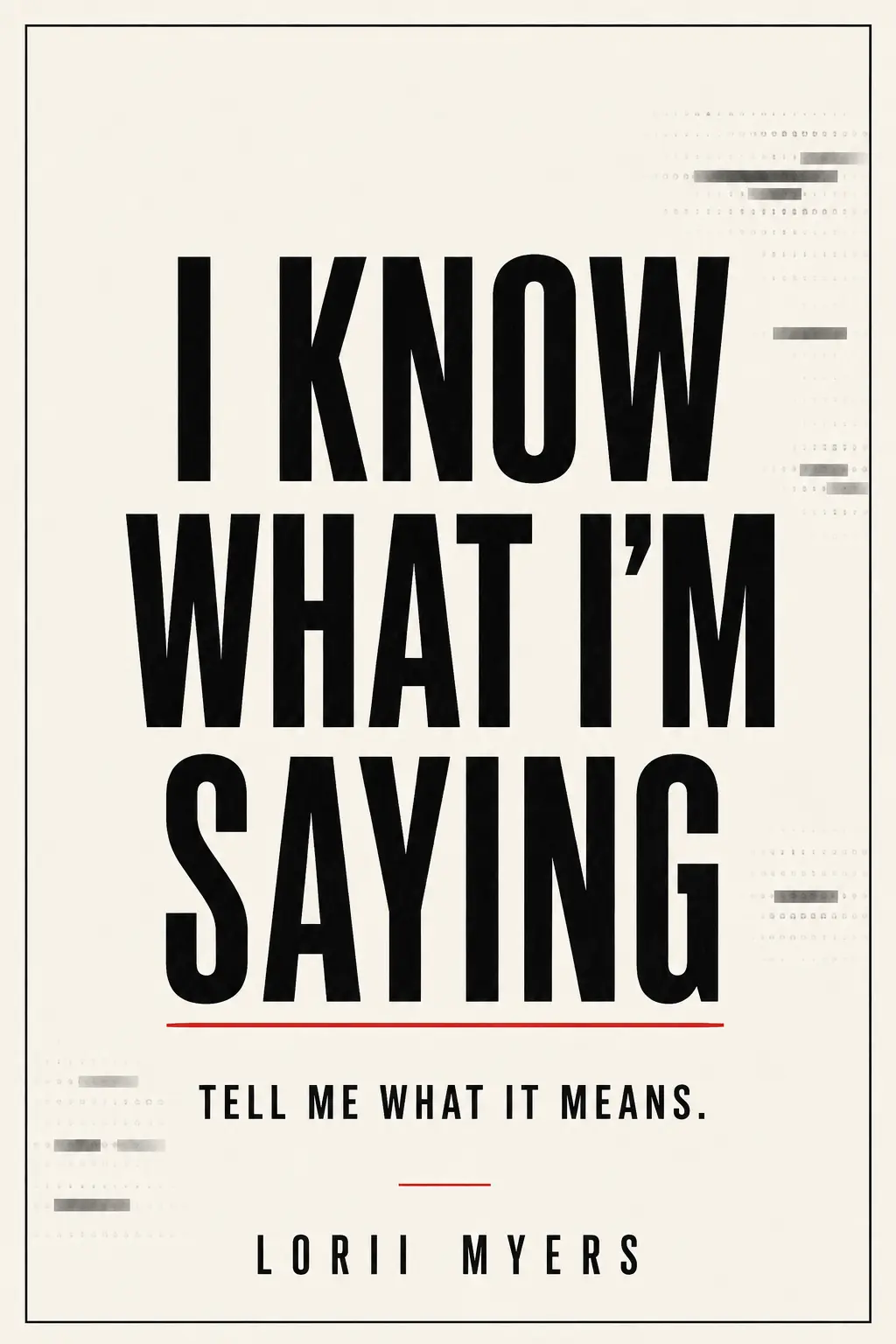
THE PUBLIC PREMISE
In I Know What I’m Saying, award-winning author and entrepreneur Lorii Myers puts everyday language under investigation—from love and business to investigative interviewing and counterintelligence. She separates what was said from what was inferred, intention from commitment, and discomfort from deception. She reveals why body language is a reason to ask another question, not a verdict—and how to turn hollow declarations into language that can be understood, tested, and trusted.
Why familiar words can create different expectations when a label is mistaken for its contents.
How to separate language from inference, private intention from public commitment and a cue from a conclusion.
Questions that make meaning knowable without rewriting the speaker or letting ambiguity govern the listener.
READ THE OPENING SAMPLE
Presented from an author-approved author-review edition.
“Don’t worry. I’ll take care of it.”
One person hears: I own this. It will be finished by Friday.
The other means: I’ll make a call when I have time.
Friday arrives. Nothing is finished. One defends the expectation; the other defends the intention. Both insist the sentence was clear.
It was not.
Most consequential misunderstandings do not begin with silence. They begin with a sentence everyone believes they understood.
The danger in vague language is not that it says nothing. It says just enough to stop the next question.
I know what I’m saying can be a declaration of self-knowledge: Do not rewrite my words to make them easier for you to accept.
It can also be a shield: Do not ask me to explain what my words require of me.
This book takes both seriously.
The listener is not entitled to overwrite the speaker’s meaning. The speaker is not entitled to govern the listener with an invisible definition.
If you know what you’re saying, make it knowable.
Knowing what you meant is not proof of what you communicated.
I do not owe you the meaning you prefer. I do owe you enough clarity that you can disagree with what I actually expressed.
Some words sound complete because they’re familiar.
“I love you.”
“I’ll work hard.”
“I support you.”
“We’re aligned.”
“We’ll handle it.”
“Trust me.”
Each phrase may be sincere. None defines itself.
The problem is not that love is too small a word. It is that the word is so large we often allow it to end a conversation it should begin.
What does your love require of you? What may I reasonably rely on? What changes because you said it?
“I’ll work hard” has the same problem in business.
What outcome do you own? What will exist, by when, and to what standard? How will we know it’s complete?
Effort was promised. Performance was inferred.
“Trust me” is a request. It is not evidence.
“We support you” may mean funding, staff, public advocacy, private encouragement—or nothing beyond approval in principle.
“We’ll handle it” begins with a basic question:
Who’s we?
These are label traps: words broad enough to create confidence but too undefined to establish responsibility.
Precision does not make language cold. It makes responsibility visible.
Not every feeling needs a deadline. A promise does.
A usable commitment identifies an actor, an action, a time, a standard and a way to confirm completion. A promise without a plan may be sincere. It is not yet executable.
When investigators preserve evidence, they document where it came from, who handled it and what changed. Important language deserves similar care.
Every consequential exchange creates a chain:
What was said.
What the speaker intended.
What the listener heard.
What the listener inferred.
What happened next.
Conflict begins when those records are collapsed into one.
By the time consequences appear, the exact sentence has often been replaced by a memory of what it was supposed to mean. Intention becomes evidence of communication. Impact becomes evidence of motive. Assumption becomes agreement.
None of those substitutions is reliable.
Intent does not erase impact. Impact does not retroactively create intent.
The speaker has authority over what was intended. The listener has authority over what was experienced. Neither has sole authority over the entire exchange.
Return to the record.
What were the exact words? Which expectation did they create? What was stated, and what was supplied by inference? Was the meaning clarified? What conduct followed?
The sentence is evidence.
Your interpretation is a hypothesis.
That does not mean interpretation is useless. It means it must be examined before it is promoted to fact.
Not all ambiguity is deceptive. People speak loosely because they’re hurried, uncertain, emotional or still forming a thought. Honest people qualify, revise and admit when they do not know.
Ambiguity can also be convenient.
It can secure trust without accepting accountability. It can invite another person’s time, loyalty, money or silence while preserving room to retreat later.
The sentence remains broad while the benefit is collected. It becomes narrow when the bill arrives.
“I said I’d support the project. I never said I’d fund it.”
“I said I’d try. I never promised a result.”
“I said soon. I never gave you a date.”
No single vague sentence proves manipulation. A pattern deserves more attention—especially when the ambiguity repeatedly benefits the same person and clarification is consistently resisted.
The best question does not accuse. It locates.
Who is responsible?
What, specifically, will happen?
By when?
What standard applies?
How will we verify it?
What happens if it does not occur?
These questions are not hostile. They expose whether two people are standing inside the same agreement.
They also require self-examination. We often demand precision from others while preserving flexibility for ourselves. We want our intentions credited and their words enforced.
Clear language costs us our escape routes.
That’s one reason we resist it.
Words are not the only information available to us. Tone changes. Pauses lengthen. Posture shifts. Eye contact breaks. A person becomes unusually still, animated or defensive.
Notice the change.
Do not invent its cause.
Discomfort is observable. Deception is an explanation.
The same behaviour may reflect fear, fatigue, shame, anger, confusion, trauma, cultural difference or the pressure of being judged. Bodies display change. They do not supply its meaning.
A cue earns a question, not a conclusion.
The discipline borrowed from serious investigative interviewing is not the fantasy of catching lies through a glance or gesture. It is the practice of producing an account that can be examined.
Begin broadly: Tell me what happened.
Then narrow: What happened next? Who was there? What did you do to prepare?
Clarify contradictions without feeding the desired answer. Compare details with records, conduct and independent evidence. Summarize what you heard and allow correction.
Precision does not prove honesty. It removes hiding places.
A relationship, a business negotiation and an intelligence interview aren’t equivalent situations. Their stakes and ethics differ. What travels between them is a discipline:
Preserve the words.
Separate observation from inference.
Ask before accusing.
Verify what matters.
The goal is not to become suspicious of everyone. It is to become exact enough that neither charm nor fear gets to do the work of evidence.
Recognition is seeing the gap.
Acceptance is refusing to fill it with what you hoped the speaker meant.
Acceptance is not approval. It does not require you to excuse the outcome or presume a hidden motive. It means allowing what happened—including repeated avoidance—to inform what you do next.
If someone says, “I support you,” but won’t name a single act of support, recognize the limitation.
If someone says, “Trust me,” but rejects every reasonable form of verification, recognize what’s being requested.
If someone repeatedly promises effort while refusing ownership, timing or standards, recognize that no usable commitment has been made.
Sometimes the answer is not contained in the original words. It is revealed by the refusal to clarify them.
Clarity does not guarantee agreement. It may reveal that no agreement existed. It may expose a difference that warmth, habit or hopeful interpretation had concealed.
That is not a failure of communication.
It is usable truth.
The book moves through love, loyalty, work, leadership, negotiation and investigation, separating promises from suggestions and later denials. It follows the meaning gap from intimate declarations and workplace promises into digital communication, public language and the deliberate engineering of inference.
It will also turn the examination inward.
Did you say enough to be understood?
Did you hear the sentence that was spoken—or the one you needed?
Did you recognize the missing answer?
Were you willing to accept it?
“Tell me what it means” is not a demand for perfect language. It is a refusal to let an important word perform work it was never defined to do.
Say what you mean.
Hear what was said.
Be honest enough to recognize and accept what was avoided.
The word was approved.
At 4:12 on Tuesday afternoon, the design director typed it into the project thread beneath the new campaign:
APPROVED.
Production released the files. Marketing booked the launch. The account team told the customer they were ready. By morning, the supplier had begun preparing an order large enough to make reversal expensive.
Then legal reviewed the campaign.
The central claim had not been cleared. Finance had not released the additional budget. Operations had not approved the delivery schedule.
The launch stopped.
“You said it was approved.”
“I approved the design.”
No one had invented the word. No one needed to be lying. The design had been approved—by one person, for one purpose, at one stage. Everyone else treated the label as permission for the next action they already expected to take.
The project did not fail because approved meant nothing. It failed because the word had been asked to mean too much.
Approved by whom?
Approved for what?
Against which standard?
With what still open?
What action did the approval authorize?
The file contained the evidence. The argument was inside the word.
This is the Label Trap: treating the name of a condition as though it has also supplied the definition, scope, standard, evidence and consequence of that condition.
A label can organize a conversation. It cannot finish the evidence.
Labels are indispensable. They save time. They gather several facts, judgments or conditions beneath one usable word.
Ready. Safe. Fair. Final. Qualified. Resolved.
Without labels, ordinary conversation would become unbearable. “Dinner is ready” doesn’t usually require a written standard for temperature, table settings and the location of every person expected to eat. Context does the work. Shared history does the work. The cost of a small difference is low.
The trouble begins when a familiar word creates the feeling of agreement before its criteria have become shared.
A Label Trap can move through four stages.
First comes compression. Several conditions are folded into one word. Ready may compress completed work, tested work, approved work, staffed work and work that can safely move forward.
Then comes projection. The listener supplies the conditions normally associated with that word. The speaker says ready. One person hears ready for review. Another hears ready for release.
Then comes closure. Because everyone recognizes the word, the conversation feels complete. People nod. They proceed. The missing criteria become invisible.
Finally, when consequences arrive, there may be elasticity. The word is narrowed, expanded or redefined:
“I said the draft was final. I did not say legal had approved it.”
“I said the proposal was realistic. I did not say we had the budget.”
“I said the issue was resolved. I meant the file was closed.”
That elasticity may be innocent. The speaker may have assumed the context was obvious. The listener may have supplied more than the sentence could carry. Or the ambiguity may have been useful. Motive is a later question.
For now, the important fact is simpler:
The label came from the speaker. The working definition did not.
A shared word can conceal two private standards.
Labels fail in different ways. Three kinds appear repeatedly.
Status labels tell us where something appears to stand: approved, final, complete, ready, resolved.
Their hidden question is stage.
When someone says a file is final, final for whom? Has the author finished revising? Has the client signed off? Have legal, design and production completed their reviews? Can another person now rely on the file without checking?
“Final” often sounds like the end of a process when it may mark only the end of one person’s part.
Evaluative labels announce a judgment: fair, reasonable, appropriate, realistic, successful.
Their hidden question is standard.
Two people can possess the same facts and disagree about whether an offer is fair because one values equal division and the other weighs contribution, risk, need or precedent. An institution can say it took “appropriate action” without naming the action, the policy, the decision-maker or the standard used to judge appropriateness.
The label delivers the verdict while withholding the test.
Risk or capability labels suggest that something can be trusted, used or entered: safe, secure, accessible, qualified.
Their hidden questions are conditions and limits.
Safe for whom? From which risk? Under what circumstances? For how long? Secure against what kind of failure? Accessible in which way, through which route, for which user or need?
These words can be accurate within a defined frame and dangerously broad outside it. The problem is not their use. The problem is allowing the positive conclusion to travel farther than the supporting criteria.
A label tells us where something has been placed. Criteria tell us whether it belongs there.
Consider a much smaller label:
“The room is clean.”
The wastebasket is empty. The cups are gone. The floor is visible. The bed is unmade, the chair holds a pile of clothes and the desk has not been wiped.
One person says the room is clean. Another says it isn’t.
They may not be disputing the facts. They may be having one of three different arguments.
They may have a content dispute: Does clean include making the bed and wiping the desk?
They may have a threshold dispute: How much disorder can remain before the room no longer qualifies as clean?
Or they may have an evidence dispute: They agree that the floor must be vacuumed but disagree about whether it was.
Repeating clean more forcefully won’t solve any of them.
Definitions do not end every disagreement. They reveal what the disagreement actually is.
That matters because people often argue at the level of the label:
“It was fair.”
“No, it wasn’t.”
“The system is secure.”
“Clearly it isn’t.”
“We were transparent.”
“You hid everything.”
Each side defends a conclusion. The useful questions remain below it: What did the label include? What threshold applied? What evidence was used? Which consequence was the word expected to authorize?
Meaning is not made clearer by volume.
Most labels do not need to be placed under examination.
Shared shorthand is normal. A colleague recommends a “nice” restaurant. A friend says the traffic is “bad.” Someone texts that they’re “almost ready.” The words may be imprecise, but the cost of a slightly different interpretation may be trivial.
Precision becomes necessary when reliance becomes consequential.
Someone may spend money, commit time, release a product, accept risk, stop checking, disclose information, decline an alternative or assure another person because a label sounded complete.
The mechanism does not change when the stakes rise. The cost of relying on it does.
The Label Trap deserves attention when the word:
• authorizes action;
• transfers responsibility;
• moves money or resources;
• closes an inquiry;
• affects safety or access;
• establishes a standard against which someone will later be judged; or
• invites another person to rely on a conclusion they cannot independently see.
One further question matters:
Who has the authority to apply the label—and who bears the consequence if it is wrong?
A manager may declare a project ready while a team absorbs the failure. An institution may call a matter resolved while the person affected loses any practical route to an answer. A seller may call an offer final while retaining the power to reopen it.
Authority to name something does not automatically make the name complete.
If someone must act on the word, they should not have to invent its standard.
When one word is carrying a consequential conclusion, audit five things.
Definition — What does the word mean here?
Do not begin with the broadest dictionary meaning. Ask what the speaker is using the word to identify in this situation.
Scope — Exactly what carries the label?
Is the entire project approved, or only the design? Is the whole matter resolved, or only one complaint? Is the venue accessible, or has one route been checked?
Threshold — What must be true before the label applies?
What must be completed before the work is ready? Which criteria make the proposal realistic? How much evidence is enough to call the result successful?
Evidence — What establishes that the threshold was met?
Was there a review, test, record, sign-off or direct observation? Is the conclusion based on a documented standard or someone’s general impression?
Consequence — What may happen because the label has been applied?
May production begin? May money be released? May the inquiry close? May another person rely on the statement without further checking?
Take the sentence:
“The file is final.”
The label is final.
The scope may be the text, not the design. The threshold may be author approval, not legal clearance. The evidence may be an email, not a complete approval record. The intended consequence may be permission to price production, not permission to print.
A usable statement might be:
“The author has approved the text. Legal, design and production reviews remain open. The file may be used for layout, but not released.”
The sentence is longer.
The uncertainty is shorter.
That is the purpose of the audit. It does not force every judgment into a checklist. It reveals which part of a judgment another person is being asked to trust.
Return to the campaign.
Instead of:
“Approved.”
The design director could have written:
“Design approved. Legal and finance remain open. Production may prepare estimates but may not place the order.”
That sentence would not guarantee agreement. Legal could object. Finance could decline the budget. Production could identify a deadline that no longer worked.
That is not a failure of clarity. It is what clarity reveals.
The original label created ease. The revised sentence created usable truth.
We do not need fewer labels. We need to stop asking them to carry standards they never contained.
The next defence is predictable:
“You knew what I meant.”
Perhaps the speaker knew. That does not tell us whether anyone else could have known.
The word was public.
The intention remained private.
That is where the next chapter begins.
SELECTED WORDS FROM THE MANUSCRIPT
Approved quotations by Lorii Myers, selected to accompany this manuscript’s public blurb and synopsis.
“Do not convert “I am not aware” into “It is not true.””
“Work is not made meaningful by how much of a person it consumes.”
CURRENT STAGE
The full 20-chapter manuscript remains private while author review and production preparation continue. The approved cover, subtitle, book description, synopsis and Introduction plus Chapter One sample are available here.