Difference informs
Opposing forces reveal capabilities, costs and conditions that early agreement can hide.
 LAMBO-MUSICARTIST · AUTHOR · LICENSING
LAMBO PUBLISHING · BIG-IDEA APPLIED PHILOSOPHY · LORII MYERS
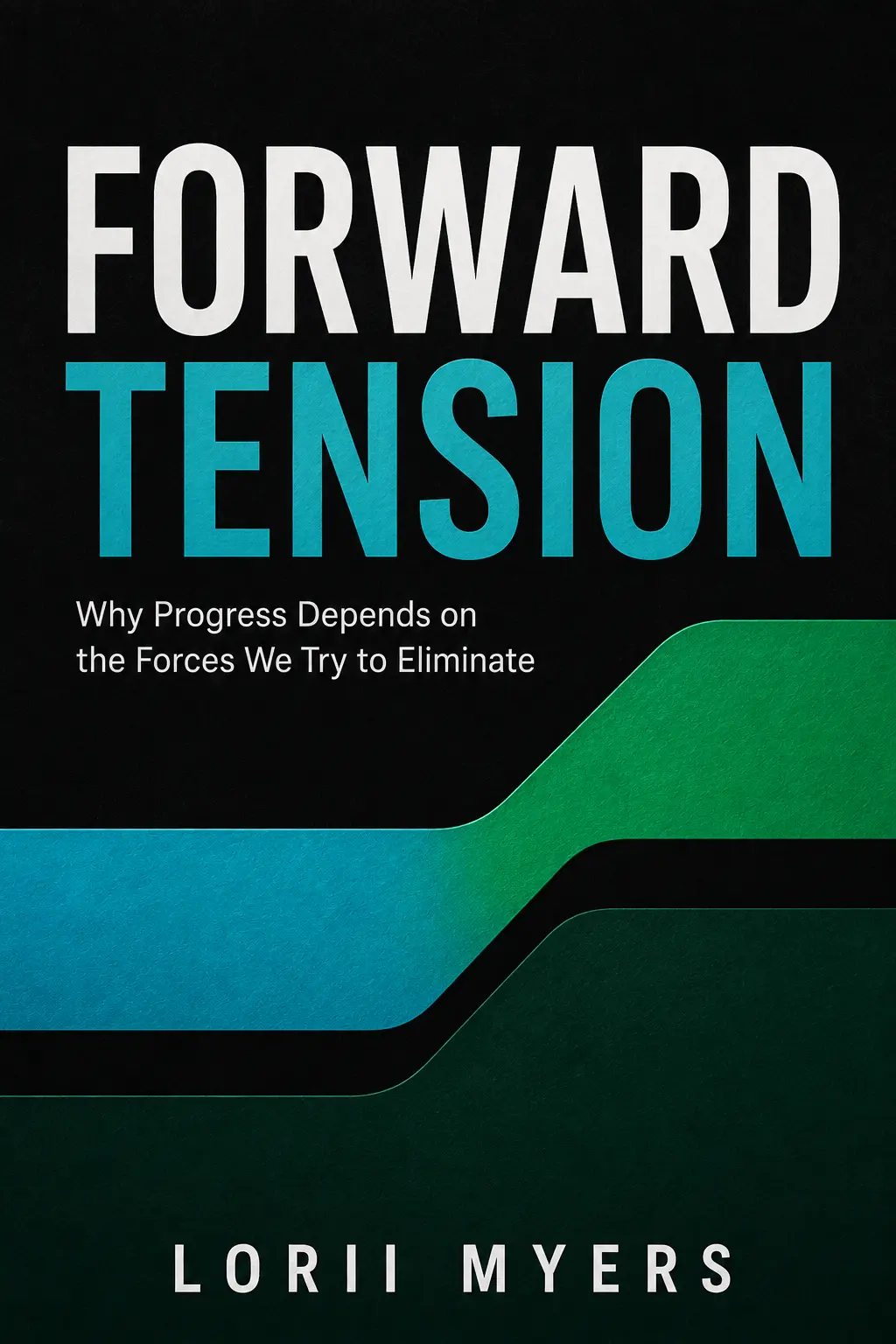
Why Progress Depends on the Forces We Try to Eliminate
We keep trying to eliminate the very forces that make progress possible.
THE CENTRAL PROPOSITION
A recurring opposition becomes generative only when both forces remain answerable to a shared object: the work, relationship, institution or future they are helping to shape.
Opposing forces reveal capabilities, costs and conditions that early agreement can hide.
When one force wins too completely, the field can lose access to information and capacity it still needs.
A shared object converts opposition into a design, cadence, threshold or question capable of revision.
THE ESSENTIAL DISTINCTION
Some conditions require resolution, choice, an honest price or refusal. The framework protects living tension without allowing complexity to become camouflage for harm.
THE READING EXPERIENCE
Difference, shared direction and the corrigible third movement.
Polarity debt, necessary distance, phase and dynamic emphasis.
Belonging, autonomy, authority, dissent, competition and the shared arena.
Conversion, correction, moral reciprocity and the right to revise.
OFFICIAL BLURB
We keep trying to eliminate the very forces that make progress possible.
Organizations silence dissent to move faster. Leaders tighten control to create order. Relationships erase difference in the name of closeness. The result can look like success—until the system loses information, capacity, and its ability to correct itself.
Forward Tension challenges the assumption that every opposition must be resolved. Lorii Myers distinguishes problems that need solutions from recurring tensions that require continued access to both sides. She reveals why victory creates hidden debt, how difference gains direction, and how a third movement can turn opposition into new capacity without erasing either side.
This is not a defence of compromise or permanent balance. Some differences must end. Some conflicts disguise harm as complexity. The harder task is knowing which tension to refuse—and which the future cannot afford to lose.
Progress does not begin when tension disappears.
It begins when tension gains direction.
SYNOPSIS
Forward Tension examines a recurring mistake in how people lead, collaborate, compete and belong: tension is treated as proof that something has gone wrong.
When speed conflicts with care, authority with dissent, autonomy with belonging, or competition with cooperation, the instinct is to choose a winner. The decision may create immediate clarity, but it can also remove information, capability and the means of correction.
Lorii Myers distinguishes problems that need solutions from recurring polarities that require continued access to both sides. Difference becomes productive only when both forces remain answerable to a shared object: the work, relationship, institution or future they are helping to shape. From that directed tension, a third movement may emerge—not a midpoint or permanent synthesis, but a new design, cadence, threshold or question that neither side could produce alone.
The book then exposes the cost of winning. When one force dominates, it creates polarity debt: the accumulating cost of losing the capability represented by the defeated side. Static balance is not the answer. Different conditions require different emphasis, but temporary dominance becomes dangerous when it hardens into a permanent arrangement.
At human scale, the framework illuminates relationships, leadership and competition. Closeness without separateness becomes merger; autonomy without connection becomes detachment. Dissent matters only when it can reach consequential authority. Rivals require a shared arena strong enough to preserve the contest.
The final section asks how tension becomes movement. Containment, translation, consequence and correction convert opposition into new capacity. But polarity language cannot excuse domination or harm. A legitimate field must remain answerable to reality and preserve reciprocal agency, dignity, consequential voice and the possibility of exit.
Grounded in documented cases from crisis management, aerospace decision-making and technical standard-setting, Forward Tension offers neither permanent balance nor easy compromise. It presents progress that uses difference without worshipping it, exercises authority without silencing correction, and creates new capacity without pretending any arrangement is final.
READ CHAPTER ONE
Presented from an author-approved author-review edition.
The track was nearly finished.
Its timing was exact. The vocal sat cleanly inside the mix. Nothing crowded the low end. Every transition arrived where it was expected. The small irregularities that had bothered the production team had been removed one by one: a counter-rhythm that pulled against the beat, an extra breath before the chorus, a brief thinning of the arrangement that had made the return feel almost too abrupt.
No single change had been unreasonable. Each had made the recording smoother.
Together, they had made it forgettable.
The problem didn’t announce itself as an error. There was no bad note to circle, no obvious distortion, no broken structure. The track simply stopped moving the people in the room. It continued from beginning to end, but continuation wasn’t the same as movement. Sound was occurring. Time was passing. Nothing was being carried forward.
The earlier version was played again.
Its appeal wasn’t hidden in one magical element. It lived in the relation between elements: the beat and the counter-rhythm, the fullness and the sudden space, the expected arrival and the fraction of delay before it. The recording hadn’t been alive because it was rough. It had been alive because distinct forces were answering one another. The polish had removed more than imperfection. It had removed difference.
Production makes the mechanism visible. A counter-pattern supplies contrast, but contrast by itself may be only interruption. Its relation to the pulse and the form makes it consequential. An anticipated arrival gives the contrast a direction: the listener can register what is being delayed, answered, or released.
The useful difference is therefore not irregularity in isolation. It is contrast connected to a shared structure and moving toward an intelligible consequence. Difference supplies possibility; relation makes it matter; direction turns the relation toward movement.
This is one of the quiet dangers of improvement. A system can become cleaner while becoming less capable. It can eliminate friction and discover, too late, that some of the friction was carrying information. It can standardize variation out of a process, discipline dissent out of a meeting, edit ambiguity out of an idea, or negotiate contrast out of a relationship. What remains may be easier to manage. It may also be unable to move.
Sameness can preserve a pattern. It cannot answer what the pattern has never met.
That does not make every irregularity valuable. A missed beat can be a mistake. Noise can be noise. An undisciplined arrangement does not become profound because it resists correction. The important distinction is not between polish and rawness. It is between a defect that reduces capacity and a difference that creates possibility.
The first can be removed.
The second must remain available.
The word polarity carries an immediate picture: two forces pulling in opposite directions. That picture is useful, but incomplete. Opposing forces can produce motion. They can also produce stalemate.
Two groups can defend opposite positions for months while the organization beneath them deteriorates. Two people can repeat the same argument so faithfully that each can predict the next sentence. A public debate can grow louder without becoming more intelligent. A leader can alternate between bold announcements and abrupt reversals, creating activity without direction.
Tension proves only that forces are present.
It does not prove that anything useful is happening between them.
This matters because tension is frequently romanticized. Intensity is taken as evidence of importance. Resistance is described as the price of greatness. Conflict is treated as proof that a team is passionate or that a bond is alive. But heat is an ambiguous signal. A furnace and a burning building both produce it. The existence of energy says nothing yet about what the energy will build, what it will consume, or whether the system containing it will survive.
Difference creates potential because it introduces more than one possible direction. It interrupts the closed certainty of a single view. It places an assumption beside something the assumption cannot absorb without changing. In that sense, difference is not an obstacle added to thought. It is one of the conditions that makes thought possible.
A mind encounters information that doesn’t fit and must revise, reject, or widen its account of reality. A team encounters a consequence that its plan didn’t include and must improve the plan or deny the consequence. A creator places restraint against freedom and discovers that each gives the other definition. A business places what the market wants against what the operation can reliably deliver and confronts the distance between desire and capability.
None of these encounters guarantees progress. They create an opening.
The opening becomes movement only when three conditions remain present:
Difference supplies contrast, information, and unrealized possibility.
Connection keeps the forces inside one consequential field.
Direction gives the tension something to alter, decide, test, or create.
The conceptual equation is therefore multiplicative:
Difference × Connection × Direction = Movement
It is not a claim about mathematics or physics. Its form makes a simpler point. If any term falls to zero, generative movement collapses.
Difference without connection becomes separation. Two forces may exist, but they no longer answer one another.
Connection without difference becomes merger or sameness. The field remains intact, but it stops receiving corrective contrast.
Difference and connection without direction become cycling. The forces remain engaged, perhaps intensely, but no consequence is required of them.
The distinction is visible in ordinary meetings. A group can contain many perspectives and still be inert because no decision is attached to the discussion. Another group can have a clear target but no meaningful difference because everyone has learned which view is safe to express. A third can have sharp disagreement and an urgent decision, but no remaining connection: the participants are defending departments, identities, or status rather than a field they still recognize as shared.
All the ingredients may appear to be present. The movement is gone.
Imagine the same launch decision unfolding in three different rooms.
In the first, difference is abundant. Sales sees a closing market window. Operations sees a support system approaching its limit. Finance sees exposure neither group has priced. The arguments are intelligent, but each function is rewarded for a different result. Sales can record the win before operations carries the promise. Operations can protect its measure by allowing the opportunity to expire. Their views meet in conversation while their consequences remain separate.
Difference is present. Connection is missing.
In the second room, everyone answers to the same result and the decision has a real deadline. Yet the discussion produces almost no contrast. The leader has already announced confidence. The most experienced people know which questions will be welcomed and which will be remembered. No instruction to agree has been given. The room has learned the answer through status.
Connection and direction are present. Difference has been edited out.
In the third room, the disagreement is real and the consequence is shared. People understand that the customer promise will belong to all of them. They meet repeatedly, name the risks, and improve one another’s descriptions. Nothing in the process determines what the conversation must change. No one owns the decision. No test is authorized. No threshold closes one path and opens another.
Difference and connection are present. Direction is missing.
All three rooms can look engaged. Each can produce minutes, action items, and another meeting. Only a field containing all three conditions can turn opposition into a changed capacity.
The missing condition is often concealed by effort. A senior leader carries information between divided functions. A privately candid employee supplies the difference a compliant room no longer produces. A patient facilitator keeps a directionless discussion coherent. Work continues because someone compensates for the absent structure.
The field mistakes rescue for design.
When that person tires, leaves, or loses influence, the missing condition appears to have vanished suddenly. It was never securely present.
Agreement feels efficient.
It shortens meetings, reduces visible strain, and allows action to begin. Leaders often read it as evidence that they have communicated well. Teams learn to produce it because agreement is rewarded and resistance is expensive. The person who keeps raising the missing cost can quickly become known as difficult, negative, slow, or insufficiently committed.
That judgment may occasionally be accurate. Opposition can become performance. Some people use objection to display intelligence, preserve control, or avoid accountability. But the existence of unproductive dissent does not make agreement inherently intelligent.
Agreement can be genuine convergence.
It can also be deleted information.
An organization rarely announces that it has deleted information. It says that everyone is aligned. The word gives silence a strategic quality. The timeline is approved. The forecast is accepted. The acquisition is described as inevitable. The customer concern is noted but not allowed to alter the plan. People leave the room carrying private doubt and public consent.
The plan now appears stronger because fewer objections are visible.
In reality, it has lost sensors.
I use the Law of Necessary Difference to name a premise of this framework: meaningful difference is a condition of generative movement. It supplies information, options, challenge, and unrealized possibility.
The law does not glorify disagreement. It identifies a functional requirement. A system that cannot receive a view unlike its preferred view cannot reliably distinguish confidence from insulation. It may continue moving, sometimes impressively, but it has weakened its ability to detect where it is moving.
This is why a contrary force has value even when it does not prevail. Its first contribution may be diagnostic rather than directional. It reveals what the preferred force cannot see from inside itself.
Each force illuminates the excess of the other. It does not automatically cancel the other’s value. It prevents a partial truth from presenting itself as the whole.
A pole becomes dangerous when it mistakes itself for the whole.
The most useful opposition does more than say no. It changes the quality of what can be known.
Consider a composite organization preparing to expand a profitable service into several new regions. The commercial case is strong. Existing customers want the service. Sales leaders have identified demand. The expansion team argues that delay will surrender an advantage that may not return.
Operations resists. The current service depends on a small number of experienced people making informal adjustments. Those adjustments are effective precisely because the people making them know the customers, the exceptions, and the history. Expansion will multiply volume faster than judgment can be transferred.
From one side, operations appears cautious. From the other, sales appears reckless. Those labels reduce the disagreement to personality. They also conceal what each side knows.
Sales knows that timing changes opportunity.
Operations knows that scale changes the nature of capability.
If the disagreement is treated as a contest between bold and timid people, the organization will choose a winner and lose part of its intelligence. If the difference is treated as information, the expansion question changes. It is no longer simply whether to grow. It becomes whether the judgment hidden inside informal work can be made visible, taught, supported, and tested quickly enough for growth to remain credible.
The contrary force has improved the question.
That improvement is movement, even before the final decision has been made. The organization is now capable of acting on a more accurate account of itself.
This kind of movement is easy to miss because modern institutions privilege visible action. A launch, a hire, a sale, and a construction project can be counted. A better question is harder to display. Yet action taken inside a bad question does not become intelligent because it is measurable.
Sometimes the most consequential movement is the moment a system stops asking the question that was keeping it trapped.
Difference makes that interruption possible.
Difference alone is abundant. The world contains countless views that never meet, forces that never interact, and alternatives that remain irrelevant to one another. Productive polarity requires more than contrast. It requires a field.
A field is the consequential relationship inside which the forces can affect a shared outcome.
Sales and operations form a field because the promise made by one must be fulfilled by the other. Freedom and responsibility form a field because the exercise of one changes the conditions under which the other can be sustained. Exploration and discipline form a field inside serious creative work because possibility must eventually take form, while form without possibility has nothing worth containing.
The field is not the same as harmony. The participants may distrust one another. They may disagree sharply. They may hold different incentives and speak different professional languages. The field exists because their decisions converge on a consequence none of them can escape.
When that shared consequence disappears, so does the productive polarity.
Two departments can remain employed by the same company while ceasing to inhabit the same field. One maximizes its metric by transferring cost to the other. One wins the quarter while weakening the next. Each presents evidence of success. The organization loses.
The formal connection remains. The consequential connection has been broken.
This explains why a declared common purpose is not enough. A mission statement cannot create a field if rewards, information, and consequences remain divided. People answer the system that actually acts upon them. If sales is rewarded only for booked revenue and operations is punished only for fulfilment failure, each side has been instructed to export its costs. Appeals to teamwork will sound moral while the structure continues to reward separation.
Connection is not a feeling in this context. It is the reality that one pole cannot claim success by making the other absorb its failure.
That is what makes difference answerable.
Connection is built into consequence before it becomes visible as cooperation.
A mission statement can announce common purpose while the operating system separates success. One function receives credit at commitment; another inherits the risk at delivery. One leader chooses the schedule; people elsewhere create the extra time required to make it appear achievable. A project is declared efficient because the labour used to rescue it remains outside the measure.
The people may care about one another. They may speak respectfully and work hard. The field is still divided if one pole can claim value while making another location absorb the unmanaged cost.
Structural connection closes that escape.
It can appear in a shared measure that includes fulfilment as well as sale, a decision right that requires the cost-bearing function to enter before a promise becomes final, or a record that keeps the original assumption beside the later result. It can appear in an interface through which a local choice becomes visible where its wider consequence will land. The form varies with the work.
The test arrives at the moment someone says, “We succeeded.”
Who is included in the we?
Which consequence has been counted?
What had to be hidden, postponed, or repaired elsewhere for the success to remain clean?
These questions are not an accusation against achievement. They complete its account. A field becomes consequential when the benefit and the burden can no longer be divided merely by choosing where to measure them.
Connection begins when consequence can travel back to choice.
Even connected forces remain trapped if nothing beyond the contest has authority.
The shared object is what the field exists to serve. Direction is the next consequential movement in service of that object. Neither can be a slogan broad enough to include every preference.
In the regional expansion, ‘growth’ is too vague. A more useful shared object is profitable expansion that a newly trained regional team can support without permanent dependence on the original experts. The next direction might be a limited market entry tied to explicit transfer and support thresholds.
That distinction recruits both poles. Commercial urgency must identify the minimum contact needed to preserve timing. Operational caution must distinguish genuine capability requirements from inherited preference. Difference begins producing design instead of labels.
The shared object disciplines both sides. Direction makes their claims answerable now.
Without it, tension tends to become personal because the only visible objects left are the people carrying it. The visionary becomes the problem. The cautious executive becomes the problem. The person asking for candour becomes harsh. The person protecting regard becomes weak. Once the pole and the person are fused, changing position feels like losing identity.
A shared object places the problem back into the field; direction requires the field to move.
The question becomes less concerned with who was right and more concerned with what the system must now be able to do.
The language of movement invites another distinction.
Activity changes what is happening.
Movement changes what becomes possible.
The test of movement is not whether something happened.
It is whether the field can now do something it could not do before.
After genuine movement, future work becomes different.
A decision may close one issue without changing the system that produced it. The launch date is chosen. The order is accepted. The disputed feature is removed. Everyone knows what happens next. Then the same incapacity returns in another form because the field acquired an answer and learned nothing from making it.
Capacity leaves a different trace.
The regional expansion team, for example, may begin with a dispute over whether growth is bold or reckless. Movement occurs when the team can identify the judgment hidden inside expert improvisation, decide which part can be taught, and test whether a new region can operate without permanent rescue from the original group. The immediate decision matters. The reusable distinction matters more.
Evidence of capacity appears in what the field can now recognize and do.
A hidden dependency has become visible before it fails.
A question that once produced personalities now produces design criteria.
A decision can be made by people who previously required rescue from one indispensable person.
A contrary signal has a route into the work while it can still alter the result.
The next problem does not have to recreate the entire argument in order to recover the learning.
Capacity also changes where competence lives. What once depended on one person’s memory becomes a distinction others can exercise. What once required escalation becomes an accountable local decision. What once arrived as surprise becomes a condition the field can recognize early.
Distribution matters. A capability held only by the original hero remains a rescue capacity. A capability carried by the field can become part of its future.
This is a demanding test because activity often leaves more visible evidence than capacity. Meetings, launches, approvals, and completed tasks can be counted immediately. A changed judgment may first appear as an error that never occurs, an escalation no longer required, or a promise made with a fuller understanding of its cost.
The absence of drama can conceal the presence of development.
Movement has occurred when the field carries forward more than the decision. It carries forward a better ability to decide.
The track regained its life when contrast returned, but the deeper gain was not the restoration of one earlier version. The production had discovered something about its own judgment. Smoothness was no longer an unquestioned synonym for quality. The team could hear the difference between cleaning a defect and erasing a relation.
That distinction would travel into the next piece of work.
Capacity had changed.
Opposition does not create movement. It creates potential. Connection gives difference consequence; direction changes what the field can do.
The test is not whether tension exists, but whether necessary forces still share an object and can create capacity between them. Before any tension is preserved, however, both forces must prove that they belong in the field.
THE FINAL PROVOCATION
The v08 Authoritative Master is complete for author review. Independent human editing, source review and copy review remain before publication.
SELECTED WORDS FROM THE MANUSCRIPT
Approved quotations by Lorii Myers, selected to accompany this manuscript’s public blurb and synopsis.
“Authority becomes credible not by never changing but by making change intelligible.”
“Preventable damage is not redeemed because it eventually exposes the truth.”
“A leader can reject an argument without teaching the room that argument itself is dangerous.”