Two ambitions under scrutiny
Maria wants to create lasting civic-scale art without surrendering authorship. Anton wants to save an irreplaceable turbine hall without sacrificing the public commitments attached to its redevelopment.
 LAMBO-MUSICARTIST · AUTHOR · LICENSING
LAMBO PUBLISHING · UPMARKET RELATIONSHIP FICTION · LORII MYERS
What the Light Reveals
The problem isn’t the light. It’s what it reveals about them.
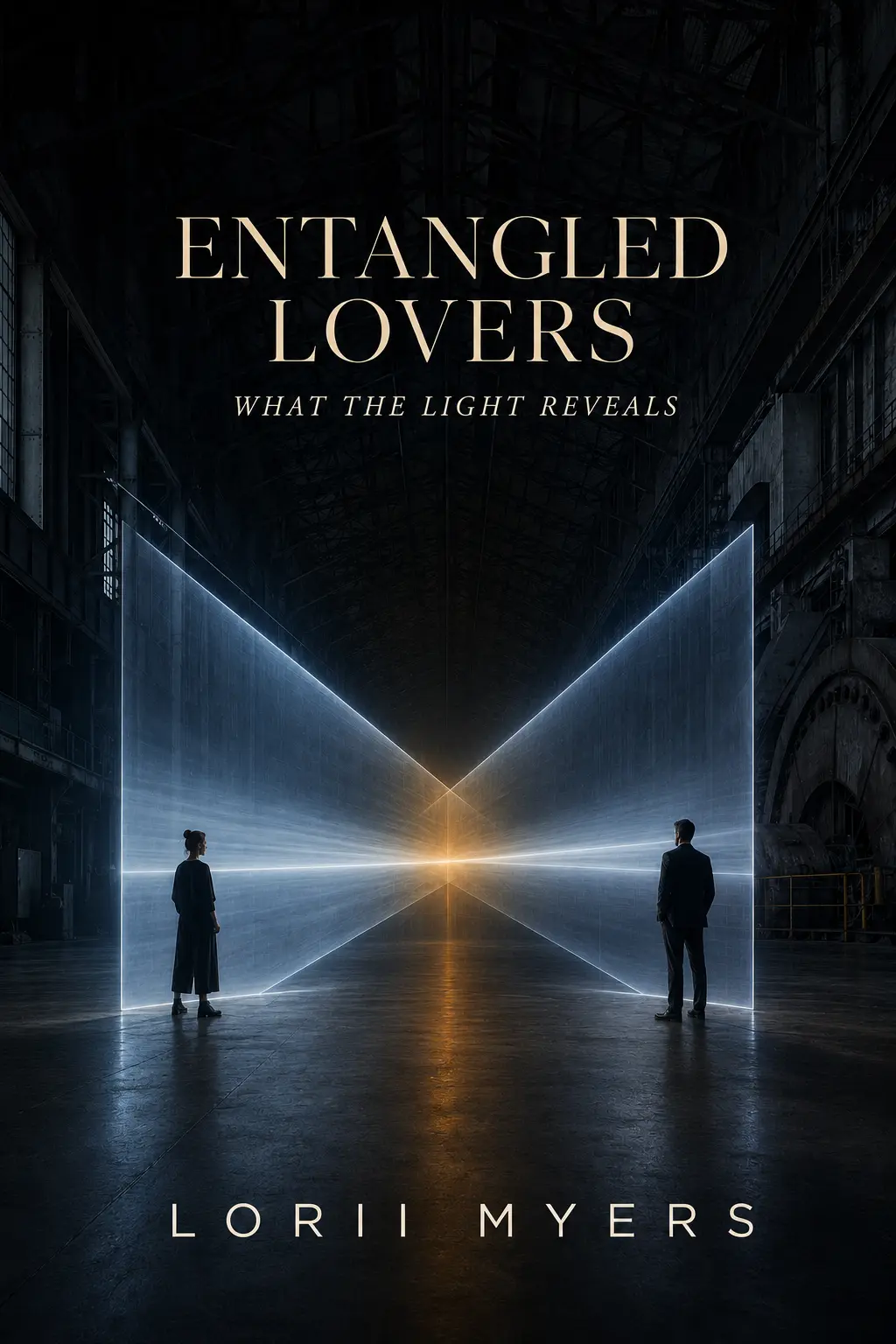
THE STORY
A work of light makes Maria and Anton’s connection public before they understand it themselves. Breakwater makes that connection professionally dangerous. Berlin asks whether it can survive Maria choosing the future she wanted before Anton existed in it.
Maria wants to create lasting civic-scale art without surrendering authorship. Anton wants to save an irreplaceable turbine hall without sacrificing the public commitments attached to its redevelopment.
Anton must stop mistaking control for care. Maria must learn that influence does not equal disappearance. Their challenge is not choosing love over independence, but finding a form in which both remain true.
WHAT SETS IT APART
Parallax and the Third Flame are more than atmosphere. The installation’s rules become the novel’s governing test: a true connection can emerge only while both people remain distinctly present.
Breakwater’s preservation, housing, financing, environmental and public-process constraints make every personal choice carry credible civic and ethical consequences.
The ending protects two homes, two careers and Maria’s continuing Berlin future. Love succeeds through honest boundaries rather than sacrifice, possession or disappearance.
OFFICIAL BLURB
The first time artist Maria Calder and civic developer Anton Varga stand together inside Parallax, the artwork does something impossible.
For forty-one seconds, a third field of amber light burns between them—a response Maria’s blue-white installation has never produced for anyone else. A camera captures it. Before Maria can investigate, the image becomes public and the phenomenon has a name: the Third Flame.
The problem isn’t the light.
It’s what it reveals about them.
Their lives collide again at Breakwater, an abandoned turbine hall Anton is determined to save—and the kind of space Maria could transform into the defining work of her career. But Anton’s firm controls its future. If they pursue each other, everything they have built separately could be called compromised. If they walk away, they must deny the one connection neither can dismiss.
Then Berlin offers Maria six months away—and the future she chose before Anton existed in it.
Anton tries to control what he cannot predict. Maria has learned to leave before love can rewrite her life. With Berlin ahead, Breakwater between them, and strangers already turning forty-one seconds of light into a love story, they must answer the question Parallax forces on them:
Will they choose each other, even if it means losing the lives they built to survive?
COMPLETE SYNOPSIS
The synopsis below contains major spoilers and is provided for agents, editors, publishers and adaptation partners.
Artist Maria Calder’s installation Parallax is designed to track two people without allowing either to disappear into the other. At its opening, Maria enters the work with Anton Varga, founder of Aster Civic. For forty-one seconds, an unprogrammed field of amber light holds between them. A visitor records it, the image spreads, and the phenomenon becomes known as the Third Flame.
A mechanical failure explains why Parallax shuts down afterward, but not why the amber field appeared. Maria rejects the gallery’s attempt to market it as destiny. Anton is equally wary of assigning it meaning, yet neither can dismiss what happened.
Anton is fighting to preserve Breakwater, an abandoned turbine hall controlled by Aster. Saving its full span could create an extraordinary civic space, but the cost and risk could threaten the development’s housing, environmental and public-benefit commitments. Maria recognizes the hall as the kind of space that could define her career, but refuses to become evidence for the outcome Anton already wants.
She agrees to participate only through a city-controlled process with public records, equal access and no promise of a commission. During a full-span trial, two separate sounds create a third acoustic beat that the reduced designs cannot reproduce. The result keeps preservation alive under strict financial, structural, environmental, operator and lender conditions.
As Maria and Anton grow closer, they recognize the instincts that have kept them safe. Maria once abandoned a commission after a romantic partner altered her work and claimed shared authorship; since then, leaving has been her surest form of self-protection. Anton manages uncertainty by making himself useful, often turning care into control.
They choose to pursue a relationship and disclose it before their next project contact. When a photograph makes them public, Anton accepts a sweeping recusal from every artist-facing Breakwater decision. An independent review preserves Maria’s possible eligibility for any future competition, but only under strict safeguards. Then Maria is nominated for a six-month Berlin residency—the independent artistic future she wanted before Anton or Breakwater entered her life.
Their boundaries soon expose deeper problems. Anton carries confidential Breakwater information through their private time without acknowledging its existence and researches Berlin logistics without being invited. Maria sees that he is still managing what he cannot control and sends him away.
Determined to prove her independence, Maria begins altering Parallax because Anton has changed how she sees it. Her producer, Leena Das, forces her to recognize the contradiction: she is damaging her own work to demonstrate that no relationship can influence her. Maria restores the original geometry and secures records proving that her civic-scale study predates Breakwater. Independence, she realizes, is not freedom from influence; it is retaining authorship over what influence becomes.
Anton undergoes a parallel reckoning. He exposes a flaw in Aster’s redevelopment model: preservation costs are counted, while the irreversible loss created by demolition is valued at zero. The board authorizes a conditional full-span path that protects housing and public commitments while removing Anton from cultural decisions.
Maria and Anton reconcile, but Berlin remains unresolved. Their renewed intimacy produces no amber light: without Parallax, cameras or witnesses, what happens between them requires no external proof and makes neither person evidence of the other. Anton books leave overlapping the residency without choosing a destination, and Maria allows herself to imagine he might accompany her without asking. When the assumption is exposed, neither uses a convenient promise to repair it. Maria continues through the Berlin selection process, presenting the failures in Parallax rather than disguising them. Anton admits that he wants Berlin to choose her and does not want her to go.
Berlin offers Maria the residency. She includes Anton in the moment, but not the decision, and accepts six uninterrupted months away.
Before leaving, Maria’s final tests produce beautiful amber fields for the wrong reasons: fixed objects are mistaken for people, predicted paths replace missing participants, and one person is effectively erased. She rebuilds the system so the third field can appear only after two distinct human beings have been independently verified. The work finally reveals its meaning: no connection is real if it requires one person to disappear.
Anton witnesses Maria’s departure without managing it. In Berlin, local restrictions make it impossible to reproduce the Toronto installation. Rather than force the original work into a different environment, Maria creates a separate branch with its own materials, collaborators, evidence and limits.
She eventually invites Anton to a public working session, but not into her private studio. He attends under the same conditions as every other visitor. They acknowledge that they love each other without demanding an answer about what happens when the residency ends.
Maria’s closing installation verifies two successful sequences and correctly withholds the amber field when a third fails. She credits her collaborators, preserves the work’s independent record and signs a future Berlin laboratory engagement.
Meanwhile, Breakwater receives separately protected funding and an independent operator. Its full span, crane runway and open hall become binding obligations against the land. No public-art competition exists, Maria receives no appointment and Anton’s recusal remains intact.
Two days after Maria returns to Toronto, she meets Anton at a bakery across from her studio. There is no amber light, camera or public story—only the two of them choosing what comes next.
They commit to a relationship in the present tense: two homes, separate careers, continuing Berlin work for Maria, and honesty before either control or withdrawal can replace trust. They leave to buy dinner, carrying separate bags across the same street.
READ CHAPTER ONE
Presented from an author-approved author-review edition.
By the ninth time someone called Parallax beautiful, Maria Calder began to suspect it had failed.
A man in a camel coat entered Parallax with his companion.
For half a second, amber trembled between them.
The man missed it.
“Beautiful,” he said again, this time to his companion.
At forty-seven, Maria knew praise could be a refusal. Beautiful often meant the work had inconvenienced no one.
“Thank you for coming,” she said.
He seemed pleased by this, as though he had installed the lights himself.
From beside the temporary bar, Leena Das lifted one eyebrow. She had heard. Leena heard everything, including remarks made under music, inside elevators, and once—memorably—through a concrete wall Maria had considered structurally reassuring.
When the couple moved on, Leena crossed the gallery carrying two untouched glasses of sparkling water. She handed one to Maria.
“Nine,” she said.
“Ten, if we count ‘gorgeous.’”
“We don’t. Different failure mode.”
Maria drank. The water had warmed to the temperature of regret.
Late-November sleet worried the warehouse windows. Since six, two hundred visitors had passed through Parallax, interrupting and photographing it while trying to stand outside its consequences.
Two blue-white fields faced each other across smoked acrylic. Motion sensors shifted the light; narrow amber film and a microprismatic scrim caught any overlap, usually as a brief flare on the floor. In testing, the longest event had lasted four-point-eight seconds, achieved with Leena, two technicians, a coat rack, and several threatened tools.
Tonight, it had appeared eleven times, never longer than two seconds.
Leena looked across the room. “They’re staying with it.”
“They’re staying with their phones.”
“They crossed the city to stay with their phones near your work. That’s culture now.”
Leena had spent twenty years getting ambitious work through doors not designed to admit it. She produced Maria’s installations, found licensed technicians at impossible notice, and asked rude questions early enough to be useful. Anyone who called her Maria’s assistant received an invoice.
Amber opened between a student and an older woman, then vanished.
The student laughed—not loudly, but with surprise.
Maria felt the knot beneath her ribs ease.
“That,” she said.
“Yes,” Leena said. “The beautiful woman laughed.”
“Don’t ruin it.”
“I’m a producer. Ruining things into deliverable form is my discipline.”
Leena took Maria’s empty glass and replaced it with the one she had not touched. Then she glanced toward the discreet black notebook on the plinth near the exit.
“Have you answered the Breakwater email?”
The knot returned.
“This is an opening.”
“And that’s an evasion.”
“I’m greeting people.”
“You’re keeping a forensic count of adjectives.”
Maria turned toward the installation rather than give Leena the satisfaction of agreement. Beyond the high windows, the city had disappeared into black glass. Reflections of the crowd floated over the rain: faces, coats, raised phones, fields of white and blue passing through all of them.
Aster invited Maria to Breakwater’s public-use review, separate from any future commission; environmental and municipal approvals remained unresolved.
It was cleaner than the usual developer invitation, in which consultation arrived pre-shaped around a rendering. Clean processes, however, could still leave fingerprints. She wanted to know who chose the questions before agreeing to answer them.
Maria had closed it, reopened it, and closed it again before her coffee cooled.
The turbine hall, if the redevelopment survived its conditions, would be one hundred and fourteen metres long. Steel, old brick, lake light. Thousands of people moving through it each day.
Maria had read the dimensions twice before she read the fee.
For twelve years, museums and galleries had assembled her work, then packed it away on schedule.
Maria wanted her next work to stay: civic in scale, weather in its joints, sharing Monday mornings with school groups, cleaners, missed trains, and people who had not agreed to enter a gallery. She wanted it difficult even after it stopped being new.
Breakwater could be that work.
It could also become a tasteful feature approved by twelve committees and attributed to a partnership so broad that authorship dissolved into a list of logos.
“They’re asking for a conversation,” Leena said, reading her silence accurately. “Not your firstborn.”
“A conversation is how they find out where the firstborn is stored.”
“You don’t have children.”
“Exactly. Excellent security.”
Leena smiled, then let it go. “You think collaboration erases the maker.”
“Bad collaboration does.”
“Good collaboration?”
“Usually gets credited to the person with the largest building,” she said.
“That wasn’t an answer.”
“It was a floor plan.”
Leena’s look was patient and entirely without mercy. “Answer tomorrow. Before noon.”
“You’ve become authoritarian.”
“Production meeting at ten. Authoritarian at ten-oh-five.”
Someone called Leena’s name from the entrance. A courier had arrived with the wrong case, three hours late and deeply hopeful that charm could substitute for documentation. Leena handed both glasses to Maria and went to remove hope from the equation.
Maria set the glasses behind the bar and returned to the edge of the work.
At nine-forty, the room began to belong to Parallax again.
Maria checked the perimeter: a cable vibration, heat near the rack, a forty-millisecond lag in sensor seven. She knew the work’s tolerances as temperament.
She crouched near the south plinth and opened the monitoring panel. All circuits were stable. The amber-event log showed a cluster around seven-thirty, when the room had been at its fullest, then only two brief occurrences in the past hour.
Footsteps sounded behind her, slowed, and stopped.
Most late arrivals entered apologetically or at speed. This person did neither.
Maria closed the panel and stood.
The man near the entrance had come alone. His charcoal coat was darkened at the shoulders by rain. He acknowledged the attendant, declined the folded guide, and looked past the wall text into the gallery.
Then his attention travelled past the lights to the ceiling.
His gaze followed the steel truss from the east wall to its bearing point, paused at the suspended rig, and returned along the diagonal bracing. He took three steps to his left for a clearer angle. A white field passed across his coat. He did not seem to notice.
Maria waited for irritation to settle into curiosity. It declined.
He moved farther into the room, eyes still overhead, reading the route of the cables and the distribution of weight. He was not glancing in the bored way of someone checking whether old industrial architecture made an attractive photograph. He was calculating.
Maria crossed to him.
“The work is lower,” she said.
He looked at her. His attention arrived fully, without the small delay in which people decided how an artist ought to be addressed.
“I found it,” he said.
“That must be a relief.”
“The ceiling is carrying part of the argument.”
She glanced up despite herself. “Only part?”
“The rest is being made by the floor.”
His voice was quiet, his expression composed but not solemn. There was silver at his temples and rain on one shoulder of his coat. He looked like someone who had come from a long meeting and refused to bring it into the room.
“You’re an engineer,” Maria said.
“I was trained as one.”
“And now?”
“Now I attend meetings where engineers explain why my ideas are expensive.”
She almost smiled. “A decline, then.”
“Financially, no. In most other respects, the evidence is troubling.”
He looked back at the suspended planes. The lights shifted as two students collected their coats near the exit.
“The suspension takes the long way down,” he said.
“By design.”
He indicated the far connection. “The rig loads the roof truss, spreads into the perimeter steel, then travels down the columns to the foundation.”
“The building preferred it.”
“Buildings rarely get asked.”
“People rarely listen.”
That earned a brief change in his face, less a smile than the decision not to suppress one.
Maria noticed Leena returning from the entrance with a signed delivery slip and the expression of someone who had defeated a minor government. Her attention landed on the man, sharpened, then moved to Maria.
The look lasted less than a second. It contained a name.
Maria found it a moment later.
Anton Varga.
His signature had been beneath the Aster Civic letter attached to the Breakwater invitation, formal and slightly too large. Founder and chief executive. Structural engineer turned developer, according to the profile Leena had forwarded and Maria had pretended not to read.
Maria had expected branding softened into curiosity. He had arrived too late for the useful audience and spent his first minutes reading steel. Trust remained unearned, but dismissal now required more effort.
He seemed to register recognition when it reached her.
“Maria Calder,” he said.
“You knew that before you arrived.”
“It was on the invitation.”
“Efficient.”
“I was late.”
“Also on the invitation, if you know where to look.”
Leena approached, saving neither of them. “Anton Varga.”
“Leena Das.”
“We close in five minutes.”
“That appears to be my strongest qualification tonight.”
Leena looked at Maria. “He can stay until ten.”
“Generous,” Maria said.
“I’m known for it.”
She was not. Leena stepped away to help the attendant begin a tactful evacuation of the remaining guests.
Anton turned toward the west field. “I saw an image of this in the briefing material.”
“For Breakwater.”
“Yes.”
“That material went out this morning.”
“I was nearby.”
The gallery was at least twenty minutes from Aster Civic’s waterfront offices in cooperative traffic. Tonight’s rain had made cooperative traffic theoretical.
Maria let the claim stand.
“Are you here to assess the work?” she asked.
“No.”
The answer came without cushioning.
“Your consultants will be disappointed.”
“They have other opportunities.” He studied the nearest smoked plane, keeping outside the taped safety line. “I wanted to understand what the photograph left out.”
“Most of it.”
“That was my impression.”
He did not ask her to explain the work. Maria found this more disarming than praise.
The last visitors moved toward the coat check. Without their bodies interrupting the sensors, the installation widened into its resting state: two pale, separate fields facing one another across the concrete floor. The smoked planes seemed almost opaque.
Anton took a slow route along the perimeter. He stopped beneath the eastern truss, then stepped diagonally toward the centre, following an invisible line Maria guessed was structural rather than aesthetic.
The north field narrowed.
He paused.
Across the gallery, an internal baffle opened with a soft mechanical note. A bar of light slid over the floor, reached the edge of a suspended plane, and vanished.
Anton moved one pace farther.
“Not there,” Maria said.
He stopped at once. “Safety?”
“Possibility.”
She walked into the south field, watching the light rather than him. Sensor four caught her movement. The western baffle adjusted. A thin amber line appeared at knee height, wavered, and went out.
Anton looked toward the place where it had been.
“Move back half a step,” she said.
He did.
Nothing.
“Your half or mine?”
“Engineering has made you literal.”
“It was a pre-existing condition.”
She crossed to the other side of the smoked plane. He shifted to give her room, and the blue-white field bent sharply around him.
This time the amber opened across the scrim into a plane.
It rose from the floor to just above Maria’s head, deep and clear, held on a surface that disappeared behind it. The colour occupied neither body. It stood between them, complete as itself.
The room contracted around it. Exit signs, wet-coat smell, and traffic beyond the glass receded as the field reorganized attention. More unsettling, Maria felt Anton’s position before she looked at him, an awareness the field had not created so much as made visible. He obeyed her instruction without turning the obedience into a performance.
Maria stopped breathing for a count, then corrected the mistake. Breath affected nothing. Movement did.
“Stay,” she said.
Anton stayed.
The amber field remained.
Five seconds.
Then ten.
The installation’s fans whispered overhead. Somewhere behind Maria, a coat hanger clicked against another. Leena did not speak.
No one else crossed the floor.
At twenty seconds, Maria checked for spill from a misaligned fixture or a shifted panel. Nothing. Programmed intensities held, yet the result remained outside the work’s recorded behaviour.
Anton traced the plane to the ceiling, then the floor near his shoes, searching for cause. Maria was grateful. Cause respected the work enough to doubt it.
She became aware that they were standing on opposite sides of the colour, their images fractured by the scrim’s fine structure. When Anton tilted his head, the field shivered but held. When Maria adjusted her weight, a darker band moved through its centre and resolved.
Forty-one seconds.
The amber deepened.
A clipped stutter came from the eastern control rack. The white fields flickered, collapsed, and left the projector fans dropping into silence. The gallery went black.
Near the entrance, one of the last visitors lowered the phone she had raised when the field first appeared.
Someone near the entrance swore softly. Emergency lights came on above the doors. Without the projectors, Parallax became cable, hardware, and dark planes occupying air.
Leena was already moving.
“Everyone stays where they are for ten seconds,” she called. “Then we leave by the lit exit and preserve our dignity in the lobby.”
The gallery technician, authorized for the installation’s lockout, reached the electrical panel and isolated the feed. Maria crossed to the control rack but did not open it. There was no heat, no smell, no alarm—likely a protection trip. The opening was over. Reopening would require a licensed electrical inspection. Leena would insist; Maria would resent it for approximately three minutes and agree.
In the emergency light, Anton remained on the mark he had found by accident.
He looked at the dark space where the amber plane had stood.
“Does the third field always do that?” he asked.
Maria looked at the dead monitors, then at him.
“It never has.”
PUBLISHING & SCREEN CONVERSATIONS
The Third Flame, Breakwater’s industrial scale and the Toronto–Berlin arc create a cinematic story world while the novel remains grounded in authorship, ethics, ambition and the difficult work of loving without erasure.
The 66,531-word Authoritative Master v15.6 is available for qualified professional review. Independent human editing remains before publication, and the full manuscript remains private.
SELECTED WORDS FROM THE MANUSCRIPT
Approved quotations by Lorii Myers, selected to accompany this manuscript’s public blurb and synopsis.
“Restraint did not become trust simply because it was correctly performed, but it gave trust somewhere to begin again.”
““I want to know who you are when you’re not arranging yourself around my return.””