Act
Contain the risk, pause the process, set the boundary or make the decision the available moment requires.
 LAMBO-MUSICARTIST · AUTHOR · LICENSING
LAMBO PUBLISHING · BIG-IDEA APPLIED PHILOSOPHY · LORII MYERS
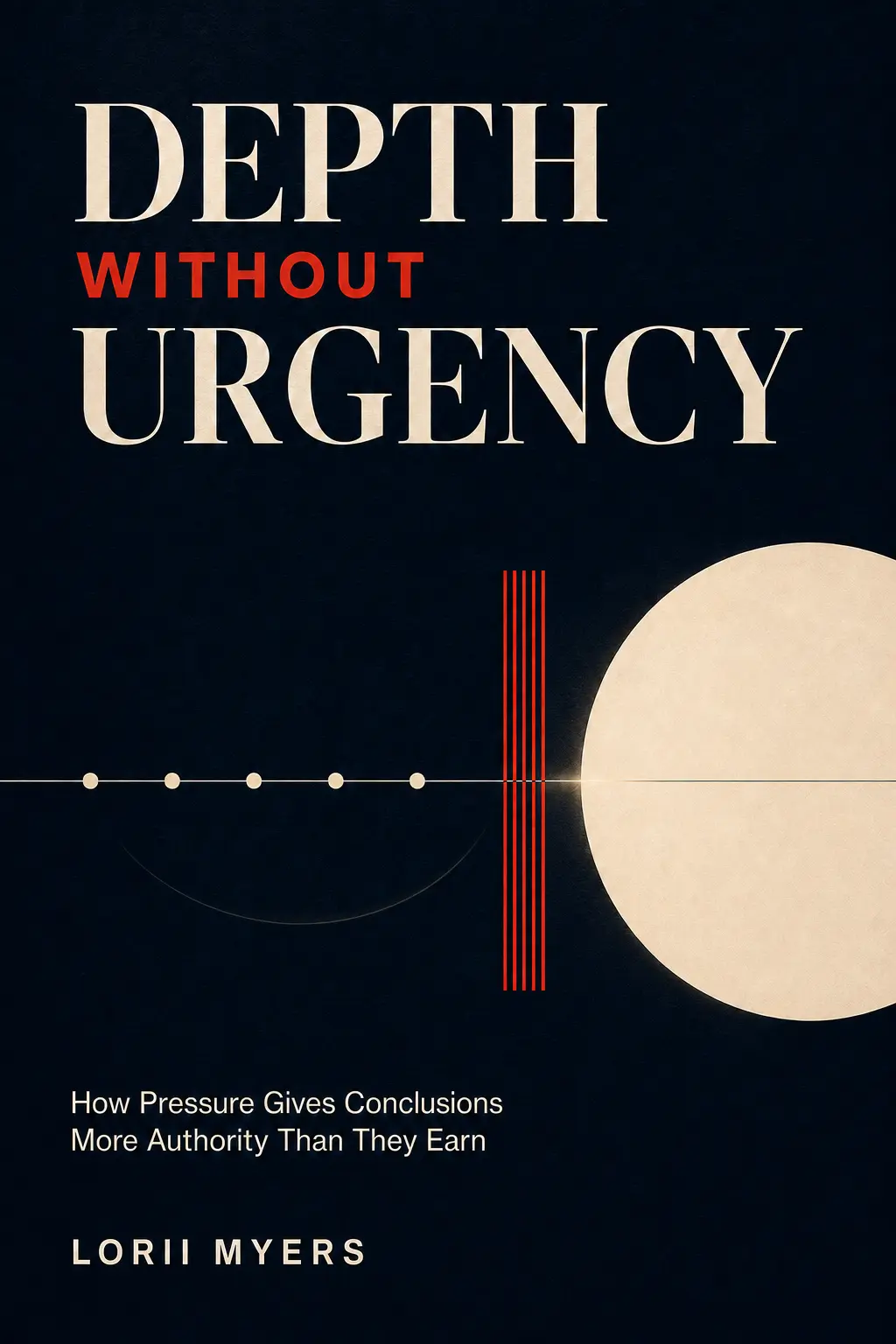
How Pressure Gives Conclusions More Authority Than They Earn
When we know the least, pressure demands that we decide the most.
THE CENTRAL PROPOSITION
A pressured moment contains two different demands: what must happen now, and what the event proves. The first may be urgent. The second must earn its authority from evidence.
Contain the risk, pause the process, set the boundary or make the decision the available moment requires.
Cause, motive, character and future remain separate questions, each requiring evidence proportionate to its reach.
A conclusion becomes powerful through what it can justify, whom it may bind and how long it continues to operate.
THE CLARITY LOOP™
The Clarity Loop™ names a vulnerability, not a rule. A pressured conclusion may be right. The question is whether it has earned the reach it has been given.
THE READING EXPERIENCE
Urgency, facts and deadlines are returned to the questions they can actually answer.
Uncertainty acquires a bearer, relief can impersonate resolution, and first answers organize later evidence.
Patterns and forecasts are tested when early judgments may have helped arrange the field.
Attention, consent, expertise, records and institutional power carry conclusions into the world.
Compassion, accountability and presumed humanity keep consequence exact without making it total.
OFFICIAL BLURB
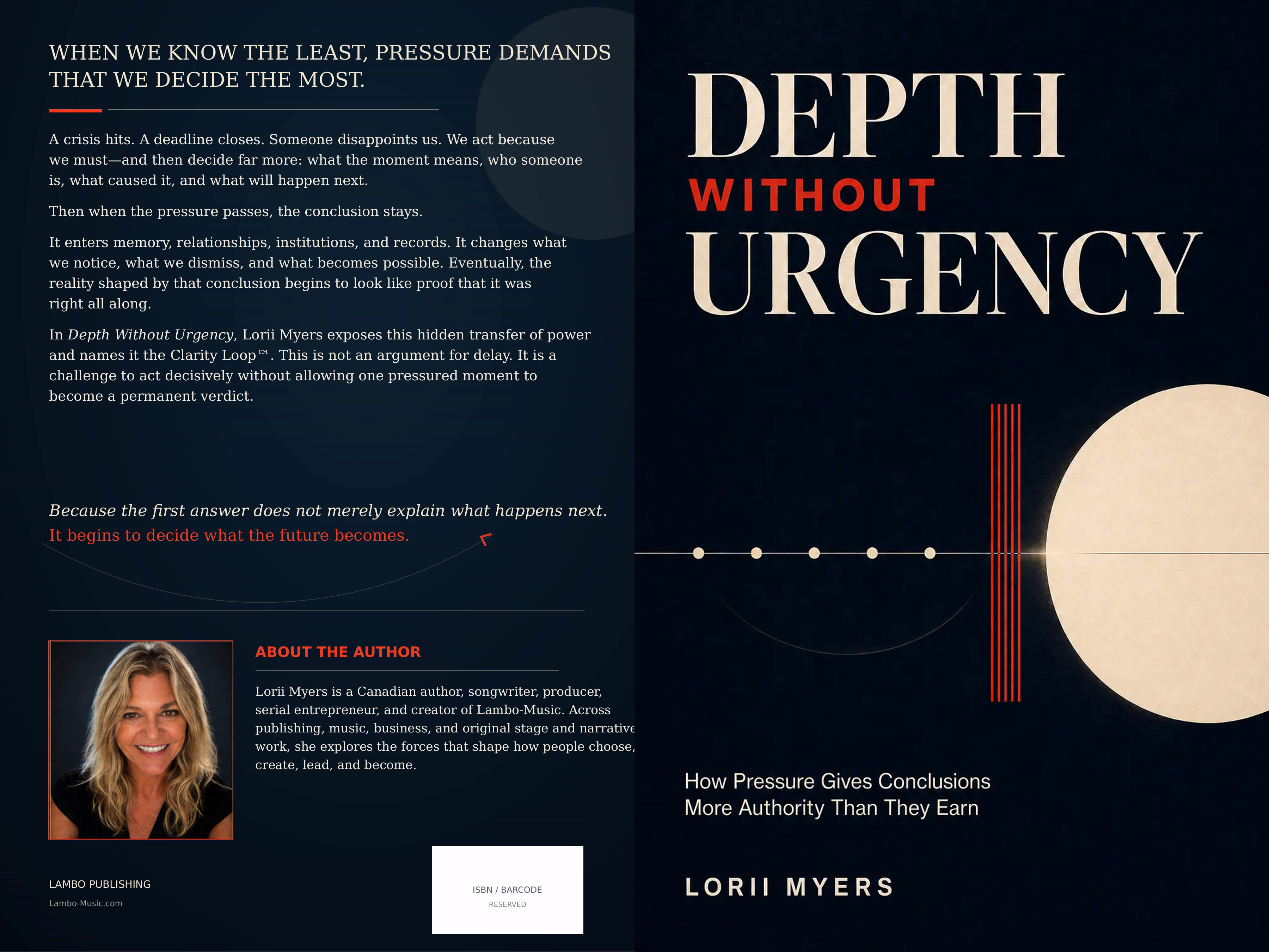
When we know the least, pressure demands that we decide the most.
A crisis hits. A deadline closes. Someone disappoints us. We act because we must—and then decide far more: what the moment means, who someone is, what caused it, and what will happen next.
Then when the pressure passes, the conclusion stays.
It enters memory, relationships, institutions, and records. It changes what we notice, what we dismiss, and what becomes possible. Eventually, the reality shaped by that conclusion can begin to look like proof that it was right all along.
In Depth Without Urgency, Lorii Myers exposes this hidden transfer of power and names it the Clarity Loop™. This is not an argument for delay. It is a challenge to act decisively without allowing one pressured moment to become a permanent verdict.
Because the first answer does not merely explain what happens next.
It begins to decide what the future becomes.
SYNOPSIS
Pressure is often right about one thing: something must happen now. The danger begins when that urgency is allowed to decide far more—what happened, who is responsible, what someone’s actions reveal, and what the future will become.
Depth Without Urgency examines the distance between necessary action and earned meaning. Lorii Myers asks how we can respond decisively without granting one pressured moment authority over an entire person, relationship, institution, creative work, or future.
At the centre of the book is the Clarity Loop™: the process by which an early conclusion enters memory, attention, records, permissions, expectations, and policy. Once there, it begins shaping what can happen next. Eventually, the consequences it helped produce may return looking like independent confirmation.
Across five movements, Myers separates urgency from proof, fact from interpretation, and relief from resolution. She tests how patterns are framed and how time can reveal what holds without acting as a neutral verdict. The inquiry moves through creativity, alignment, consent, expertise, institutional power, and correction before arriving at compassion, accountability, and the presumption of humanity. Judgment must answer real conduct without erasing what the evidence has not established.
This is not a defence of delay. It is an applied philosophy of proportion: act when action is required, keep the decision the size of the evidence, and remain responsible for the future that decision helps create.
APPROVED COVER DIRECTION
The selected v4 front cover and author-photo back panel remain the approved creative direction. Authoritative Master v6.4 does not require a redesign; exact spine width and the final print wrap still await ISBN, printer template, paper stock and production pagination.
OPENING SAMPLE
The previous v5.6 sample remains withdrawn. A replacement opening has been regenerated from Authoritative Master v6.4 and will publish only after independent human source-and-case review.
THE FINAL PROVOCATION
Authoritative Master v6.4 is complete at 52,841 words and 240 rendered pages. Portfolio-wide natural-language, integrity and production QA have passed. Independent human source, case and editorial review remain before publication.
SELECTED WORDS FROM THE MANUSCRIPT
Approved quotations by Lorii Myers, selected to accompany this manuscript’s public blurb and synopsis.
“You can do what the moment requires without deciding what the moment means forever.”
“Power is visible not only in who may decide, but in who is given time to understand.”
“Let the feeling be real without making it evidence of motive, future, or fact.”