The convincing surface
Why credentials, fluency, confidence and previous success can receive more authority than the specific evidence they contain.
 LAMBO-MUSICARTIST · AUTHOR · LICENSING
LAMBO PUBLISHING · BIG-IDEA NONFICTION · LORII MYERS
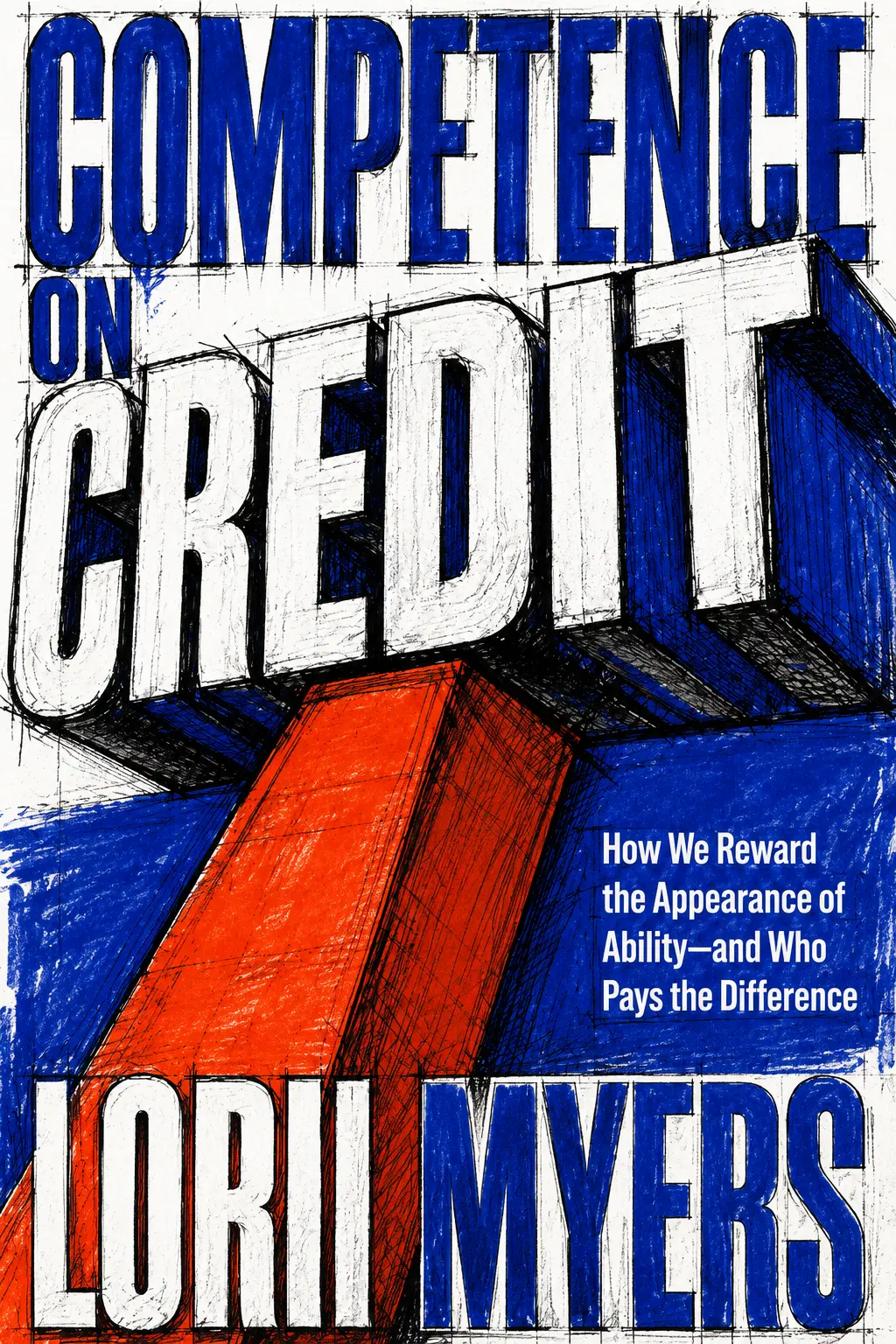
How We Reward the Appearance of Ability—and Who Pays the Difference
We rarely see competence before we must trust it.
So we look for signs: the right credentials, fluent answers, visible confidence, quick decisions, an impressive record. Those signs are not meaningless. The danger begins when we mistake them for proof.
Once appearances are rewarded, people and institutions learn to optimize them. Looking capable becomes more valuable than becoming capable. Productive doubt begins to resemble weakness. Quiet judgment is overlooked. Failure is explained instead of examined - because admitting that the wrong person was trusted may threaten everyone who trusted them.
But the mirage has another source: the people who quietly repair what weak judgment leaves behind. Their competence protects the outcome, conceals the failure, and allows someone else to keep receiving the credit.
Competence on Credit exposes how confidence, status, speed, polish, and borrowed results acquire authority they have not earned. It reveals why genuine competence may be hardest to recognize precisely because it understands its own limits - and why real capability is finally proved through adaptation, accountable recovery, and what remains after the apparent expert leaves.
This is not a case for distrusting expertise. It is a guide to trusting more intelligently - before the title, résumé, presentation, or perfect answer makes the decision for us.
Because the greatest danger is not the incompetence we can see. It is the incompetence somebody else has become skilled enough to hide.
THE PUBLIC PREMISE
Credentials, fluency, confidence, composure and reputation can all matter. Trouble begins when evidence that should open an inquiry is allowed to close one. Competence on Credit follows the trust extended before the work can fully speak, the people and conditions that disappear from the visible result, and the later evidence that confirms, revises or overturns an early verdict.
Why credentials, fluency, confidence and previous success can receive more authority than the specific evidence they contain.
How assistance, conditions, correction and the people beneath a result can disappear from the story of who produced it.
A practical standard for matching proof to consequence while preserving expertise, revision and accountability.
READ THE OPENING SAMPLE
Presented from an author-approved author-review edition.
INTRODUCTION
Most consequential trust begins before the relevant evidence is complete.
We choose physicians, contractors, advisers, schools, technologies, leaders, and institutions before we can fully observe what they will do. We accept a recommendation before its effects are known. We grant authority before reality has had time to show how that authority will be used.
So we rely on signals.
Credentials. Fluency. Confidence. Composure. Reputation. Previous success. The confidence other people already place in the same source.
These signals are not empty. A credential can represent years of disciplined study. Fluency can reflect deep familiarity. A strong record can contain meaningful evidence. Confidence can help people act when delay has a cost. Reputation can direct limited attention toward someone who has earned it.
The danger begins when evidence that should open an inquiry is allowed to close one.
Competence on Credit examines the trust extended in that interval—and what reality later confirms, revises, or overturns.
Credit is extended early. Consequences arrive later.
We often speak about competence as though it announces itself.
She looks capable. He knows the language. They have done this before. The room feels more confident after the answer. Each observation may matter. None establishes the whole claim.
The signal usually belongs to one moment. The trust built on it reaches forward.
A résumé is historical evidence used to forecast future performance. A confident diagnosis is an interpretation used to guide what happens next. A polished plan is a description of work that has not yet met its conditions. A successful result is evidence that something worked. It does not complete the account of how the result was produced.
The useful question is not whether signals should be ignored. We cannot make every consequential decision by waiting for years of complete observation. The useful question is what each signal actually establishes, where its reach ends, and what evidence should follow.
Sometimes a result survives for reasons the official account does not record. The chapters ahead follow that missing evidence: who supplied it, why it disappears, and what its absence eventually costs.
The problem is not assistance. Nothing important is produced alone. Serious work depends on specialization, collaboration, trust, and the ability to combine different forms of expertise.
The problem is an account of capability that becomes false when assistance is omitted.
This book is not a field guide to exposing fraudulent people.
A mistaken competence verdict does not require deception. A person can be sincere, accomplished, and wrong about the range of their ability. A credential can be valid and poorly matched to the task. A past success can be real and non-transferable. A leader can be intelligent and over-credited. A team can perform well while misunderstanding where its strength lives.
The mistake may belong less to the person than to the method of seeing.
That is why replacing one stereotype with another will not help. The quiet person is not automatically more capable than the fluent one. Hesitation is not proof of depth. Confidence is not proof of shallowness. The unconventional candidate is not inherently better than the credentialed candidate. Outcomes are not self-interpreting. Luck, timing, conditions, team contribution, and unrecorded intervention can all influence what appears to be individual performance.
Competence is not a moral category. It is contextual, developmental, and task-specific.
Someone can be highly capable in one domain and dangerously extended in another. A person can grow into work that once exceeded them. A genuine expert can misjudge a novel situation. A novice can make a sound call within a narrow boundary.
The useful question is not, Is this a competent person?
It is, What evidence shows that this person can carry this work, under these conditions, through its consequences?
That question is more demanding than admiration and more generous than suspicion.
It protects expertise because it refuses to reduce expertise to its costume. It gives accomplished people room to state where their knowledge ends. It gives less familiar people a fairer route to proof. It treats correction as information rather than humiliation. It makes the work—not the performance around the work—the final authority.
The problem is becoming harder because the visible signals of competence are becoming easier to produce.
Polished language can be generated quickly. Presentations can be assembled before the underlying reasoning is settled. Dashboards can turn partial measures into an impression of control. Professional vocabulary can travel without the experience that once made it costly to acquire. An institution can distribute a coherent story faster than the people closest to the consequences can test it.
Artificial intelligence intensifies this condition, but it did not create it.
Organizations have always rewarded what they could see. People have always used status, confidence, familiarity, and reputation as shortcuts. Metrics have always invited optimization. Hierarchies have always affected whose explanation sounds complete. AI matters here because it lowers the cost of producing an answer that looks finished. It makes verification more important at the same moment that fluency makes verification feel less necessary.
Production and judgment are not the same capability.
An answer can be clear without being accurate. A recommendation can be plausible without being usable. A plan can look complete without surviving its actual conditions. The better we become at performing competence, the less performance can prove.
The appropriate response is not blanket distrust. Suspicion is another shortcut. If every signal is dismissed, expertise becomes impossible to recognize and action becomes impossible to take.
The task is to trust more intelligently.
Intelligent trust is not certainty with better manners. It is a decision that preserves the difference between what is known and what is being forecast.
That changes the role of a first signal. A credential can justify opening the door without being asked to settle everything that will happen beyond it. A strong record can raise a reasonable expectation without making every new condition equivalent to the old ones. A clear answer can support a next step while leaving its assumptions available for examination. The signal is allowed to matter. It is not asked to carry more than it contains.
The evidence required should also fit the consequence. A small, reversible decision does not need a tribunal. We can act, watch, and adjust. When the exposure is greater—when a choice will place someone’s safety, livelihood, care, money, or freedom at risk—the proof should move closer to the work before the cost becomes difficult to reverse. That is not distrust of the person. It is respect for the reach of the decision.
Intelligent trust therefore belongs to more than the person making the judgment. The person receiving trust has a role in naming what they know, what remains uncertain, and where their experience stops. The institution has a role in making sure later evidence can return, including evidence that complicates an admired first account. Trust becomes stronger when revision is possible without requiring disgrace.
This also protects genuine expertise. A capable professional need not pretend to know everything in order to keep authority. A boundary stated accurately becomes evidence of judgment, not a confession of failure.
We will still be wrong sometimes. No method can remove uncertainty from human judgment. The aim is to stop converting uncertainty into a verdict so early that the evidence arriving later can no longer get a hearing.
A competence claim is only the beginning. Its evidence changes as the claim moves into use, meets changing conditions, and produces consequences. The chapters ahead follow that movement without turning caution, confidence, failure, or success into automatic proof.
Part I examines how signals become verdicts. Part II follows what the visible account leaves out. Parts III and IV turn toward the evidence that makes trust more accurate and capability more accountable.
The argument also turns toward the reader.
Before hiring, promoting, following, funding, delegating, or accepting advice, what evidence are you treating as decisive? Does it belong to the work at hand? Which conditions produced it? How quickly will reality answer? Who is already carrying part of the result without entering the account?
Then the harder questions.
Where does your own reputation travel farther than your direct evidence? When do you use polish to close a question that remains open? Which parts of your success depend on conditions or people you’ve stopped noticing?
These are not questions of guilt. They are questions of accuracy.
Accuracy makes better trust possible. We will still have to act before proof is complete. The mistake is not trusting under uncertainty; it is forgetting that the verdict is provisional. The book begins where that forgetting becomes consequential.
PART I
THE CONVINCING SURFACE
We rarely see competence before we must trust it.
CHAPTER 1
The following is a composite scene.
At 4:47 on a Thursday afternoon, the meeting had one question left and no appetite for a complicated answer.
The product launch was scheduled for Monday. The campaign was ready. Inventory was moving. Senior leaders had already told the board that the date was secure. Then someone raised a concern about a recent change in a supplier’s compliance documentation.
Daniel answered before the question was fully finished.
“It doesn’t affect us,” he said. “Our category is exempt.”
His voice was steady. He did not look at his notes. He explained the exemption in three clean sentences and reminded the room that the same issue had been reviewed the previous quarter. Several people visibly relaxed. The launch lead closed her laptop. Someone made a joke about being allowed to go home.
Mara, sitting two seats away, did not relax.
“I need to check the current language,” she said. “The exemption may depend on which entity is named as importer.”
The room changed temperature.
No one challenged her directly, but the pause itself seemed to count against her. Daniel had brought relief. Mara had returned uncertainty to a meeting that wanted certainty. The launch lead asked whether she had seen anything specific. Mara said not yet—only enough to know that the answer should be verified.
Daniel repeated that the category was exempt.
The meeting ended reassured.
By nine the next morning, he was wrong.
The exemption existed, but not for the entity named in the new agreement. The planned shipment could not proceed under the documentation already issued. Mara found the discrepancy, traced the affected orders, rebuilt the sequence, contacted outside counsel, worked with the supplier, and created a narrower launch plan that preserved the date without misrepresenting compliance.
By Monday, the product launched.
The organization remembered that the team had handled a late complication. It remembered Daniel as calm under pressure. It barely registered that Mara’s hesitation had been correct or that her work had made the successful outcome possible.
No one had falsified a record. No one had deliberately taken credit. Daniel was knowledgeable, respected, and often right. Mara was not infallible. The error occurred earlier, in a fraction of a second: reassurance was treated as evidence, while the request to verify was treated as a lack of command.
The room did not recognize competence.
It predicted competence, then forgot that it had made a prediction.
That distinction is the beginning of this book.
We speak about competence as though it announces itself.
We say someone looks capable. She sounds like she knows. He has the background. They carry themselves like a leader. We experience these judgments as recognition—as if ability were already present, complete, and visible, and we were simply perceptive enough to notice it.
But competence is rarely available to us in full when we make consequential decisions about it. We do not get to observe every candidate doing the actual job across changing conditions before deciding whom to hire. We do not see every executive tested by contradiction before choosing whom to trust. We cannot wait for a complete record before assigning responsibility in a live meeting.
So we use signals.
Confidence. Credentials. Speed. Status. Polish. Familiar language. A record of prior selection by other people. The ability to make complexity sound contained.
These signals are not meaningless. Each may carry useful information. The mistake is subtler: we forget that we are using them to forecast what a person will be able to do later.
What we call recognition is frequently prediction disguised as certainty.
Recognition sounds settled: That person is competent.
Prediction preserves the missing information: Based on what I have seen, I expect that person to perform this work well under these conditions.
The first statement closes inquiry. The second creates a claim that reality can test.
This matters because the mind does not wait passively for complete evidence. It matches what it sees to patterns it already knows. Research on leadership categorization has shown that people carry internal pictures of what a leader is like and use those prototypes to interpret who belongs in the category. When someone fits the picture, leadership can seem visible before leadership has been demonstrated.
The process is efficient. It also contains a trap.
A prototype is built from what has been repeatedly visible, not necessarily from what has been repeatedly effective. If an organization has historically promoted a particular style of person, that style becomes easier to recognize as leadership. If the people who receive authority are the ones most comfortable speaking early and decisively, decisiveness begins to look like evidence of authority. The pattern can become self-confirming: those who resemble prior leaders are trusted sooner, given larger opportunities, and accumulate the very record later used to prove that the early trust was justified.
The unfamiliar candidate must demonstrate.
The familiar candidate is allowed to signify.
Once that first distinction is made, later information does not enter an empty room. The confident person’s mistake may be called an understandable miss; the cautious person’s mistake may be treated as confirmation that she was never ready. The familiar candidate’s questions can sound strategic, while the unfamiliar candidate’s questions sound like gaps. One is credited for seeing the whole field. The other is asked to prove she belongs on it.
This is one reason early predictions matter even when everyone insists that final decisions are based on performance. An initial judgment can shape which work a person receives, how closely the work is watched, how much explanation is demanded, and whether an error is treated as developmental or defining. We do not merely predict competence from a distance. We help create the conditions under which some people can demonstrate it and others remain permanently unproven.
The prediction can also enter the performance it claims merely to foresee.
Dov Eden and Abraham Shani demonstrated that possibility in a randomized study of military training. One hundred and five male trainees were matched on aptitude and assigned to conditions that gave instructors high, regular, or unspecified expectations about them. The trainees whose instructors had been led to expect more later scored higher on objective achievement tests. They also reported more positive attitudes and perceived more positive leadership behaviour from their instructors.
The study did not simply show that some instructors were better at spotting talent. The expectation had been introduced by the researchers. Aptitude matching and random assignment made it possible for the forecast itself—not a previously established difference in ability—to become part of the conditions under which performance developed.
That is a more difficult problem than a biased impression sitting harmlessly in someone’s head. An early belief can alter the instruction, challenge, patience, correction, and encouragement through which later evidence is produced. By the time the organization reviews the record, the record may be real. One person may have completed more demanding work and accumulated stronger proof. The mistake is to treat the resulting difference as though opportunity had played no part in creating it.
The other side of the loop is quieter. Someone given narrow, routine work may produce less evidence of range because range was never requested. An absence of proof can then be misread as proof of absence.
The boundary matters. This was a small, highly structured study of 105 male military trainees in Israel, published in 1982. It cannot establish how large expectancy effects are across mixed civilian workplaces, different identities, or every kind of task. A training command also gives instructors unusual control over the environment in which capability becomes visible.
The study establishes a narrower point, and it is enough: evaluators do not always stand outside the evidence they later use. Sometimes the first prediction changes the path to proof. A fair judgment must therefore ask not only who performed, but who received the conditions in which performance could become observable.
That does not make every difference in opportunity unfair. Responsibility should expand with evidence. But when access to meaningful evidence depends on already looking like the answer, the reasoning becomes circular: the person is trusted because she appears capable, then appears capable because she was trusted with the work.
This does not require malice. Often it feels like discernment. The person “just has it.” The fit seems obvious. The room feels more confident after they speak.
But the room may be evaluating the person’s ability to create confidence rather than the person’s ability to carry the work.
Those abilities sometimes coexist. They are not the same.
Confidence is persuasive partly because uncertainty is expensive.
A hesitant answer holds the problem open. An assured answer appears to close it. Under time pressure, that emotional difference can be mistaken for an evidentiary one.
The person who reduces uncertainty fastest may only be reducing your awareness of it.
Research by Cameron Anderson and his colleagues helps explain why confidence receives such generous early terms. Across naturalistic and experimental studies, people who were more confident achieved higher social status in groups, even when their confidence exceeded their actual ability. Follow-up research tested what happened after objective performance was revealed. Overconfident people were not penalized with lower status, and across three studies overconfidence retained a net status benefit. The advantage began while ability was partly hidden—and could survive the arrival of clearer evidence.
That is the environment in which many workplace judgments are made.
The executive answers a strategic question whose consequences will not be visible for months. The consultant presents a recommendation that the client’s own staff must implement. The candidate describes how she would handle a crisis that cannot be reproduced in the interview. The senior employee offers a rapid diagnosis, then more junior people do the detailed work required to discover whether it was sound.
Confidence is immediate. Accuracy often arrives later.
By then, the social decision may already have been made.
Confidence may deserve the room; only calibration can justify keeping it.
Few places create stronger feelings of recognition than an interview.
A candidate enters. Within minutes, the interviewer has a sense of her: strategic, thoughtful, difficult, energetic, not quite senior enough, exactly what we need. The conversation produces a coherent person.
The coherence feels earned because the interviewer has asked questions and received answers. Yet a conversation can create a powerful impression without adding much reliable information.
In a set of experiments published in 2013, Jason Dana, Robyn Dawes, and Nathaniel Peterson asked participants to predict students’ future grades. The participants had access to useful background information, including prior grades. Some also conducted or watched unstructured interviews. In one condition, the students answered questions through a random-response procedure, producing information that could not meaningfully reveal their academic prospects.
The interviewers still formed coherent impressions. They were similarly confident whether the answers were natural or random. Adding the interviews could make their predictions worse than using the valid background information alone. In another part of the research, participants preferred having even a random interview to having no interview.
The mind does not like disconnected material. It turns replies, posture, word choice, timing, resemblance, and mood into a story. Once the story exists, confidence in the story can be confused with knowledge of the person.
Later research with people involved in hiring found a related effect: adding unstructured interview information to standardized test information increased overconfidence in predictions of candidate performance.
This does not make conversation useless. An interview can examine communication when communication is part of the job. It can clarify experience, allow candidates to assess the organization, and surface information that other methods miss. But an open conversation followed by a global impression gives the evaluator enormous freedom to decide which details mattered—and to decide after meeting the person.
That freedom feels humane. It can also make the standard move.
Experiments by Eric Uhlmann and Geoffrey Cohen demonstrated how evaluations of merit can be reconstructed around the candidate an evaluator already prefers. Participants changed the importance they assigned to particular qualifications depending on which applicant possessed them. The criterion appeared objective after it had been rearranged.
Decide what matters before the person’s style tells you what to admire.
If you wait until the candidate is in the room to define competence, the person who looks like the answer can quietly become the definition of the answer.
The word competent sounds complete. It is almost always missing an object.
Competent to diagnose? To decide? To explain? To build? To recover? To teach someone else? To perform in stable conditions or when the conditions change?
Someone who excels in a stable technical environment may be placed into a volatile people role. Someone brilliant at diagnosis may be poor at implementation. A founder who can create from nothing may not be the person who can build repeatable systems. A leader who succeeds with a mature team may struggle when the work requires teaching novices.
None of these people is simply competent or incompetent. Their ability has a relationship to the task, the conditions, and the stage of their own development.
Competence can grow. It can also be misapplied. A person may have the raw judgment to become exceptional but not yet the experience to carry a particular consequence. Another may have years of experience that belong to conditions no longer present. Treating competence as contextual does not lower the standard. It makes the standard more exact.
The useful question is not, Is this person competent?
It is, Competent to do what, here, now—and what makes us believe so?
Few phrases reveal the ambiguity of recognition more clearly than executive presence.
The phrase can point toward genuine ability. A leader may need to synthesize conflict, communicate under pressure, hold attention, make decisions without becoming reckless, and help others function when the situation is unstable. These are not superficial demands. In many roles, the ability to create clarity in a room is part of the work.
But executive presence is often invoked without naming any of those behaviours.
Someone has it. Someone lacks it. The evaluation arrives as a conclusion with no observable path behind it.
When the standard remains vague, familiarity can enter disguised as fit.
Leadership-prototype research illustrates the risk. In four studies published in 2008, Ashleigh Rosette, Geoffrey Leonardelli, and Katherine Phillips found evidence that participants in the United States associated business leadership with Whiteness and, under specific conditions, evaluated successful White leaders more favourably than equally successful non-White leaders. Later preregistered work found minimal support for Whiteness as part of the business-leader prototype and, across six studies, no condition in which White leaders were rated more favourably than non-White leaders. Other recent experiments suggest that the association can still appear, depending on how it is measured.
That evolution is important. Bias is not a frozen universal law, and no single study should be turned into one. Prototypes can change as experience changes.
The larger lesson remains: the image that feels naturally leaderlike is partly learned from who we have repeatedly seen occupying leadership.
Gender, race, age, accent, disability, class signals, body type, and temperament can all affect familiarity. So can industry style. A soft-spoken scientist may look authoritative in one setting and insufficiently forceful in another. An expressive founder may appear visionary to one board and undisciplined to the next. The same behaviour can be read as decisive, abrasive, confident, emotional, commanding, or cold depending on the person performing it and the template held by the observer.
The answer is not to prohibit judgments about communication or influence. It is to make those judgments answerable.
If executive presence matters, define the work it must accomplish.
Does the person explain a difficult trade-off without concealing its cost? Can she hold disagreement without punishing the dissenter? Can he distinguish what is known from what is assumed? Does the leader adjust when the facts change? Can the person translate expertise for the people who must act on it?
Those are behaviours. They can be observed, compared, developed, and discussed.
“Not executive enough” is not a developmental instruction. It is an atmosphere.
A useful test is this: if you can’t explain what the person’s presence must enable other people to understand or do, you may be measuring your own comfort with the person’s style.
Comfort is real. It is not neutral evidence of competence.
There is an obvious objection to all of this: no one has time to investigate every impression.
Organizations must choose. Emergencies do not offer controlled trials. Leaders routinely assign work with incomplete information. Even a careful hiring process is still a forecast. We cannot refuse to act until uncertainty disappears.
Nor are first impressions always useless. In some contexts, brief observations correlate with later evaluations. Research by Alexander Todorov and colleagues found that judgments of political candidates’ competence based only on facial appearance predicted election outcomes better than chance. A rapid impression can therefore predict something consequential.
But notice what it predicted.
It predicted who would win.
It did not establish who would govern competently.
A signal can accurately predict success inside a recognition system while remaining a poor measure of success at the underlying work.
The candidate who looks electable may, in fact, be more electable because other people share the same impression. The polished executive may be more effective in a role that depends heavily on reassuring investors. The charismatic fundraiser’s ability to generate trust may produce real results.
These are legitimate considerations when they are named honestly.
The trouble begins when we take evidence that a person can be selected, believed, or followed and silently convert it into evidence that the person can diagnose, build, decide, or carry responsibility.
Fast judgment is unavoidable.
Unexamined fast judgment is not.
The goal is not to eliminate prediction. It is to return prediction to its proper status: provisional, specific, and accountable to what happens next.
The next time someone immediately strikes you as capable—or incapable—do not argue with the impression. Slow it down enough to inspect it.
Ask:
• What, exactly, am I predicting this person will be able to do?
• What did I directly observe, and what did I infer?
• Which signal influenced me most: confidence, credentials, speed, status, polish, similarity, or something else?
• Have I seen the relevant ability, or only something I associate with it?
• What information would cause me to revise this judgment?
• When will I look again?
These questions do not require you to pretend that every decision can wait. They prevent a temporary forecast from hardening into identity before reality has had any say.
In a meeting, ask the confident speaker to name the assumption most likely to change the answer. When you hear “not senior enough” or “not leadership material,” ask what future performance is actually being predicted. After a consequential decision, compare what the room expected with what happened. A forecast that is never revisited can feel accurate forever.
The questions also apply when you’re the person being judged.
If confidence comes naturally to you, you do not need to suppress it. Add calibration. Make the boundary of your knowledge as clear as the answer itself. Say what your conclusion depends on. Name what would change your mind. Let people see that certainty is something you allocate, not a tone you apply.
If you’re careful by nature, do not romanticize your own hesitation. A pause is not proof of depth. Attach caution to movement. Explain what you need to verify, why it matters, and when the answer will come. Make your reasoning visible enough that others don’t have to choose between trusting you blindly and overlooking you completely.
If your work is often quiet, do not assume the result will explain your contribution. Name the decision you changed, the risk you identified, or the capacity you built. This is not vanity. Invisible evidence cannot correct a faulty prediction.
And if you lead others, pay attention to what happens after the first answer.
Who asks the question that improves the decision?
Who changes position when the facts change?
Who can turn uncertainty into a next step without pretending it has disappeared?
Who is becoming more capable—and who merely remains convincing?
Do not reverse the bias and assume that the quietest person is the wisest, the least polished person the most authentic, or the most cautious person the most competent. That would preserve the same error in a different costume. Style still is not proof.
The point is not to distrust the person who looks like the answer.
It is to stop granting the appearance of an answer the authority of a result.
Return to that Thursday meeting.
Daniel’s quick answer should not have been rejected because it was confident. Mara’s concern should not have been accepted because it was cautious. Both were claims about reality. One sounded finished. The other preserved a question.
The room’s responsibility was to know the difference.
Had Daniel been asked what the exemption depended on, the hidden assumption might have surfaced. Had Mara been asked what she intended to verify and by when, her caution could have become actionable. The meeting did not need less confidence. It needed a way to prevent confidence from ending the inquiry too soon.
Instead, it selected an answer before the work had a chance to speak.
That is how competence is extended on credit: the signal is accepted now, while proof is expected to arrive later.
But what would count as enough proof? When should it arrive? Where should we look for it when the person who made the claim is not the person closest to its effects?
Those questions lead to the Proof Gap—the distance between what the surface invites us to believe and what the work has actually established. They also lead to Consequence Distance: the distance in time, visibility, and responsibility between a display of capability and the arrival of its results.
Before the work speaks, every judgment of competence is partly a forecast.
The next discipline is learning where proof speaks—and why organizations so often listen in the wrong place.
CURRENT STAGE
The approved book description and opening sample are available here. The complete manuscript remains private. Independent editing, fact-checking, permissions, title and rights review, copyediting and proof remain before submission or publication.