The lens
State, experience, expectation and attention influence what appears important before a conclusion has been consciously chosen.
 LAMBO-MUSICARTIST · AUTHOR · LICENSING
LAMBO PUBLISHING · PRESCRIPTIVE NONFICTION · LORII MYERS
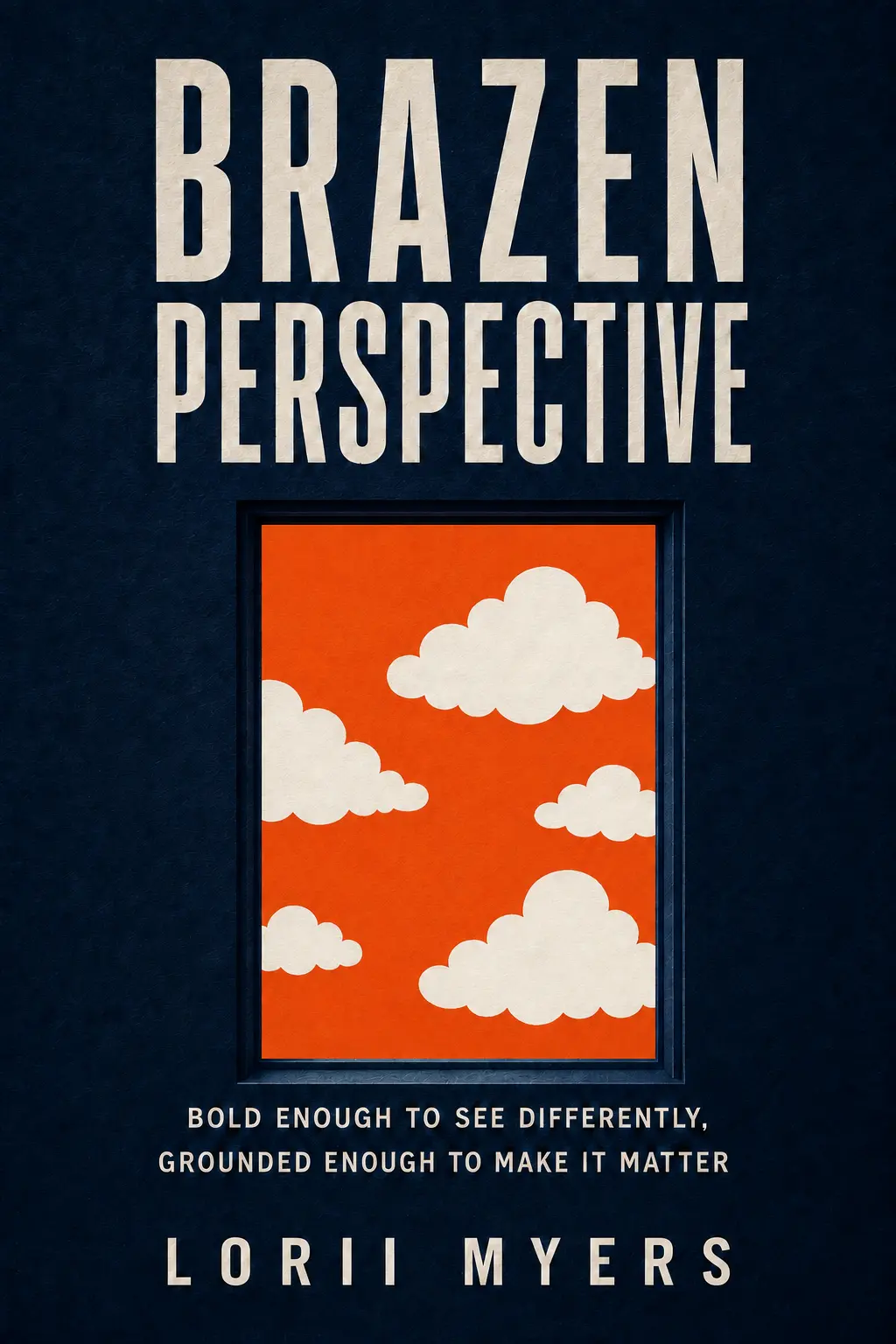
Bold Enough to See Differently, Grounded Enough to Make It Matter
The most powerful interpretation in a room is not always the truest. Sometimes it is simply the one no one challenges.
THE CENTRAL PROPOSITION
The interpretation receiving the most attention, repetition, confidence or authority is not necessarily the truest. It may simply be the one that has stopped looking like an interpretation. BRAZEN PERSPECTIVE examines what happens when that first frame becomes visible—and testable—again.
State, experience, expectation and attention influence what appears important before a conclusion has been consciously chosen.
A private interpretation becomes public information through tone, timing, questions, choices and repeated conduct.
What receives time, protection, correction or ridicule becomes informal instruction about what participation permits.
THE ESSENTIAL DISTINCTION
The book rejects both magical positivity and helpless literalism. Facts remain facts. Power, history, incentives and conditions matter. Interpretation still influences attention, communication, choice, persistence and participation—and those consequences can be observed.
THE ORIGINAL MANIFESTO · 2015
The restored manuscript preserves the five principles exactly as they first appeared:
What I know now: failure can call for persistence, redesign, help or an ending; beliefs deserve examination; freedom operates inside real conditions; and direction can be chosen without pretending every outcome can be commanded.
Discovery without testing becomes impulse. Agency without limits becomes fantasy. The point is not to lose the brazen part. It is to make it answerable to reality.
THE READING EXPERIENCE
Attention, the observing lens and disciplined curiosity reveal how a first view is assembled.
Confidence, humility, fear and grounded aliveness bring the expanded view into contact with evidence.
Vulnerability, environment and practice convert interpretation into more credible conduct.
Reciprocity, constructive presence and reinforcement reveal what a room learns from repetition.
LOCKED BACK-COVER BLURB
The most powerful interpretation in a room is not always the truest. Sometimes it is simply the one no one challenges.
One sentence can close a conversation. One question can reopen it. A familiar fear can become an instruction—or the edge of a braver response.
In Brazen Perspective, Lorii Myers shows how attention selects a frame, repeated signals shape behaviour, and everyday responses teach a room what it may notice, question, or become.
Drawing on moments of work, music, family, fear, failure, and unexpected belonging, she turns seeing differently into a disciplined practice. The State–Signal–Frame–Shift–Effect audit helps readers challenge inherited assumptions, test interpretation against evidence, change what they contribute, and observe what happens next.
This is not magical positivity or contrarianism for attention. It is curiosity without gullibility, confidence without rigidity, and courage grounded enough to matter.
Anyone can claim a different view.
The proof is what becomes possible because of it.
Be the difference.
SYNOPSIS
An unfinished idea is offered in a meeting. Someone responds, “We tried something like that.” No one formally rejects the proposal, but the room understands the signal. Attention turns toward the old failure, possible contributors fall silent, and the past begins deciding what the present may consider.
Change one response—“What would have to be different for it to work now?”—and the same people, facts, and limitations produce a different conversation. Brazen Perspective examines the consequential space between those two responses.
Lorii Myers argues that perspective is not merely a private opinion. It is a sequence with public effects. State influences attention. Attention strengthens particular signals. Signals privilege a frame. The frame shapes behaviour, and repeated behaviour teaches other people what the room values, permits, dismisses, or expects.
Perspective does not control reality. It changes what people notice, how they respond, and what reality receives from them next.
The book rejects both magical positivity—the promise that the right internal state guarantees the desired result—and the belief that interpretation is irrelevant because facts are fixed. Myers instead defines “frequency” as recurrence: what people repeatedly notice, rehearse, reward, and permit. Repetition cannot make an interpretation true, but it can make it familiar and difficult to question.
The book’s practical engine is the State–Signal–Frame–Shift–Effect audit. State identifies the observer’s condition. Signal reveals what is being repeated or emphasized. Frame tests the interpretation being treated as obvious. Shift turns insight into a behavioural or environmental change. Effect examines what actually happened rather than allowing intention to become the final verdict.
Part I, “See Differently,” explores how a view is assembled. Standing above the coast of North Wales, Myers tries to make one photograph tell the truth and discovers the book’s governing metaphor: every frame clarifies something while allowing something else to recede. Attention is not neutral; whatever receives time gains an advantage.
The section examines how experience, emotion, expectation, and social pressure shape what feels self-evident. It presents curiosity as disciplined resistance to premature closure. Myers’s experience welcoming an exchange student into her family shows curiosity moving beyond intellectual openness. Through misunderstanding, humour, repair, and care, a temporary arrangement becomes belonging.
Part II, “Test What You Think You Know,” asks whether a different interpretation can survive evidence. Confidence must include the ability to revise. Fear must be read as information rather than obeyed as instruction. Gratitude must widen attention rather than conceal what still requires action.
Myers’s relationship with music shows confidence developing through the decision to let something private be heard. At the edge of a swimming pool, a frightened boy gathers himself, leaps with “full gangster bravado,” and discovers that the anticipated moment and the lived moment are not the same. The goal is never a more comforting story. It is a more accurate one.
Part III, “Build a Better Response,” turns perception into conduct. A valid concern delivered as contempt can make correction harder; enthusiasm without preparation can transfer risk to everyone expected to follow.
The chapters examine disciplined vulnerability, the environments that repeatedly reinstall behaviour, and resilience as a practice of prediction, action, observation, and adjustment. Persistence is not automatically courageous. Sometimes the evidence calls for assistance, redesign, a pause, or departure from a structure that no longer deserves continued effort.
Part IV, “Make It Matter,” follows perspective into shared consequence. A chaotic family fishing trip reveals how rarely meaningful exchange follows the planned script. Reciprocity is not identical return or guaranteed reward; it is a visible, voluntary response to what another person actually offers.
Constructive presence is measured through repeated conduct: the questions asked, uncertainty acknowledged, information protected, corrections accepted, and commitments fulfilled. When Myers places the first proof of her work into her father’s hands, persistence becomes tangible—something completed, carried, and shared.
In the final chapter, a young child named Charlie signs what he wants at a family celebration. The adults respond without ridicule, teaching him that expression can influence the next moment without guaranteeing the desired result. Culture is being formed before anyone calls it culture.
The book remains explicit about limits. Hierarchy, incentives, resources, history, and formal power are already present in every room. No attitude can erase a harmful structure. Sometimes the responsible shift is escalation, protection, redesign, withdrawal, or refusal.
The conclusion returns to the photograph from Wales. No frame captures everything. The responsibility is to remain alert to what the current frame reveals, what it conceals, and what it produces.
Brazen Perspective transforms seeing differently from an identity claim into a disciplined capability: notice the frame, test the interpretation, change the signal, observe the effect, and revise.
Originality is not the final measure of perspective.
Be the difference.
READ THE OPENING SAMPLE
Presented from an author-approved author-review edition.
An idea is offered in a meeting.
It is not wild. It is not fully developed either. It arrives in that vulnerable state most new ideas occupy before evidence, language, and other minds have had a chance to strengthen it.
Someone leans back and says, “We tried something like that.”
The sentence is not a refusal, technically. No one has said the idea is impossible. Yet the room understands the signal. A few people look down. One person who had started to speak changes their mind. The conversation begins circling the reasons the old attempt failed. Within minutes, a proposal about what might be possible has become a memorial to what didn’t work before.
Now change one response.
The same idea is offered. The same history exists. This time someone asks, “What would have to be different for it to work now?”
The question does not guarantee a better idea. It does not erase the earlier failure or force the team to proceed. It does something smaller and more valuable: it keeps the room cognitively open. One person names a constraint. Another remembers that the technology has changed. Someone else recognizes that the old attempt solved the wrong problem. The proposal may still be rejected, but it will be rejected for reasons that belong to the present rather than by reflexive loyalty to the past.
Two rooms. Almost identical people, facts, and limitations. One sentence changes what becomes available next.
Every room is being tuned.
The word frequency is often used as if people transmit an invisible force that attracts whatever matches their internal state. That idea can feel satisfying because it turns uncertainty into order: think well, vibrate well, receive well. It also collapses quickly under the weight of real life. Thoughtful people encounter misfortune. Generous people are not always treated generously. Confident people can be wrong. A person can enter a room with excellent intentions and still be misunderstood, outvoted, or ignored.
I’m interested in a version of frequency that survives those facts.
Frequency, in this book, means recurrence. It means how often something happens and what repeated occurrence makes easier.
• How frequently does an idea receive attention?
• How often is one interpretation rehearsed until it feels self-evident?
• How repeatedly is urgency mistaken for importance?
• How consistently is a behaviour rewarded in a particular setting?
• How often does a group hear curiosity, contempt, caution, possibility, or defeat in its own language?
An interpretation repeated ten times does not become ten times more true. It may become ten times more familiar. Familiar thoughts come to mind faster. Familiar phrases require less explanation. Familiar reactions attract less social risk. What is familiar begins to feel like what is normal; what is normal begins to travel through the room without being asked for identification.
That is how noise becomes culture—and how a better signal can begin.
Consider one person who asks for the missing fact before blame settles, acknowledges uncertainty without exporting panic, or disagrees without turning dissent into punishment. None controls the outcome. Each changes what the room can observe and consider. That is presence becoming signal.
We tend to speak of perspective as if it were a possession: I have my perspective; you have yours. The phrase makes perspective sound stable, almost architectural, as if we each occupy a fixed lookout point and report the view.
In practice, perspective is more active and less reliable. It shifts with distance, context, expectation, available information, social pressure, fatigue, fear, prior experience, and the behaviour of the people around us. The same person can interpret the same message differently on two different days. The same team can call a proposal reckless during a loss and visionary after a win. A delay can feel like rejection when we’re insecure, protection when we’re cautious, or merely a delay when we have enough information.
The event matters. So does the condition of the observer.
This does not mean reality is invented by perception. A locked door remains locked whether I interpret it as an insult, a safety measure, or an administrative mistake. Perspective changes which explanation I privilege, what emotion follows, and what I’m likely to do next. It can therefore change the human consequences without changing the original fact.
That distinction protects this book from two equal mistakes.
The first is naïve positivity: if I frame everything well, everything becomes well. It does not. Some conditions are unfair, dangerous, wasteful, or simply wrong. A useful perspective must be able to recognize a fire without admiring the light.
The second is helpless literalism: because facts are real, interpretation contributes nothing. That is also false. The meaning assigned to an event influences attention, communication, choice, persistence, and participation. Interpretation is not everything, but it is never nothing.
A perspective does not have to create reality to change what reality receives from us next.
This book is about that next.
Perspective often changes before the situation does.
That may sound too small to matter. A decision is still difficult. The facts are still incomplete. The room still contains the same history, authority, pressure, and competing interests. Yet there’s a second—sometimes no more than a second—in which a first reaction can either become the next signal or be examined before it travels.
That second is usable.
It is the interval between receiving and contributing. A dismissive remark lands. A number disappoints. An idea excites us. A familiar person takes a familiar position, and we feel the rest of the conversation forming before they’ve finished the sentence. The mind is fast because speed is often useful. It closes gaps, predicts patterns, protects energy, and prepares action. The difficulty begins when we mistake that speed for completion.
We are not responsible for every thought that arrives. We are responsible for deciding which thoughts receive a microphone.
The usable second has one job: interrupt the automatic handoff. It does not determine how long the interpretation should take or what sequence the eventual action should follow. Those are later decisions. This first interruption simply keeps an internal event from becoming a social instruction before we know what it contains.
It does not require composure worthy of a meditation retreat. It may happen while the heart is racing, while irritation is present, or while an attractive possibility is pulling hard. Its function is not to make us serene. It gives proportion a chance to enter.
In that second, a person can ask:
• Am I reacting to what happened, or to what I expect will happen next?
• Which part of this deserves immediate action?
• Which part needs one more fact?
• What will my first visible response teach this room?
That last question matters because reactions are rarely private once other people can see them. A raised eyebrow can retire an idea. A rushed agreement can make caution harder to voice. A long silence can be thoughtful, withholding, or simply tired; the room will still assign it meaning. Even restraint sends information.
This is why brazen perspective is not merely a way of thinking. It is the decision to take responsibility for the transmission.
That responsibility is especially visible when we hold authority. Other people may treat our first reaction as a forecast of what the room will tolerate. A curious response can keep an unfinished idea alive long enough to improve. A contemptuous one can teach everyone to bring only what has already been made safe. The authority may forget the moment. The room may rehearse it for months.
The useful pause may lead to a strong objection. It may lead to enthusiasm, a direct question, a refusal, or an admission that a better answer is not yet available. It does not prescribe softness. It protects proportion.
Some rooms move too quickly for a visible pause. Then the usable second can become a sentence: “I want to separate my first reaction from what we actually know.” That sentence does more than buy time. It gives other people permission to examine their own speed without pretending the decision can wait forever.
Frequency begins here—not with a mood we hope to maintain, but with a response we choose often enough to become dependable. One examined reaction will not retune a culture. Repeated examined reactions can change what a room expects from pressure.
The second is brief.
Its consequences are not.
When I use the word room, I mean any shared field of influence.
A room may be a boardroom, classroom, kitchen, studio, shop floor, rehearsal space, online thread, volunteer committee, family gathering, project team, or conversation between two strangers. It may be physical or digital. It may last three minutes or several years. What makes it a room is not walls. It is the presence of people responding to common signals.
Rooms develop habits. One interrupts. Another waits. One celebrates speed; another rewards precision. Some rooms use humour to release tension. Others use humour to hide contempt. Some make it safe to say “I do not know.” Others promote certainty so aggressively that people learn to conceal the very information the group needs.
No single participant creates all of this. History, hierarchy, incentives, identity, resources, and formal power matter. A junior employee’s calm question cannot neutralize a leader committed to humiliation. A thoughtful comment cannot repair a platform designed to reward outrage. Signal is influence, not sovereignty.
That is one of the book’s losing conditions: sometimes a room is structured to resist the very conduct it needs. In that case, the responsible move may be escalation, protection, withdrawal, redesign, or refusal—not a more cheerful tone.
Even then, perspective matters. It helps us distinguish a room that is temporarily tense from one that is persistently unsafe; a disagreement from coercion; a difficult learning curve from a fundamentally broken process. The goal is not to make every room pleasant. The goal is to see the room accurately enough to improve our contribution or recognize the limits of contributing there.
The central practice in this book is deliberately small. It’s meant for the live moment—before a reaction hardens into a message and the message becomes part of the room.
For any consequential interpretation, reaction, or social signal, ask:
State: What is happening in me right now?
Signal: What am I receiving, rehearsing, or amplifying?
Frame: What other accurate interpretation is available?
Shift: What input, behaviour, or environmental cue can I change?
Effect: What did my conduct make easier or harder in the room?
The order matters.
State is not a demand to become calm before earning the right to speak. It is an inventory. Am I hurried, embarrassed, tired, defensive, energized, curious, or eager to impress? Naming a state does not invalidate the message. It helps separate the message from the extra volume the state may have added.
Signal asks what is being repeated. Perhaps the room has said “urgent” so often that no one is distinguishing urgency from importance. Perhaps I am replaying one criticism and ignoring five useful observations. Perhaps a confident speaker is being treated as a credible one without having supplied evidence.
Frame does not ask for a nicer story. It asks for another accurate interpretation. “They are incompetent” may become “they are missing information,” but only if missing information fits the facts. Reframing is not the art of making ourselves comfortable. It is the discipline of increasing explanatory range.
Shift moves the audit out of the head. What can change now? Ask for the document. Slow the meeting. Invite the quiet expert. Move the phone out of reach. Rest before replying. Test one assumption. Change the sequence. A shift should alter an input or behaviour, not merely decorate the original belief with a slogan.
Effect closes the loop. Did my conduct make candour easier? Did it make error harder to admit? Did my question open thought or merely display intelligence? Did my calm help, or did it signal indifference? Intent begins an action; effect teaches us what the action actually did.
The audit is not a ritual for every minor decision. No one needs five questions before choosing a sandwich. Use it when the interpretation carries consequence—when it may affect a person, decision, relationship, opportunity, conflict, or repeated pattern in a room.
Here is the earlier meeting in audit form:
• State: We are disappointed by the last failed attempt and eager not to look foolish again.
• Signal: The failure story is receiving more attention than present conditions.
• Frame: The old result is evidence about that design at that time, not automatic proof about every related proposal.
• Shift: Identify what is materially different now and set a small test rather than arguing from confidence.
• Effect: The room can examine the idea without pretending risk has disappeared.
That is recalibration—not positive thinking, not surrender, and not control.
This book will not teach you to maintain a permanently elevated state. That would be both impossible and undesirable. Grief, anger, caution, doubt, and fatigue can carry important information. A room populated only by polished optimism can become dangerously stupid.
It will help you do something more practical:
• notice what your attention is arguing for;
• recognize that observation arrives already shaped;
• remain curious long enough for an overlooked option to emerge;
• test familiar or intuitive interpretations rather than worship them;
• treat fear and gratitude as information without turning either into instruction;
• separate a temporary state from a final truth;
• redesign the feeds and contexts that make some responses too easy;
• create behavioural evidence through practice;
• disagree without surrendering respect or discernment;
• understand presence as conduct rather than charisma;
• and become more responsible for what your repetition makes normal.
The promise has limits. You may ask a better question and still receive a poor answer. You may regulate your response and still face hostility. You may change your signal without changing the room. The value of a brazen perspective is not that it guarantees the preferred result. It improves the quality of what you bring to the uncertain result—enough to alter decisions, teams, creative work, and sometimes entire cultures. We begin where every signal begins: with attention.
Simply put, Brazen Perspective is a thinking book: a guide to provoke and tweak your passions and interests, to coax your inquisitiveness to resurface, and to tempt you to revisit your belief system.
That invitation does not ask you to discard judgment. It asks you not to become so correct, safe, or rehearsed that discovery can no longer interrupt you. The discipline in these pages gives the original pulse somewhere credible to travel.
This would be our manifesto:
• Never be content with or discouraged by failure.
• Strive to passionately live in discovery mode.
• Carefully comprehend and choose your beliefs.
• Embrace and exercise your personal freedoms.
• Actively manage and command your direction in life.
I still recognize the nerve in those lines. I wouldn’t write every one of them exactly the same way today—not because the ambition has diminished, but because experience has made it more exact. Failure can teach us to persist, redesign, seek help, or stop. Beliefs deserve examination rather than automatic obedience. Freedom operates inside real conditions. Direction can be chosen without pretending every outcome can be commanded.
The manifesto supplied the nerve. The audit supplies the discipline.
Discovery without testing becomes impulse. Agency without limits becomes fantasy. The point is not to lose the brazen part. It is to make it answerable to reality.
Make an impact—be the difference.
Before we can test an interpretation or change our effect on a room, we need to notice how the view is being assembled.
The lens is not a lie. It is a selection device. It brings some detail forward, pushes other detail into the background, and gives the mind a manageable picture from more information than it could consciously hold at once. Without selection, we could not function. With unexamined selection, we can become astonishingly certain about a partial view.
Part I examines three live movements of perspective. Attention decides what receives priority. Prior experience and present state shape what the observer treats as relevant. Curiosity delays closure long enough for missing information or contribution to arrive.
This is not an excavation of every belief you’ve inherited or a project to rebuild your identity. It is closer to adjusting a camera while the scene is still moving. What’s in focus? What has disappeared at the edge? What changes when you alter distance, light, or angle? What becomes possible when you admit that the first frame was real—but incomplete?
Changing the lens does not change every fact in front of it.
It changes whether we’ve given the facts a fair chance to be seen.
That chance has practical consequences. A missed detail can become a missed risk, but it can also become a missed contribution, overlooked strength, unasked question, or idea dismissed before its useful element is visible. Lens work is therefore not private reflection for its own sake. The adjustment matters because someone will act from the view: speak, decide, allocate, invite, exclude, continue, or stop. The chapters that follow keep returning to that movement from seeing to participation. A perspective earns attention not because it sounds expansive, but because it helps the observer meet the actual scene with greater proportion and gives the room a better next move.
In May 2000, I stood high above the coast of North Wales trying to make one photograph tell the truth.
Our group had travelled slowly through the countryside, moving along canals and through villages where history seemed less like a subject than part of the weather. That morning we climbed above Holyhead. The voices around me gradually quieted as the view widened. Far below, sheep moved across green fields. Near my feet, clusters of small white flowers bent in the wind.
Through the camera, the flowers and sheep appeared strangely close in size. One was physically near and naturally small; the other was distant and only looked small. I adjusted the focus, trying to hold both. When the flowers sharpened, the hillside softened. When I favoured the sheep, the nearest detail blurred. I shifted my position and found a small break in the ground that made the distance visible inside the frame.
I took the picture.
The scene had not changed while I worked. The flowers did not grow. The sheep did not shrink. Yet every adjustment changed the story the photograph was most prepared to tell.
At first I thought I was solving a technical problem: how to preserve foreground and distance in one image. Over time the photograph became a more demanding lesson. A frame can be accurate and incomplete at the same time. Nothing inside it needs to be false for the composition to mislead us about scale, distance, or importance.
That is what attention does every day.
Attention is often described as a spotlight. The metaphor is useful because it captures illumination and exclusion: what falls under the beam becomes visible; what lies outside it becomes harder to see.
But attention is more than illumination. In a shared setting, attention is an argument.
Every minute a room spends on one issue is a practical claim that the issue deserves that minute. Every repeated question tells people which kind of answer is valued. Every interruption says something about whose completion matters. Every metric displayed, headline shared, error revisited, or success celebrated competes for limited cognitive and emotional space.
We may never state the argument aloud. We make it through allocation.
Imagine a weekly project review in which ninety percent of the conversation concerns mistakes and ten percent concerns learning. The team may sincerely claim to value innovation. Its attention argues for error avoidance. People will eventually adapt to the stronger message. They will offer safer ideas, disclose problems later, and spend energy proving they were not responsible.
Now imagine the opposite distortion: a team so committed to celebration that warning signs are treated as negativity. Its attention argues that morale matters more than accuracy. It may feel better for a time. It will not necessarily perform better.
The point is not to focus on the positive or the negative. The point is to ask whether the distribution of attention fits the work reality requires.
Attention is not a spotlight on the whole truth. It is a vote for what the room will treat as important.
Votes accumulate.
The problem named first often receives the widest search for solutions. The speaker acknowledged first often gains perceived authority. A complaint repeated without examination can become the room’s organizing story. A possibility given ten uninterrupted minutes may gather enough detail to become testable. Attention does not certify any of these things as true. It gives them developmental advantage.
There’s a tempting mistake hidden inside almost every philosophy of focus: the suggestion that what we attend to becomes reality.
Attention can change experience, learning, memory, behaviour, and coordination.[1.1] It cannot make an unsafe process safe by ignoring the hazard. It cannot convert a weak proposal into a sound one through enthusiasm. It cannot make an external constraint disappear because we refuse to “give it energy.”
If a smoke alarm sounds, the brazen move is not to protect a high-quality state by focusing on a pleasant song. Facts sometimes demand the foreground.
This is the counterweight to the Wales photograph. Changing focus may reveal a better composition, but no focus setting brings the entire landscape into perfect detail. Some forms of attention are required by the scene. A driver approaching an intersection should not broaden awareness so poetically that the stop signal becomes one interesting colour among many. An accountant closing a set of books needs selective precision. A parent hearing an unusual sound in the next room may correctly allow that sound to interrupt everything else.
The goal is not permanent panoramic attention. The goal is flexible attention: the ability to concentrate, widen, redirect, and verify according to the demands of the moment.
Our minds are drawn toward what’s loud, novel, emotional, threatening, immediate, or repeatedly presented. These qualities create salience: they make something stand out.
Salience and significance sometimes overlap. A sudden warning may be both attention-grabbing and important. But the loudest item is not always the most consequential, and the most consequential item may arrive quietly.
The angry email occupies the mind while the stable customer relationship becomes invisible. The dramatic idea dominates a strategy session while a modest process improvement would produce greater value. A single public criticism outweighs months of useful private feedback. A familiar risk receives elaborate protection while a new risk remains outside the frame because no one has language for it yet.
Digital environments intensify this problem by placing measurement beside stimulus. We do not merely see a message; we see how many others reacted. Popularity appears next to content as if it were evidence of importance. Repetition supplies familiarity. Urgency supplies pressure. Emotion supplies heat. Together they can make a thin signal feel thick.
The immediate question is not “How do I stop noticing?” We cannot and should not become indifferent to everything designed to attract attention. The better question is “What has this item done to earn continued attention?”
Sometimes the answer is: nothing yet.
Attention is spent whether we direct it or not.
I think of every room as working with a practical limit. There are only so many questions people can hold, so many problems they can examine with care, so many emotional alarms they can keep active before something else becomes background. When a room devotes attention to one signal, it is not merely choosing what to see. It is also choosing what will receive less development.
This creates an attention cost.
The cost is easy to miss because the omitted possibility leaves no invoice. We see the hour spent revisiting a mistake. We do not see the idea that was never completed during that hour. We hear the loudest concern. We may never hear the quieter operational detail that would have solved it. We track the visible failure and stop noticing the stable practices that prevented five others.
I’ve watched business conversations become crowded with the most recent event. A complaint arrives and suddenly the entire customer experience is discussed through that complaint. A promising number arrives and the room becomes equally eager to treat one result as a trend. Both reactions feel responsive. Neither has necessarily earned the space it occupies.
The discipline is not to give every topic equal time. Equal time can be as distorting as unequal time. A serious defect may deserve the whole meeting. A passing irritation may deserve none of it. The question is whether the amount of attention matches the consequence, the evidence, and the decision still available.
One way to test the distribution is to ask what the room would notice if the loudest item disappeared for ten minutes.
Would someone mention the same risk from a different source? Would a neglected opportunity return? Would the group discover that it has been discussing a symptom because the symptom is easier to name than the cause? Would the person closest to the work finally enter?
This is not a trick for making unpleasant facts vanish. The loud item comes back. It simply loses its temporary monopoly.
Attention also seems to have a recovery time. I’ve watched a blame-heavy discussion linger after the agenda moved to “solutions.” The room may become inventive immediately; it may also carry the previous signal forward. People can edit themselves or calculate exposure. A new topic doesn’t guarantee a new condition for contribution.
There is also a cost to returning. When an important issue is repeatedly displaced by whatever is newest, the room may have to rebuild context each time. Details can fade, ownership can blur, and persistence can begin to look more important than merit. The issue carried by the most relentless voice may survive. The issue carried by the most careful voice may wait quietly until the delay matters.
The same is true when excitement dominates. Once a room has celebrated an idea as the answer, practical questions can sound like disloyalty. Enthusiasm is valuable energy. Unexamined enthusiasm can spend tomorrow’s credibility before today’s evidence arrives.
The brazen move is to manage the transition, not merely the topic. Name what the last discussion has done to the room. If blame has narrowed it, restore inquiry before asking for ideas. If excitement has accelerated it, invite the strongest constraint before announcing commitment. If one voice has taken most of the space, ask what remains unspoken rather than simply requesting “any other thoughts?”
Attention becomes more trustworthy when it can say why it gave its time where it did.
Why this issue? Why this much time? Why this source? What are we no longer seeing while we look here?
The answers do not have to be perfect. They have to be available. An attention pattern that cannot explain itself may defend itself with urgency, habit, or rank.
The room is always paying.
Perspective decides whether it knows the price.
Attention becomes especially influential when it is rehearsed.
Consider a leader who begins every meeting by recounting what is going wrong. The intention may be practical—problems need correction—but the sequence trains the room to enter through deficiency. People arrive ready to defend, explain, or locate fault. Now consider a leader who begins with celebration and never reaches the defects. That sequence trains the room to protect the atmosphere from reality.
A stronger opening might ask three questions: What changed? What did we learn? What now requires attention? The order acknowledges movement, extracts information, and directs effort without demanding pessimism or optimism as a permanent identity.
The same principle works in private thought. Rehearsal increases accessibility. If I mentally replay a slight all afternoon, I do not prove the offender’s intent. I make that interpretation easier to retrieve. If I repeatedly imagine success without gathering evidence, I may feel prepared while remaining behaviourally untouched. If I review what happened, distinguish observation from inference, and identify a next test, I rehearse responsiveness instead.
Frequency is doing its real work here. Not vibration. Recurrence.
What returns gains fluency. What gains fluency can feel natural. What feels natural can pass through a room without challenge.[1.2]
Focus is praised so consistently that we rarely ask what it may be protecting us from.
Deep concentration can produce excellent work. It can also become a respectable hiding place. A team may focus intensely on execution because revisiting the premise would threaten months of investment. A person may optimize a routine that no longer serves the actual goal. A committee may perfect the wording of a statement while avoiding the decision the statement is meant to announce.
Busy is not always distracted. Sometimes busy is exquisitely focused on the wrong level of the problem.
This is why a brazen perspective periodically changes focal length.
• Close focus asks: What exactly is happening here?
• Mid-range focus asks: What pattern is forming?
• Wide focus asks: What larger purpose or system does this serve?
• Reverse focus asks: What becomes visible from another participant’s position?
• Historical focus asks: What has changed since the last time we judged this?
• Future focus asks: If repeated, what will this attention normalize?
No focal length is morally superior. Each answers a different question. Trouble begins when one setting is mistaken for the whole view.
Suppose a presentation contains one incorrect figure. The error matters. It must be corrected. In the meeting, however, the figure receives twenty minutes of discussion. The presenter backtracks three times. Two senior people explain the importance of checking work. The original strategic question receives five rushed minutes at the end.
The room will remember that accuracy matters. It may also learn that offering work before it is invulnerable carries a social cost. The error was real; the distribution of attention created an additional message.
A recalibrated response might sound like this: correct the figure, identify how the error entered, set the verification step, then return to the decision. The room gets accuracy without allowing one defect to consume the work’s entire meaning.
Now reverse the example. Suppose the number is corrected instantly and everyone rushes on, but the error reveals a recurring data problem. In that case, brevity would be neglect. The same outward act—spending more or less time—cannot be prescribed in advance. Attention must be proportional to consequence, recurrence, and learning value.
That is why this is an audit, not a formula.
Use the audit when one subject, message, person, or emotion has begun to occupy disproportionate space.
State — What is happening in me right now? Am I captured by urgency, embarrassment, excitement, irritation, or the desire to prove a point? State often determines what feels impossible to postpone.
Signal — What am I receiving, rehearsing, or amplifying? Name the repeated item plainly. “I have replayed one criticism six times.” “We have discussed the visible error but not the underlying decision.” “The most confident speaker has received most of the questions.”
Frame — What other accurate interpretation is available? The criticism may contain one useful point without defining the entire response. The error may be a one-time defect or evidence of a system problem. Confidence may indicate preparation, status, habit, or temperament—not correctness.
Shift — What can I change? Alter the focal length. Ask for the missing metric. Invite the person closest to the work. Set a time limit. Separate correction from blame. Place the device out of sight. Write the observation before writing the story.
Effect — What did my conduct make easier or harder? Did the room gain proportion? Did an ignored risk become visible? Did people become more willing to contribute, or did my redirection dismiss a real concern?
The final question prevents a self-congratulatory version of perspective. We do not earn credit merely for changing the subject. We look for what the shift produced.
I still think about those flowers and sheep.
At the time, I wanted the camera to preserve what my eyes felt they could hold all at once: the intimacy of what was near and the scale of what was far away. The imperfect photograph became more useful because it refused. It made the selection visible.
Most mental frames don’t announce their exclusions so politely. They present the selected view with the smoothness of completeness. We see the late arrival and not the emergency that preceded it. We see the enthusiastic proposal and not the untested assumption inside it. We see resistance and not the experience that made caution intelligent. We see the foreground sharply and call the background irrelevant because it has blurred.
The first discipline of a brazen perspective is not to distrust every view. It is to remember that a view has edges.
Attention tells us what entered the frame.
The next question is more unsettling: what had already trained us to focus there?
THE FINAL PROVOCATION
The manuscript is in author review and available for qualified professional consideration. Evidence and rights clearance, independent human editing and final proof remain before publication.
SELECTED WORDS FROM THE MANUSCRIPT
Approved quotations by Lorii Myers, selected to accompany this manuscript’s public blurb and synopsis.
“The feed is not the world, but what we amplify can become someone else’s evidence about the world.”