Dangerous intimacy
A love that is real, compromised and impossible to reduce to either devotion or deception.
 LAMBO-MUSICARTIST · AUTHOR · LICENSING
LAMBO PUBLISHING · UPMARKET LITERARY · PSYCHOLOGICAL SUSPENSE · LORII MYERS
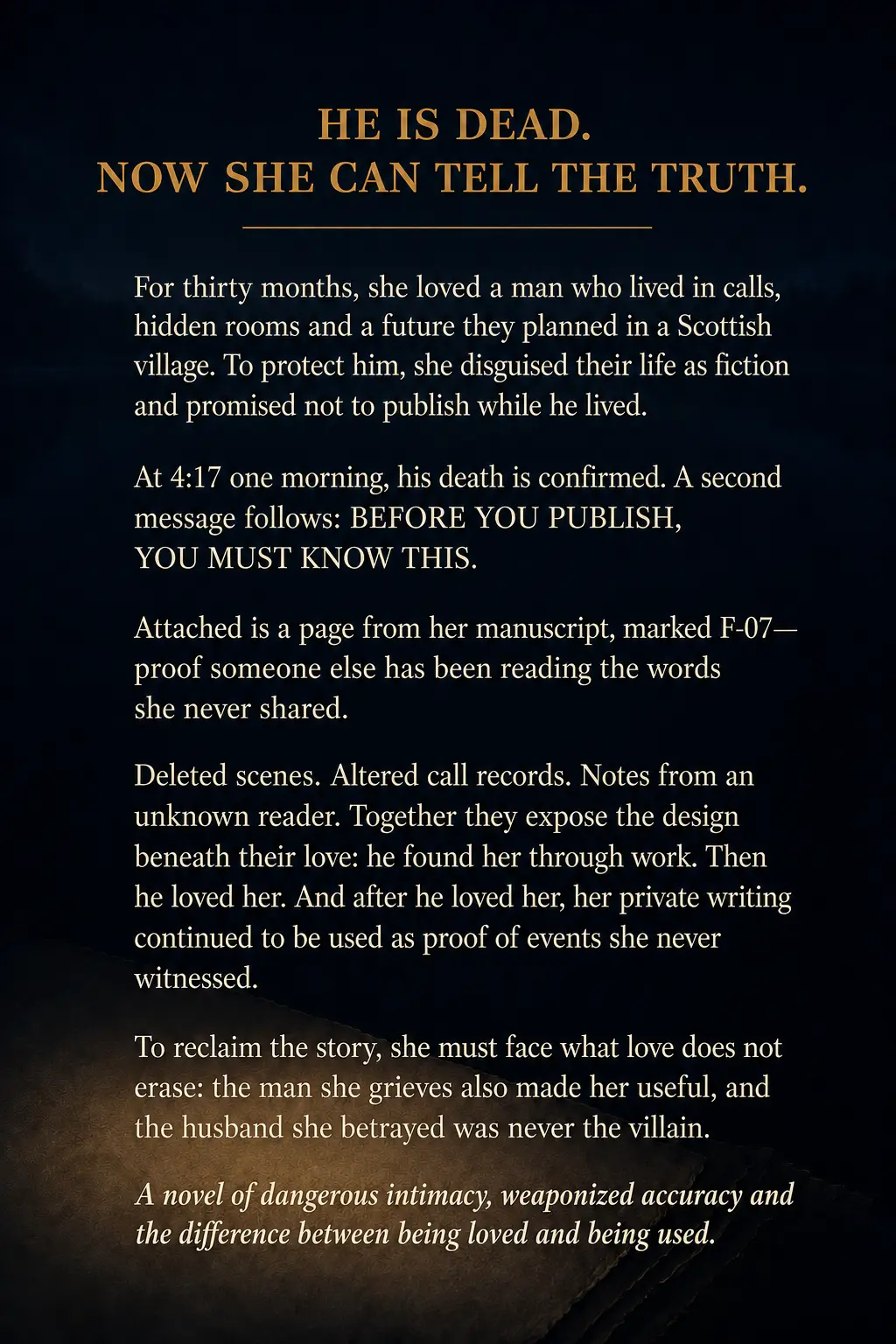
HE IS DEAD. NOW SHE CAN TELL THE TRUTH.
For thirty months, she loved a man who lived in calls, hidden rooms and a future they planned in a Scottish village. To protect him, she disguised their life as fiction and promised not to publish while he lived.
At 4:17 one morning, his death is confirmed. A second message follows: BEFORE YOU PUBLISH, YOU MUST KNOW THIS.
Attached is a page from her manuscript, marked F-07—proof someone else has been reading the words she never shared.
Deleted scenes. Altered call records. Notes from an unknown reader. Together they expose the design beneath their love: he found her through work. Then he loved her. And after he loved her, her private writing continued to be used as proof of events she never witnessed.
To reclaim the story, she must face what love does not erase: the man she grieves also made her useful, and the husband she betrayed was never the villain.
A novel of dangerous intimacy, weaponized accuracy and the difference between being loved and being used.
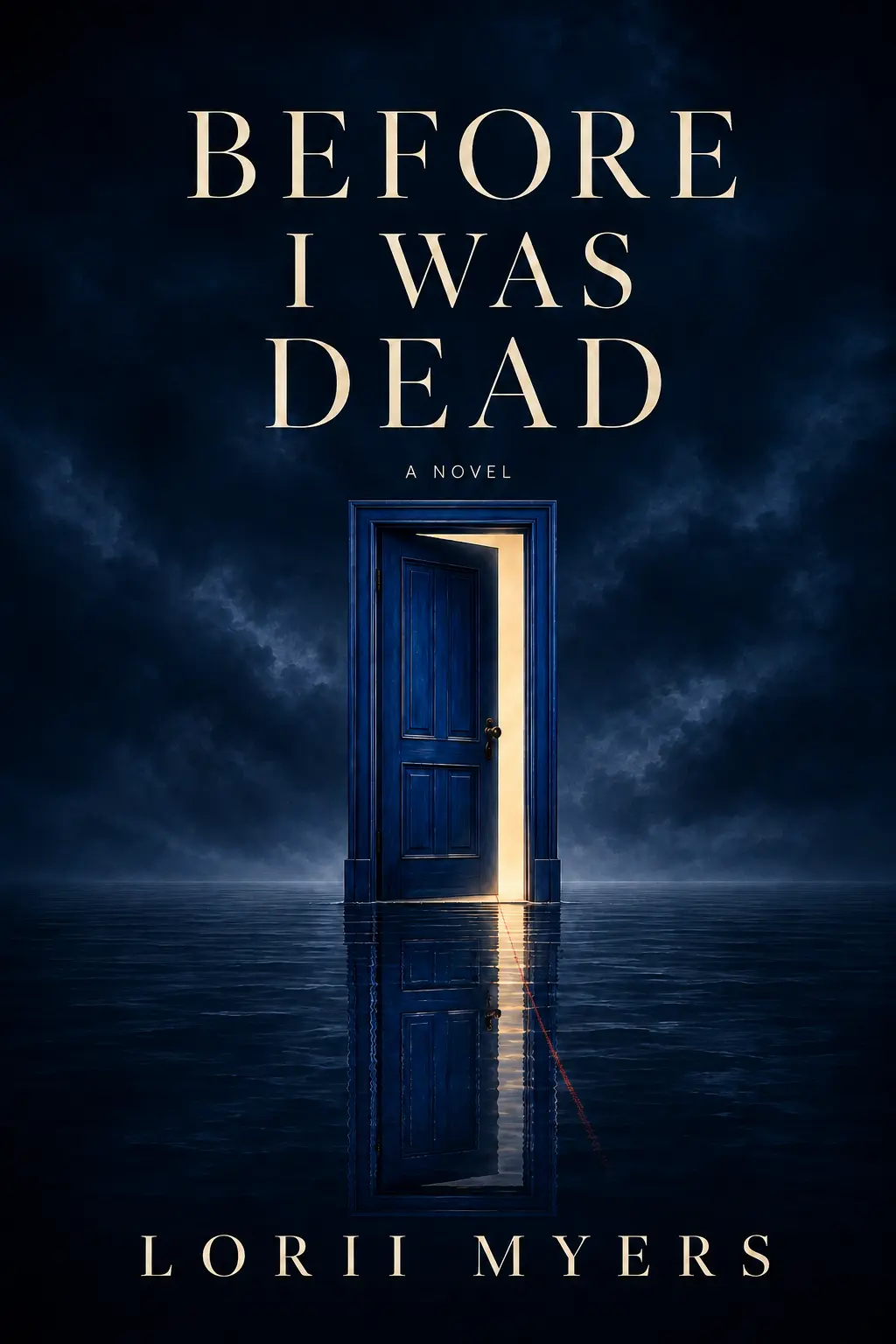
THE PUBLIC PREMISE
After the secret love of her life dies, a married Canadian writer discovers that the private novel in which she preserved their affair was used as an independent record of events she never witnessed—and must decide whether publishing it will expose his deception or finally return the story to her.
A love that is real, compromised and impossible to reduce to either devotion or deception.
Private fiction becomes an independent record of events its author never witnessed.
Publishing becomes the act through which the writer reclaims both the story and herself.
FULL SYNOPSIS
At 4:17 one morning, an unnamed Canadian writer learns that her secret lover of thirty months is dead. His death releases her from the promise that kept their story unpublished. Minutes later, a message arrives with three pages and a warning: Before you publish, you must know this. One is an early draft of her private novel, marked in his handwriting with a code she has never seen—F-07—an instruction to verify his death twice, and a note saying she does not know.
Before she can decipher it, a man calling himself DANIEL PRICE contacts her through the dead man’s phone. Claiming to represent estate security, he orders her to delete the pages and surrender everything connected to them. He knows the manuscript’s concealed filename. She disconnects her computers, preserves every draft and tells her husband that the man she loved has died. Wounded but exacting, her husband helps her build a chronology instead of reducing the affair to a simpler betrayal.
The chronology reconstructs how the relationship began. The dead man approached her with an apparent work question: which sentence in a three-page document was lying? She found the deeper defect—an absent authority could answer through another person’s signature—and their ten-minute review became an intimate conversation. Yet he had obtained her number through documents she had never seen. Weeks later, he quoted a sentence deleted from her novel before they met. Either he had read her private work or someone else had read it for him.
Their attachment deepened through calls fitted around her marriage and his unexplained world. He imagined them in a Scottish cottage with a blue door and a room where she could write. Refusing to make her husband cruel to justify leaving, she preserved the affair as fiction by changing dates, cities and identities. When she met her lover in London, he touched and kissed her in the exact sequence she had written years earlier. She kept the coincidence from him as the one fact that remained entirely hers.
Now the same page has returned, carrying his black-ink instructions and questions from an unknown graphite reader. A courier delivers another private chapter annotated with the true hour of a call she deliberately disguised. Hidden inside the original attachment is a table connecting dates to passages across successive drafts, each marked VERIFIED, DISPUTED, MISSING or TRANSFERRED. It records her accuracy without revealing who built it, who used it or who authorized the use.
Working together, the writer and her husband uncover a concealed instruction in the document that first brought the dead man to her: obtain an independent reading without disclosing the connection, then identify the reader to a holder. He had been routed to her because her fiction described the document’s weakness with dangerous precision. His assignment ended eleven minutes into their first call; he kept talking because he wanted to. Their love was real. The work, however, did not end with it.
Seventeen days before his death, he warned her to keep every version and tried to withdraw an instruction whose consequences he no longer controlled. Her notebook records a thirty-seven-minute call beginning at 8:41; the official statement preserves only eleven minutes beginning at 9:08. He promised to call the next morning and never did.
The frightened woman who first confirmed his death admits she was the graphite reader. She had received sections of the novel after being falsely told the writer had consented to anonymized use. F-07 designated the route by which references were planted in the dead man’s calls and transformed, through the writer’s instinct to fictionalize, into time-stamped corroboration. Her pages could prove that documents and events existed outside the systems of those relying on them. She had witnessed nothing. She had been turned into their timestamp.
The dead man built the table to prove the outside record was reliable. After falling in love, he continued because it became his only proof of what had been done: both use and confession. He tried to stop the process after it acquired other owners, but the holder remains unknown and Daniel Price may be a man, a function or both. The truth offers no easy verdict. Her lover found her through work, genuinely loved her, then used her after love should have changed the terms. Her husband loved her while she concealed another life. His decency does not erase her betrayal; her lover’s deception does not erase their love.
When pressure reaches the house, she rejects the dead man’s demand to keep the archive private. She deposits a sealed copy with counsel, adds the chronology to a police report and denies every claimant the only proof. She will publish not as evidence, which could be seized and used again, but as a novel. Names and locations will change; the archive will remain protected. Fiction lets her expose what was done without surrendering ownership of the truth.
Six months later, she travels alone to the Scottish village they imagined. Her husband has read the manuscript and written only that she did not make him cruel. Their marriage is unresolved but honest. The rented cottage has a grey door. She paints it blue—not to fulfil her lover’s promise, but to claim the image. Listening to rain without a phone carrying the sound to either man, she closes the door herself. She is no longer waiting for a future to begin. She is alive.
APPROVED BACK COVER
The approved back-cover treatment for the current author-review edition.
READ THE OPENING SAMPLE
Presented from an author-approved author-review edition.
PERMISSION
When he died, I inherited nothing except permission.
No property. No money. Not even an ordinary object made precious by the fact that his hand had touched it. Nothing a lawyer could catalogue or a family could contest.
What came to me was invisible and absolute: the end of my promise to remain silent.
The message arrived at 4:17 in the morning from a number without a name.
It is confirmed. He is gone.
I read it three times.
The room had not changed, yet everything inside it felt misplaced. The glass beside my bed. The chair near the window. My own hands holding a life-ending sentence as though it were an appointment I might reschedule.
I’d imagined this moment differently. There would be disbelief. Collapse. A sound leaving my body that I wouldn’t recognize as mine.
Instead, I checked the time again.
Ordinary details become witnesses when we do not yet know how to grieve.
He had given me permission more than a year earlier.
“If I go first, you can publish it.”
“You haven’t read it.”
“I don’t need to.”
“Then how do you know what’s in it?”
“Because I know what I gave you.”
I’d tried to laugh. He had not.
“And if telling it harms you?”
“Then make certain I’m dead.”
The manuscript had waited ever since.
It was not a memoir. Not exactly. I’d changed names, moved cities and bent dates until no fact pointed cleanly towards the people who had lived it. But I’d invented none of the emotion. Every promise, absence, fear and impossible tenderness remained where it had fallen.
I called it fiction because fiction was the only form strong enough to carry the truth without exposing it.
While he lived, his life was the lock.
Now the lock had opened.
I crossed the dark room and woke my computer. The manuscript appeared where I’d left it, buried beneath a filename no one would open by accident.
I’d changed the title eleven times.
I’d never changed the first sentence.
For years, I believed our story began the day he found me. It did not. It began much earlier—with the life I’d mistaken for being alive.
My finger rested above the key that would open the document.
Another message appeared.
This one contained an attachment and seven words.
Before you publish, you must know this.
I opened it.
Three pages.
I read them once as the woman who had loved him.
I read them again as the woman who had survived him.
By the end, I understood that his death had not made our story safe.
It had made the truth possible.
There is a difference.
I opened the manuscript and placed my hands on the keyboard.
This is what happened before I was dead.
THE FIRST PAGE
AFTER — DAY ONE
The first page was mine.
Not addressed to me. Not written for me.
Written by me.
It was a scan of the opening page of my manuscript, complete with the line I’d refused to change and a comma I’d removed six drafts ago. Someone had printed it, written across it and scanned it back into the world.
In the upper right corner, where an editor might have written a question or a page number, there was only a code.
F-07.
Across the top, in black ink, were four words.
VERIFY MY DEATH TWICE.
Below that:
USE THE VERSION DATED 14 OCTOBER.
And beneath it, smaller:
SHE DOES NOT KNOW.
I enlarged the image until the paper grain broke into pixels. The handwriting was decisive, each letter formed once, without hesitation. I’d watched it travel across hotel stationery and the backs of business cards, had received photographs of notes written at airport counters, in moving cars, beside cups of coffee gone cold while he spoke to me.
He printed like a man who distrusted ambiguity.
Halfway down the page, he had drawn a bracket beside a paragraph about the first time we kissed. I had changed the city and the weather, but not the way he touched my face before he touched my mouth. In the margin beside it, he had written a transaction reference.
Eight letters. Six numbers. A slash.
He had written a number in the margin of our first kiss.
I moved away from the screen.
For a moment I could hear nothing but the old refrigerator cycling in the kitchen and the lake worrying at the stones below the house. The windows reflected the room back at me: desk, lamp, bookshelves, the blank pale oval of my face.
Upstairs, my husband slept.
The knowledge of him was not new, but at that hour it felt newly dangerous. Forty years of shared walls had trained me in the language of the house. I knew which floorboard objected outside the bedroom, how long the plumbing sighed after a tap was closed, the precise weight with which he turned in sleep.
I’d learned secrecy in the most ordinary place possible.
I looked again at the scanned page.
You haven’t read it, I’d told the dead man.
I don’t need to.
That had been another room, another hour, his voice low in my ear. I’d mistaken certainty for innocence.
He had lied about reading the manuscript. That was the least frightening thing on the page.
The second page of the attachment was a table.
No letterhead. No names. Four narrow columns headed DATE, SOURCE, REFERENCE and STATUS. The dates covered twenty-eight months, beginning with our first long conversation—four weeks after his first message—and ending seventeen days ago. Some appeared only once. Others repeated.
The source column contained groups of three numbers separated by periods.
The reference column held strings like the one beside our first kiss.
Most entries in the final column contained one of three words:
VERIFIED.
DISPUTED.
MISSING.
At the bottom of the page was the hidden filename under which I’d stored the book.
Not its title.
Not any title I’d ever spoken aloud.
The ridiculous, forgettable filename I’d chosen precisely because no one would open it by accident.
GARDEN_NOTES_11.
My hands became cold.
There are betrayals that arrive like blows. Others enter quietly, disguised as information, and wait for the mind to understand what the body already knows.
Someone had been inside my computer.
Or inside my house.
Or he had known far more about my life than I’d allowed myself to consider.
The third page was a note in his hand.
I read it again.
Verify my death twice. The number I gave you will provide the first confirmation, not the second.
The book is an independent record. That is why it matters.
Do not publish. Do not destroy the manuscript. Do not send it to anyone, regardless of what they claim or whose authority they invoke. Keep the original version and every copy you made before 14 October.
Begin with F-07.
You will believe I made you part of this without your consent.
You will be right.
The final sentence sat alone beneath the others.
What I felt for you was not part of the work.
No apology.
It was like him to offer a distinction when contrition was required.
I touched the words on the screen, then withdrew my hand.
Grief had not yet arrived in any form I recognized. There was only a pressure beneath my ribs and the disciplined movement of my mind from one fact to the next.
The message had come from an unknown number.
His death had not been publicly announced.
The attachment contained material no stranger should possess.
The first page of the manuscript was an old version.
The filename was current.
Love wanted me to keep reading. Experience told me to stop touching the evidence.
I closed nothing.
Instead, I photographed each page with the small camera I kept in the desk. My phone was already part of the event; I did not know who had sent the message or what record it might keep. The camera was twelve years old and incapable of sending an image anywhere. I photographed the message itself, the number, the time, then the attachment information and the narrow line of file properties I only partly understood.
Received at 4:17.
Created two days earlier.
Modified at 3:56 that morning.
The modification time stopped me.
If the message was automated, someone had prepared it. If it was not, someone had been awake, waiting.
I inserted a new memory drive and copied the attachment onto it. Then I copied the entire folder containing the manuscript, including every draft, every page of notes and the fragments I’d cut but could never bring myself to delete.
The progress bar moved with obscene calm.
Eight percent.
Fifteen.
Twenty-three.
I went to the doorway and listened.
The house held.
My husband’s sleep was a soft mechanical rhythm above me. I could wake him. I could say that someone I’d known was dead and that something had arrived which frightened me.
The first statement would demand the second.
The second would demand his name.
There are truths that cannot enter a marriage by degrees. Once admitted, they rearrange every room.
I returned to the desk.
Forty-one percent.
The lake beyond the windows was black, but the line separating water from sky had begun to show. A thin November wind pushed dry leaves along the terrace, making them scratch at the glass.
He had heard that sound through the phone.
Once, during a storm, he had asked me to stand near the window so he could listen.
“I want to know what the weather is doing where you are.”
At the time, I’d thought it tender.
Now I wondered whether there had been another reason he needed to know I was home.
The thought shamed me, not because it was disloyal to him, but because suspicion came so quickly once death had made it permissible.
Sixty-eight percent.
I found the card he had told me to keep.
It was hidden in an envelope behind the removable back of the bottom desk drawer. The card bore no company name, only a phone number and a handwritten instruction.
If you ever hear that I am dead, call once.
I’d mocked him when he gave it to me.
“Do you hand these out to all the women?”
“No.”
“Only the important ones?”
“Only you.”
“And what happens when I call?”
“You will be told whether it is true.”
“And if it isn’t?”
“Destroy the card and never mention it.”
I’d kept it for more than two years.
The number rang twice.
A woman answered without greeting.
“I was told to call this number.”
“Who gave it to you?”
I looked at the computer, at his handwriting on the third page.
“Your client.”
Silence.
“What reference were you given?”
There had been no reference on the card. Until now.
“F-zero-seven.”
The woman drew a breath so quietly I might have imagined it.
“Your name?”
“He said I wouldn’t have to provide it.”
A pause.
“That is correct.”
Her voice was educated, careful and not young. I’d never heard it before.
“Is he dead?”
“Yes.”
The answer entered me cleanly.
No softening. No phrase about passing. No offer of sympathy.
I gripped the edge of the desk.
“When?”
“Earlier this morning.”
“Where?”
“I am not authorized to disclose that.”
“How?”
“I cannot tell you.”
“Were you with him?”
“No.”
“Did you send me a message?”
Another pause, different from the first.
“What message?”
“Three pages. An attachment.”
“Do not describe it.”
Her urgency was the first unguarded thing she had given me.
“Why?”
“Did you open it?”
“Yes.”
“On the device you’re using now?”
“I am not using a device now.”
This was true in the narrowest possible sense. The phone in my hand was connected to the wall.
“Listen carefully,” she said. “My instructions are to confirm the fact of death and nothing else. I am not authorized to send you documents, request documents or arrange their collection. If anyone claims otherwise, they are not acting with my authority.”
“With yours?”
“Or his.”
The line went dead.
I kept the phone against my ear until the silence became foolish.
On the computer, the copy had completed.
I removed the drive, labelled it with the date and time, then placed it in the inner pocket of the coat hanging behind the study door. I inserted a second drive and began again.
It was not panic. Panic wastes movement.
Years of reading agreements written to conceal their true purpose had taught me to begin with the simplest questions: Who benefits? Who has authority? What is being requested? What happens if I do nothing?
No one had yet asked me to hand over anything.
That was what frightened me.
I opened the folder of earlier drafts.
The version dated 14 October was there.
I never saved over a manuscript. Every substantial revision became another file, a habit formed long before cloud storage began offering to remember on my behalf. I had once lost sixty pages to a power failure. After that, I trusted no system that promised permanence without evidence.
GARDEN_NOTES_08.
GARDEN_NOTES_09.
GARDEN_NOTES_10.
The October file was number nine, not eleven.
His note had specified the date, not the filename.
I copied version nine onto the desktop and disconnected the computer from the internet. Then I switched off the wireless router in the hall. The green lights disappeared one by one.
When I returned, the document waited where I had left it.
I did not open the copy.
First, I checked the file information.
Created: 14 October, 11:08 p.m.
Last modified: 15 October, 12:31 a.m.
I remembered the night.
He had called from an airport lounge, though I’d never heard an announcement or the movement of travellers around him. We had spoken for nearly two hours. He had asked what I was writing.
“The part where she begins to understand him.”
“Does she?”
“Not yet.”
“What does she misunderstand?”
“His silences.”
He had laughed softly.
“Then don’t change anything tonight.”
“Why?”
“Because you’re tired.”
“I’m always tired when you call.”
“Save it. Close it. Let me keep you company instead.”
I’d done as he asked.
At 11:08, apparently.
I opened the attachment on the disconnected computer and returned to the second page.
The number groups in the SOURCE column were coordinates.
The first number was a chapter. The second, a paragraph. The third, a word.
I tried the first six against the current manuscript.
AFTER. HOUSE. TIME. WINDOW. SAID. ONE.
Nonsense.
Then I opened the October version and began again.
DO.
NOT.
ANSWER.
HIS.
NUMBER.
Five words, not six. The sixth coordinate landed on an empty paragraph.
I checked it twice.
The blank was deliberate.
DO NOT ANSWER HIS NUMBER.
I wrote the sentence on a legal pad.
He had lived in a world where the same word could mean a story, a record or a place where wealth was made to disappear. He used language that way, letting one meaning shelter another until he chose which truth to reveal.
I moved down the table.
The first date was the day of our first long conversation. I knew because I’d written it into the book, changing the month but not the day. Beside it was a reference ending in 6214.
The second date marked a conversation six weeks later, when he had called before sunrise and told me about a delayed shipment. I had not understood the transaction. I had understood his exhaustion.
The third was the day he first said we should build something together.
I’d treated the dates as private history.
He had indexed them as evidence.
I moved down the source column.
Chapter Three.
Chapter Eleven.
Chapter Eleven again.
Chapter Seventeen.
Beside some of the dates he had written VERIFIED.
Beside others, DISPUTED.
One source entry pointed to a chapter I’d removed.
I searched the folder and found it among the cut pages.
The chapter was called The Promise.
I had deleted it because it felt too naked. In it, I had reconstructed a conversation we had repeated so many times that I could no longer remember which version came first.
He would arrange the money.
He would settle the work.
He would come to me free of both.
We would live somewhere small enough that no one cared who we had been.
I had changed the country, the season and the house. I had preserved one detail: a blue door.
On the table, beside the missing chapter, was a reference number and a status.
TRANSFERRED.
I leaned back.
The room shifted—not visibly, but in its allegiance. My desk no longer seemed like the place where I’d written a love story. It was a site someone had used. The notebooks on the shelves, the calendars in the drawers, even the preserved drafts felt less like memory than inventory.
The book is an independent record. That is why it matters.
He had known I wrote after we spoke.
Had he shaped the conversations so I’d preserve certain facts?
Had the delays, the promises, the oddly specific stories been more than the architecture of our private life?
Perhaps he had never needed me to understand his work. Perhaps he had needed precisely the opposite.
A witness who did not know she was witnessing.
The second copy finished.
I removed the drive and put it in a small padded envelope. On the front, I wrote my own name and the time. I considered the safe in the bedroom, then dismissed it. Anyone who came into the house looking for documents would begin with the desk and the safe.
The envelope went into the lining of my coat beside the first drive.
I made a third copy.
This one contained only the current manuscript. I renamed it exactly as it had been and left it in the ordinary folder after removing the earlier drafts.
A decoy.
At 5:12, my mobile phone began to vibrate across the desk.
His name appeared on the screen.
I did not answer.
The call ended. A moment later, the phone announced a voicemail.
The man who spoke was not the man who had died.
“This is Daniel Price, calling on behalf of estate security. You may have received a fraudulent three-page document purporting to contain final instructions. Do not open it. If you have opened it, delete it and any copies immediately. Do not forward it or discuss its contents. We will call again at six to confirm compliance and arrange secure collection of any related material.”
He paused.
“For clarity, the relevant material may be stored under the name Garden Notes Eleven.”
The message ended.
No condolences. No explanation of how a stranger had his phone. No uncertainty about the filename.
I photographed the call record and the voicemail details with the old camera. Then I turned the phone face down without returning the call.
At 5:58, the eastern sky had begun to pale. The opposite shore emerged in pieces: dark trees, two unlit houses, the bare suggestion of a dock.
I put on the coat containing the drives.
At 6:00, the phone began to ring again.
His name lit the screen.
On the legal pad beside it, in my own hand, were his final instructions.
DO NOT ANSWER HIS NUMBER.
I let the dead man ring.
SELECTED WORDS FROM THE MANUSCRIPT
Approved quotations by Lorii Myers, selected to accompany this manuscript’s public blurb and synopsis.
“I called it fiction because fiction was the only form strong enough to carry the truth without exposing it.”
CURRENT STAGE
The approved front cover, locked back-cover blurb, full spoiler-inclusive synopsis, approved back-cover concept and Prologue plus Chapter One sample are available here. Authoritative Master v3.2 remains private. Independent editing, rights review, copyediting and final proof remain before submission or publication.