Who am I becoming?
For readers questioning inherited beliefs, identity, fear, regret, responsibility or the life that no longer reflects who they are.
 LAMBO-MUSICARTIST · AUTHOR · LICENSING
LAMBO PUBLISHING · APPLIED PHILOSOPHY · LORII MYERS
The Truths That Shape Us
You were shaped before you could choose. Becoming begins when you ask what still deserves authority.
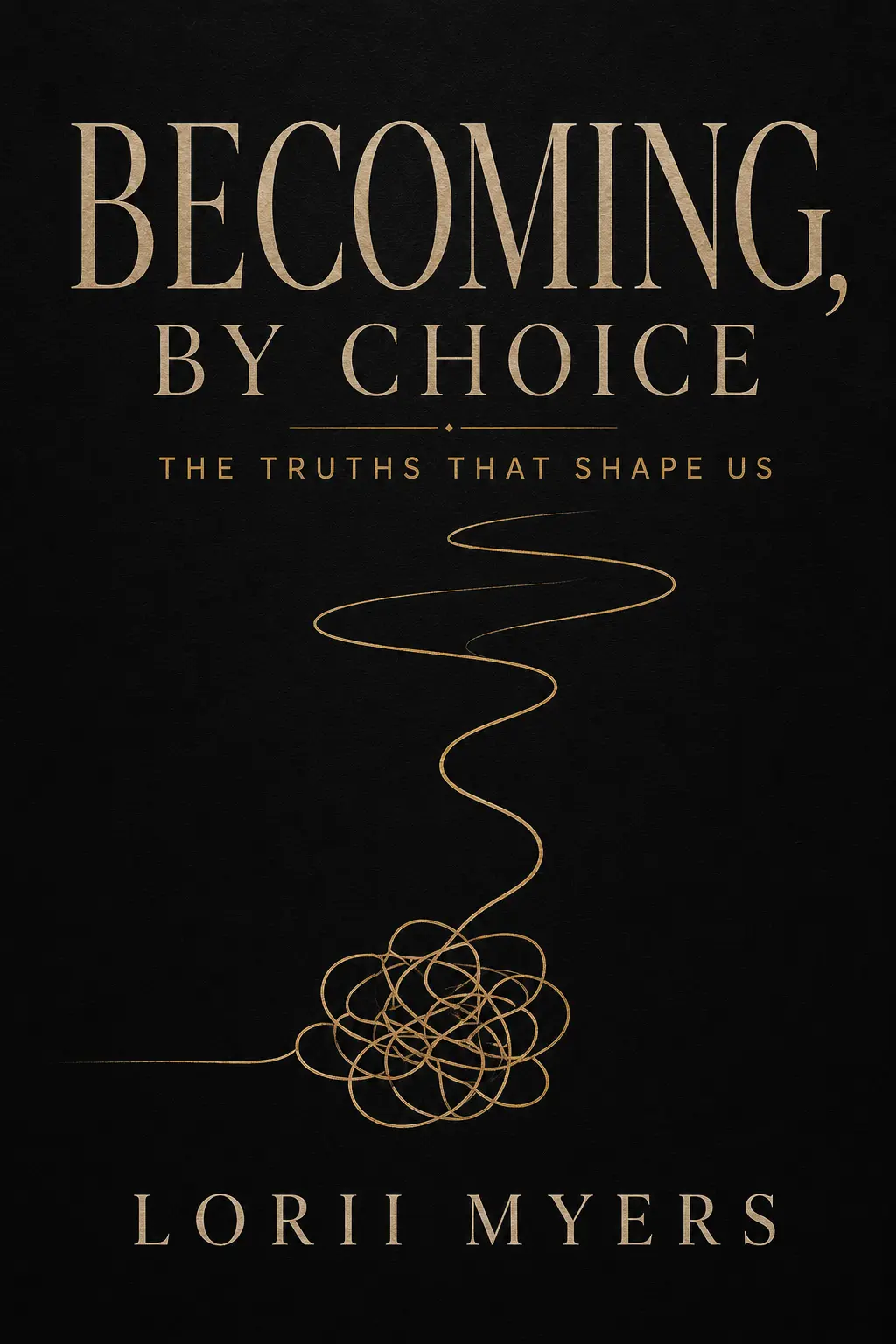
OFFICIAL BLURB
Long before we consciously choose who to be, we inherit truths—about worth, love, success, money, trust, age and possibility. Repeated long enough, they stop feeling like beliefs. They feel like life.
BECOMING, BY CHOICE examines how those assumptions enter identity, how experience reinforces them and what happens when we return them to examination.
Through lived vignettes, original distinctions, Find Your Mirror and the Becoming Map, Lorii Myers offers a philosophy of conscious self-authorship without denying history, responsibility or consequence.
This is not a formula for reinvention. It is an invitation to see what has been shaping you—and decide what still deserves that authority.
The book remains unchanged so that you can discover you have not.
SYNOPSIS
A life can be governed by truths a person never consciously chose. From childhood onward, we absorb conclusions about identity, worth, capability, trust, money, relationships, ageing and possibility. Repeated long enough, those conclusions stop feeling like interpretations. They begin making decisions.
BECOMING, BY CHOICE examines the invisible architecture beneath those decisions. Lorii Myers reveals how an accepted truth organizes attention, shapes interpretation, enters identity, influences repeated choices and builds structures that later return looking like proof. The result can be a capable, coherent life still governed by an inherited understanding of the self.
Across five parts and eighteen chapters, the book moves from the truths we borrow into identity, fear, change, trust, partnership, money, beauty, legacy, time, wonder and meaning. It distinguishes history from destiny, responsibility from self-punishment, gratitude from denial and meaningful partnership from disappearance.
Through Find Your Mirror and the Becoming Map, readers can identify what currently holds authority, examine the evidence beneath it and choose what they are prepared to live from now. The book does not manufacture a new identity. It asks a more demanding question: Which truths still deserve your life?
Becoming never ends. The choice is whether it continues by inheritance—or by intention.
THE CENTRAL MECHANISM
What we accept as true directs attention. Attention shapes interpretation. Interpretation becomes identity, identity influences repeated choice, and repeated choice builds structure. Over time, that structure can return evidence that makes the original belief feel inevitable.
FIND YOUR MIRROR
The book opens with an issue-based guide that lets readers enter where life is asking the clearest question—not where a conventional sequence says they must begin.
For readers questioning inherited beliefs, identity, fear, regret, responsibility or the life that no longer reflects who they are.
For readers examining attraction, trust, betrayal, relational fit, endings, repair or partnership without self-erasure.
For thresholds shaped by illness, loss, ageing, money, time, work, meaning, legacy or the decision to begin again.
WHAT SETS IT APART
This is not formula-driven self-help. It is applied philosophy that respects the reader's authority, acknowledges real limits and makes experience more visible without deciding what another person must conclude.
COMPLETE CONTENTS
The book can be read in sequence or entered through the question that is most alive. Its architecture moves from inherited truth to identity, relationship, a life worth living and the wisdom required to keep becoming.
How beliefs gain authority before examination becomes possible.
Identity, fear, change and the difference between performance and integration.
Trust, tenderness, truth, relational fit and partnership without disappearance.
Money, beauty and the human consequences that continue through others.
Time, wonder, meaning and conscious participation in ongoing becoming.
BUILT TO BE REVISITED
A reflective record of what currently holds authority, which questions have opened and what direction the reader is prepared to choose now.
A dedicated language system clarifies the book's central distinctions and makes its philosophy easier to revisit, discuss and apply.
A closing distillation gathers the book's most portable ideas without replacing the deeper questions and context that produced them.
READ CHAPTER ONE
Presented from an author-approved author-review edition.
Before we choose our beliefs, our beliefs begin choosing us.
A child sits at a kitchen table while the adults talk around her. They are not delivering a lesson. No one announces that a philosophy is about to be taught. They are simply discussing money, neighbours, work, marriage, success, failure, and the kind of people who can or cannot be trusted.
She hears that money is hard to keep. That certain dreams are unrealistic. That good people endure. That sensible people do not take unnecessary risks. That family comes first. That appearances matter. That asking for more is ungrateful. That love means staying. That strength means not needing help.
She does not evaluate these statements. She has no competing framework against which to test them. She absorbs them in the same way she absorbs language: through repetition, tone, consequence, and belonging.
Years later, she may no longer remember the conversations. Yet she may hesitate before an opportunity because ambition feels dangerous. She may remain silent because disagreement feels disloyal. She may call endurance love, self-erasure generosity, or fear practicality. The words have disappeared. Their authority has not.
This is how many truths enter a life—not as arguments we accept, but as atmospheres we breathe.
We inherit language before we understand it. We inherit beliefs before we learn how to examine them. We inherit expectations before we discover whether they deserve our lives.
No one begins life with a philosophy. We begin life inside someone else’s.
An inherited truth is not necessarily false. Much of what we receive is useful, protective, wise, and hard won. Families pass down courage, discipline, humour, faith, resourcefulness, tenderness, and the knowledge required to survive what earlier generations faced. Culture gives us language, ritual, memory, and belonging. Experience gives elders lessons that the young should not have to purchase again through avoidable pain.
Inheritance is not the enemy. Unconscious obedience is the danger.
A belief can begin as wisdom and later become confinement. ‘Be careful’ may protect a child and restrict an adult. ‘Do not depend on anyone’ may help someone survive instability and later prevent intimacy. ‘Finish what you start’ may build discipline and also keep a person committed to what has become destructive, empty, or untrue.
The words may remain identical while the life around them changes. A truth that once served us can quietly become a rule that governs us long after its original purpose has expired.
Borrowing is not the problem. Remaining unconscious of what we’ve borrowed is.
We rarely identify these beliefs as borrowed because they’ve been with us for so long. They sound like our own voice. They appear in the mind without quotation marks. We say, ‘That’s simply how life is,’ when what we may mean is, ‘That’s how life was explained to me.’
Familiarity gives an idea the feeling of truth. Repetition gives it authority. Belonging gives it emotional weight. None of these alone proves that it deserves to direct a life.
The forces that shape us aren’t limited to family. Schools teach us what intelligence looks like. Workplaces teach us which parts of ourselves are rewarded. Communities teach us the price of difference. Religion may give us moral language and spiritual depth, while particular interpretations may also teach us whom to fear or how much of ourselves to suppress. Advertising teaches us what should be desired. Algorithms repeat what already holds our attention until familiarity begins to resemble consensus.
Relationships become authors too. The person who laughs at an idea may teach us to stop offering it. The person who listens carefully may return us to our own depth. Praise can shape identity. So can ridicule. Absence can become a definition. Consistent regard can become permission.
We’re shaped not only by what people tell us, but by what receives warmth, what produces tension, what is welcomed, and what must be hidden to keep the room comfortable.
A child quickly learns the emotional architecture of belonging. Which questions are safe? Which feelings are inconvenient? Who is allowed to be certain? Who must apologize? What version of the self keeps connection intact? These lessons may never be spoken, yet they can become some of the most durable truths a person carries.
This is why becoming conscious can feel disruptive. We’re not examining isolated ideas. We’re touching agreements that may once have protected our membership in a family, relationship, institution, or culture.
To question a borrowed truth may therefore feel like questioning the people who gave it to us. But discernment is not betrayal. Examination does not erase gratitude. We can honour where a belief came from without surrendering the rest of our lives to it.
Consider the person who says, ‘I’m not creative.’ It sounds like a description of identity. Yet beneath it may be a single classroom moment, an impatient teacher, a comparison with a gifted sibling, or a narrow definition of creativity limited to drawing and music.
Consider the person who says, ‘I’m bad with money.’ The statement may have been repeated for years, reinforced by one early mistake, then used to avoid learning the very skills that could disprove it.
Consider the person who says, ‘I’m just someone who keeps the peace.’ Perhaps. Or perhaps peacekeeping became necessary in a home where honesty produced conflict. What looks like temperament may partly be adaptation.
We often defend an old strategy as though it were our permanent nature. This is understandable. A strategy repeated long enough becomes fluent. Fluency feels natural. What feels natural is easily mistaken for what’s essential.
But identity deserves a more careful question: Is this who I am, or who I learned to be in the conditions that formed me?
The answer need not invalidate the person we’ve been. Adaptations are evidence of intelligence. They helped us belong, cope, succeed, or remain safe within the world we knew. The point is not to shame them. The point is to notice when yesterday’s intelligence has become today’s limitation.
Some inherited truths become foundations. Others quietly become ceilings.
A woman declines an opportunity she has quietly wanted for years. Her explanation arrives immediately: ‘People like me don’t do things like that.’
The sentence is so familiar that no one challenges it—until someone asks, ‘Who are people like you?’
She begins with practical answers: people with responsibilities, people who must be realistic, people who cannot risk disappointing others. But the question remains. Who decided what people like her are permitted to do? When did responsibility come to mean permanent self-denial? Why is disappointing herself treated as the least serious consequence?
Nothing in her circumstances changes during that conversation. No obstacle disappears. Yet a rule becomes visible. And once visible, it can no longer operate with quite the same secrecy.
This is the beginning of discernment. Not immediate rejection. Not rebellion for its own sake. Not the theatrical destruction of everything inherited. Simply the recovery of authorship.
Discernment asks a belief to identify itself. Where did you come from? What were you trying to protect? What have you made possible? What have you made impossible? Are you a fact, a fear, a value, a habit, a loyalty, or an old conclusion?
A belief that remains true will not be weakened by examination. It will become more consciously held. A belief that survives only by avoiding questions may never have been truth; it may have been familiarity wearing truth’s authority.
A belief that deserves authority should be able to survive honest questions.
Every belief organizes attention. It tells us what to notice, what to dismiss, and what to expect. If we believe people can’t be trusted, evidence of betrayal becomes vivid while evidence of reliability is treated as an exception. If we believe our voice carries little value, we may speak tentatively, withdraw quickly, and interpret interruption as proof. If we believe change is irresponsible, we’ll calculate the cost of moving while ignoring the cost of remaining.
Beliefs don’t merely describe reality. They participate in producing the reality we experience.
We become what we repeatedly accept as true.
This doesn’t mean thought controls every event or that hardship can be wished away. Circumstances are real. Power, history, health, economics, chance, and other people’s choices are real. A philosophy becomes dishonest when it turns every difficulty into a failure of mindset.
But within what we can’t control, beliefs still influence what we attempt, tolerate, repeat, and recognize. They determine which doors we approach and which we declare locked without touching the handle.
The cost of a borrowed truth is therefore rarely confined to thought. It appears in opportunities declined, questions unasked, boundaries abandoned, talents minimized, relationships misread, and years organized around assumptions that were never brought to trial.
The deepest cost may be this: we can live a life that is coherent with our conditioning while remaining unfamiliar to ourselves.
Rethinking doesn’t require contempt for the past. We don’t become freer by replacing inherited certainty with automatic rejection. To oppose every old belief simply because it’s old is another form of being controlled by it.
The more mature task is to separate origin from value. A belief may have come from someone imperfect and still contain wisdom. Another may have come from someone loving and still be wrong for the life now being lived. Good intentions do not guarantee good guidance. Painful origins do not automatically invalidate what was learned.
We’re not deciding whether our inheritance was entirely good or entirely harmful. Human inheritance is rarely that clean. We’re deciding what remains true after affection, fear, loyalty, habit, and time have been separated from the belief itself.
This is where choice becomes more demanding than reaction. Choice asks us to keep what’s worthy without keeping everything. It asks us to release what’s limiting without rewriting everyone who shaped us as a villain. It asks us to accept responsibility for our present philosophy even when we weren’t responsible for its beginnings.
We may not have chosen the first truths that shaped us. Eventually, however, we become responsible for whether they continue shaping us unquestioned.
Throughout this book, we’ll return to a simple movement: vignette, accepted belief, disruptive question, rethinking, reader’s choice.
The vignette gives the idea a human setting. The accepted belief names what is usually left unspoken. The disruptive question opens space around the familiar. Rethinking examines what remains when assumption is removed. The reader’s choice returns authority to the only person who can decide what deserves to shape the life ahead.
This sequence is not a formula for instant certainty. It is a practice of seeing. Some beliefs will clarify quickly. Others will resist examination because they are attached to belonging, identity, grief, duty, or love. A question may need to rest for months before its real answer becomes available.
The aim is not speed. It is honesty.
You may choose to keep a belief exactly as it is—but consciously. You may refine it, place conditions around it, or recognize that it belonged to an earlier chapter of your life. The power is not in reaching a predetermined answer. The power is in no longer confusing inheritance with inevitability.
Perhaps this is the first act of becoming: becoming conscious of the philosophy we’ve already been living.
Not the philosophy we claim when asked. Not the values we admire in theory. The philosophy revealed by our repeated choices: what we protect, what we permit, what we postpone, what we call impossible, what we continue to obey, and what we believe we must become smaller to preserve.
The life already being lived is evidence. It shows us which truths currently hold authority.
We can meet that evidence without accusation. Awareness is not a verdict against the self. It is the moment the self becomes available for conscious participation.
The question is not whether we’ve been shaped. We have. The question is whether shaping will remain an unconscious event—or become a deliberate relationship between what formed us and what we now choose to form.
Before we can choose what comes next, we must become able to see what came first.
ENDURING OBSERVATION
Our first truths are borrowed. Becoming by choice begins when we discern which ones deserve to remain.
QUESTION
Which belief has shaped my life so completely that I’ve never thought to question it?
A belief I know I inherited is…
It may once have protected or provided…
The cost of continuing to obey it without examination may be…
What I now want to ask of this belief is…
For now, I choose to keep it, revise it, release it, or continue examining it because…
PUBLISHING & RIGHTS
The 70,548-word NF-01-F Authoritative Master v49 spans eighteen chapters and five parts. The complete presentation package and full manuscript are available through qualified professional review.
SELECTED WORDS FROM THE MANUSCRIPT
Approved quotations by Lorii Myers, selected to accompany this manuscript’s public blurb and synopsis.
“Freedom is being able to consider what shaped us without automatic obedience or automatic opposition.”